




Key Highlights
- Futures open interest in ETH surged 26% to reach $25.4 billion
- Spot Ethereum ETFs in the US have attracted $248 million in cumulative inflows over 10 days
- Bitmine Immersion purchased $312 million in ETH, expanding holdings to 4.87 million tokens
- Perpetual funding rates have turned negative repeatedly, reflecting bearish sentiment
- Weekly DApp revenue on Ethereum declined to $11 million from February’s $24 million
Ethereum continues to maintain support above $2,320 after recovering from the $1,940 level reached on March 29. The asset has been range-bound near $2,350, facing resistance around $2,380.
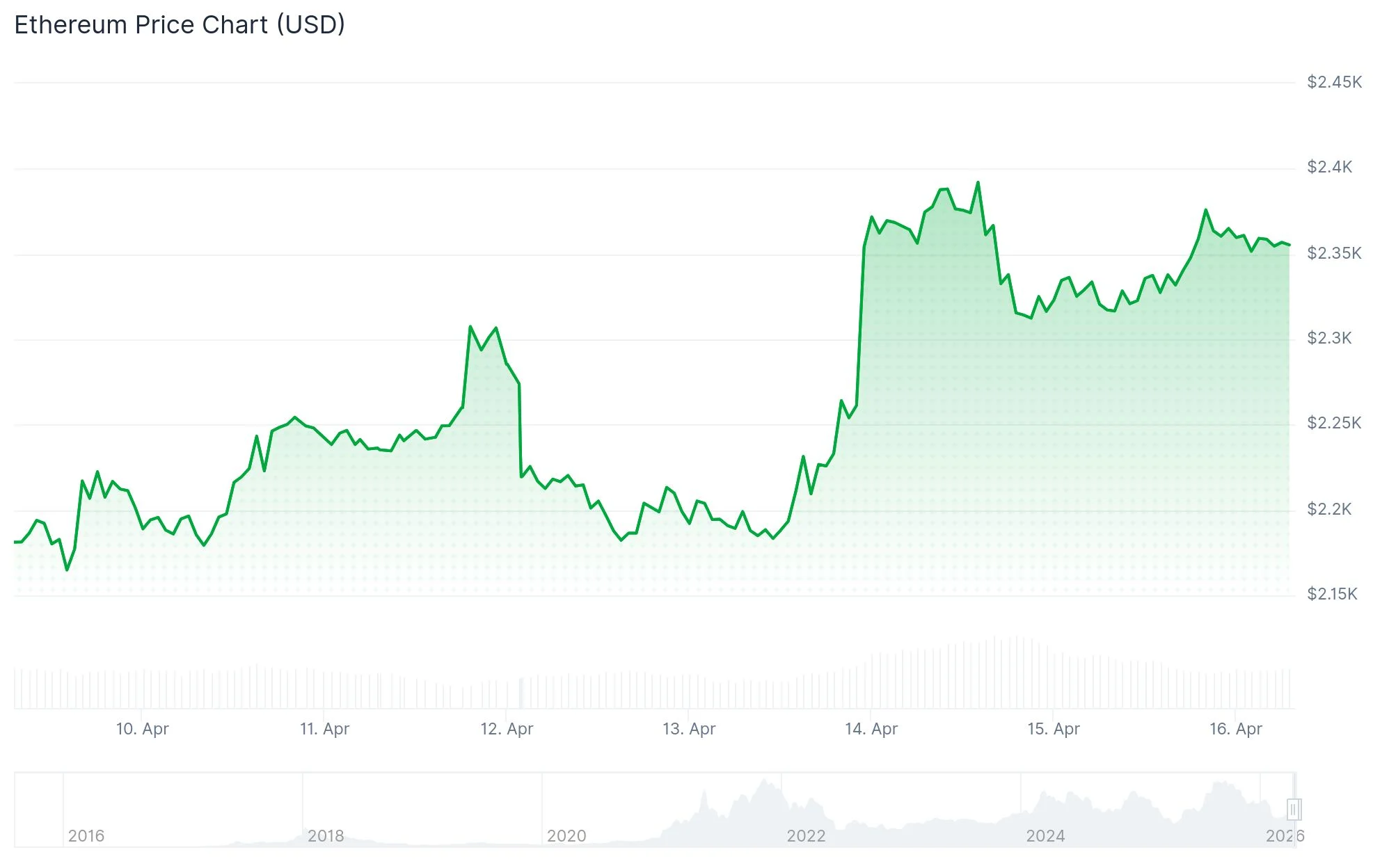
Open interest in ETH futures contracts climbed 26% to $25.4 billion, indicating increased leveraged positioning among market participants. This growth follows 10 consecutive weeks where ETH failed to sustain moves above the $2,400 threshold.
Despite increased trading activity, funding rates for ETH perpetual contracts have fallen into negative territory on multiple occasions. This pattern indicates that short positions are outweighing long positions, as traders pay to bet against price appreciation. Healthy markets typically maintain funding rates between 5% and 10%.
Spot Ethereum exchange-traded funds in the United States recorded cumulative net inflows of $248 million across the most recent 10-day period. Data from Wu Blockchain shows that on April 15 alone, these products captured $67.85 million in fresh capital.
Bitmine Immersion (BMNR) disclosed a major acquisition of $312 million worth of ETH, bringing its total position to 4.87 million tokens valued at roughly $11.46 billion. The company’s holdings currently sit 13% underwater relative to purchase price.
Total assets managed by US Ether ETFs now stand at $13.7 billion, representing a decline from the $20.5 billion recorded three months earlier.
DApp Activity Continues Weakening
Ethereum’s weekly revenue generated from decentralized applications has contracted to $11 million, a sharp decline from the $24 million level seen in early February. Reduced activity spans multiple sectors including memecoins, lending protocols, decentralized exchanges, and NFT marketplaces.
Emerging blockchain networks such as Hyperliquid and Plasma are capturing market share, prompting investors to question Ethereum’s ability to dominate future decentralized application growth.
On-Chain Data Presents Conflicting Picture
Some network fundamentals paint an encouraging picture. The 14-day moving average for total Ethereum transactions has reached an all-time high, showing consistent upward momentum since March. Active wallet addresses have also begun recovering from January lows.

Staking activity continues accelerating. Since the beginning of April, validators have added 550,000 ETH to staking contracts, pushing the total staked supply to 39.28 million ETH. For the year to date, staking inflows have accumulated to 3.29 million ETH.
However, total value locked across Ethereum’s DeFi ecosystem remains stagnant at approximately $55.6 billion, suggesting minimal fresh capital deployment into protocols.
Market analyst Crypto Patel highlighted on X that Ethereum is positioned just beneath an unfilled CME gap spanning $2,474 to $2,634, suggesting this range as the probable next upside objective. He outlined the $2,900–$3,050 zone as critical resistance, noting that a daily close above $3,056 would confirm a complete trend reversal. Downside protection sits at $1,765.
Technically, ETH is forming a tightening triangle pattern with overhead resistance at $2,380. A decisive breakout above $2,400 could trigger momentum toward the $2,500–$2,550 range.
Year-to-date staking inflows totaled 3.29 million ETH as of April 16, 2026.
