



Key Takeaways
- XRP is currently changing hands near $1.35, showing modest gains for two consecutive sessions amid ongoing market pressure.
- Exchange-traded funds tracking XRP recorded $2.3 million in net redemptions Monday, with total assets declining to $944 million from $1.65 billion in January.
- Open Interest in XRP futures contracts has collapsed to $2.45 billion, representing a dramatic 73% decrease from its $10.94 billion July peak.
- Technical analyst Ali Martinez projects a possible 30% additional correction before XRP enters a sustained uptrend beginning in 2026.
- Ripple has integrated native cryptocurrency functionality into its treasury management system, supporting both XRP and the RLUSD stablecoin.
As of Wednesday, April 2, XRP is maintaining a position slightly above $1.35. The digital asset has registered consecutive daily increases, yet investor appetite from both individual and institutional participants remains subdued.
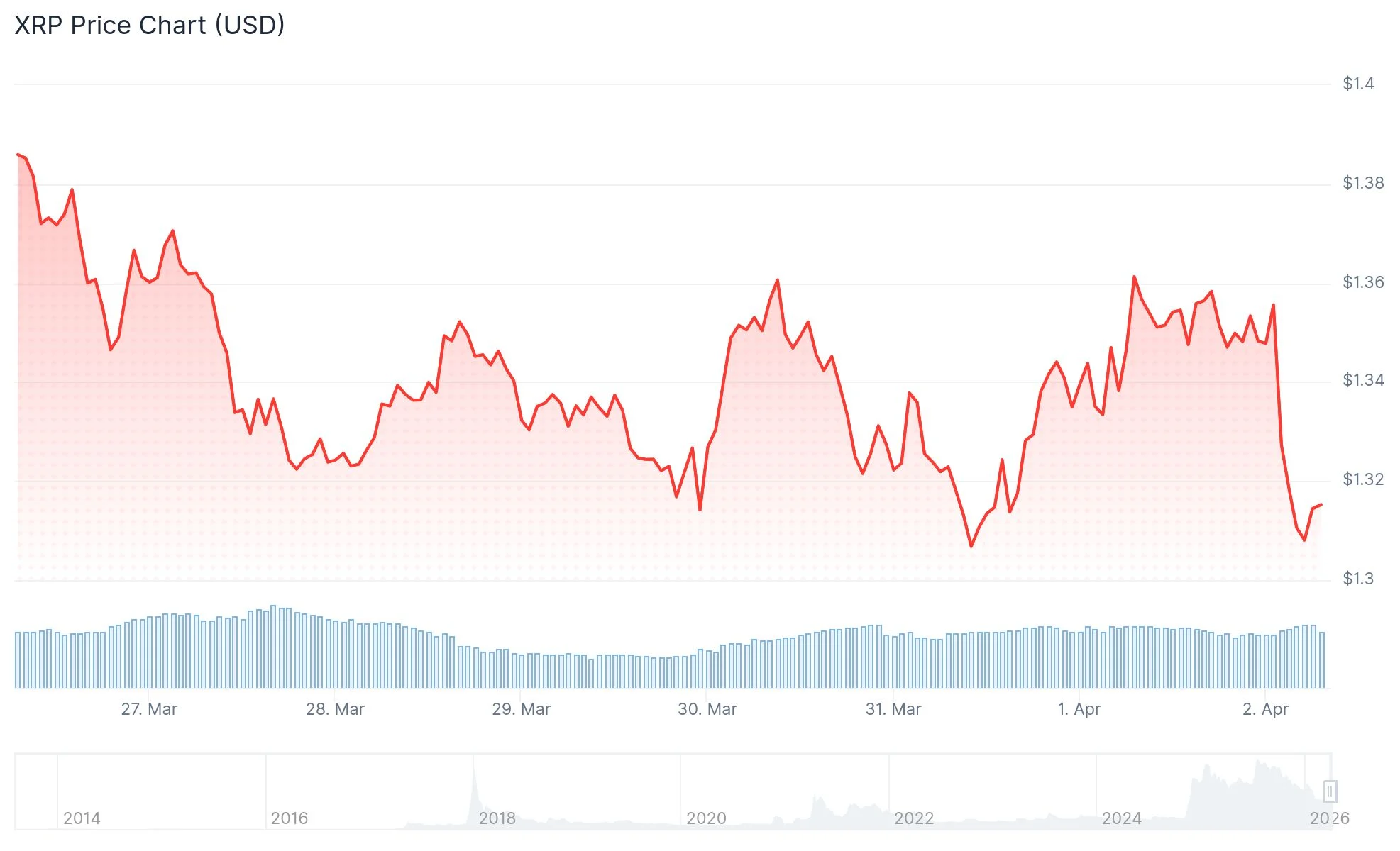
The token began the trading session at $1.34 before posting modest upward movement. However, XRP remains trapped beneath a critical descending trendline resistance, with rebound efforts consistently failing near the $1.43 threshold.
Technical indicators paint a bearish picture. The 50-day, 100-day, and 200-day Exponential Moving Averages are all positioned significantly above current trading levels. The MACD histogram shows negative momentum below its signal line on the daily timeframe, while the Relative Strength Index registers approximately 43—indicating sustained selling pressure without entering deeply oversold conditions.
Geopolitical tensions have compounded market challenges. The protracted conflict involving the United States, Israel, and Iran, now extending into its second month, has created headwinds across cryptocurrency markets, with attempted rallies frequently meeting swift reversals.
Investment Vehicle Data Reveals Diminishing Interest
Spot XRP exchange-traded funds listed in the United States experienced $2.3 million in net withdrawals on Monday. Tuesday’s trading session saw minimal flow activity in either direction. While aggregate inflows since launch remain at $1.21 billion, total assets under management have contracted to approximately $944 million—a substantial decline from the January 1 peak of $1.65 billion.

Open Interest for XRP futures contracts declined to $2.45 billion on Wednesday from $2.54 billion one day earlier. This represents a precipitous fall from the record $10.94 billion registered in July, coinciding with XRP‘s all-time high of $3.66. March 2026 represents the first calendar month showing negative net ETF flows since these investment products debuted in November 2025.
Crypto analyst Ali Martinez shared a long-term technical assessment of XRP’s price structure, highlighting what appears to be an ascending triangle formation developing across multiple years. The pattern’s horizontal resistance level sits approximately at $3.32, and following XRP’s failure to breach this barrier, the token has surrendered more than 55% of its value.
According to Martinez: “If XRP is following this ascending triangle, it could offer a short-term buying opportunity and a strong long-term uptrend.” His analysis suggests an additional 30% decline may materialize before a significant recovery takes hold, with a multi-year logarithmic support trendline serving as a critical level for market participants to monitor.
Ripple Expands Treasury Platform With Native Crypto Support
On the corporate front, Ripple has unveiled the integration of native blockchain functionality into its Ripple Treasury service. The newly introduced capabilities, branded as Digital Asset Accounts and Unified Treasury, enable chief financial officers to monitor and control both traditional fiat currencies and digital assets—including XRP and the RLUSD stablecoin—through a consolidated interface.
Ripple’s Chief Executive Officer Brad Garlinghouse previously disclosed that the platform facilitated $13 trillion in transaction volume during the preceding year, catering to a diverse client base spanning small enterprises to Fortune 500 corporations. Notably, none of that historical volume involved cryptocurrency assets, though the new integration aims to fundamentally alter that dynamic.
The Digital Asset Accounts functionality incorporates real-time asset valuation, precision to 15 decimal places, and automated transaction documentation. Unified Treasury delivers instantaneous visibility across all digital asset holdings and cash positions.
Several corporate clients are currently participating in beta testing prior to the platform’s worldwide commercial release.
