



When you ask someone who gambles online regularly to explain the value of their casino loyalty rewards, you’ll usually get a vague answer. They’ve accumulated points. Those points turn into something eventually. More play equals better perks at some undefined point. But if you ask them to calculate their actual return per dollar wagered in concrete terms, most draw a blank.
This confusion isn’t by accident. Loyalty programs in the casino industry are engineered to be opaque. Conversion formulas shift depending on which games you play. Different redemption paths carry different effective values. Tier advancement thresholds are calibrated to keep players perpetually chasing the next level without quite getting there. The end result? A program that promises much and frequently underdelivers.
When ZunaBet entered the market in 2026, it rejected this traditional model completely. Instead of points, it built a six-tier loyalty system based on straightforward rakeback percentages that apply universally across the platform. No convoluted calculations. No conversion confusion. No ambiguity about returns. This analysis examines why this approach represents a significant departure from industry norms and what it means for players.
Contents
Why Points-Based Systems Create Confusion
The casino industry gravitated toward points-based loyalty frameworks because they serve operator interests effectively. These systems create a perception of generosity without guaranteeing specific returns. Players feel appreciated when they see points accumulating. Whether those points actually represent meaningful value becomes a question of redemption mechanics, tier qualifications, expiration policies, and game-specific contribution rates that few players fully understand.
The established platforms have perfected this approach. Systems like DraftKings Dynasty Rewards, Caesars Rewards, BetMGM’s tiered loyalty program, and FanDuel’s rewards structure all follow similar blueprints. Play generates points. Points exchange for bonus credits, tangible goods, or in Caesars’ case, access to resort amenities and dining experiences. For players who regularly visit physical casino properties, these non-gaming benefits hold real appeal. For those focused purely on online gambling, the value proposition becomes murky.

The core frustration that pushes players away from points frameworks is the calculation barrier. To determine actual loyalty value on traditional platforms, you need to identify the points-per-dollar rate for your chosen games, understand the conversion ratio for your preferred redemption method, then determine if the final number matters at your play volume. Most players never complete this analysis. They simply play, watch points grow, and occasionally redeem rewards without knowing if they received fair compensation.
Rakeback eliminates this entire problem.
Understanding Rakeback as a Loyalty Mechanism
Rakeback represents a straightforward percentage return on gambling activity. You wager money, experience wins or losses, and automatically receive a predetermined percentage of your total action or net losses back as tangible value. The percentage remains fixed for your tier. The return works the same regardless of game selection. No conversion steps, no redemption hoops, no uncertainty about what you’re getting.
The concept originated in poker rooms, where “rake” — the house’s portion of each pot — was partially refunded to loyal players as a retention incentive. Online casinos expanded this idea into a comprehensive loyalty approach. Within crypto casino circles, rakeback has emerged as the dominant loyalty structure because it aligns with what crypto-native users expect from digital platforms — clarity, simplicity, and self-calculable value.
Under a 10% rakeback arrangement, a player who wagers $1,000 monthly receives exactly $100 back. At 20% rakeback, that same activity returns $200. The mathematics are instantaneous. The value is unambiguous. There’s no speculation about whether points converted favorably or if bonus credits were worth claiming.
How ZunaBet’s Dragon Evolution System Works
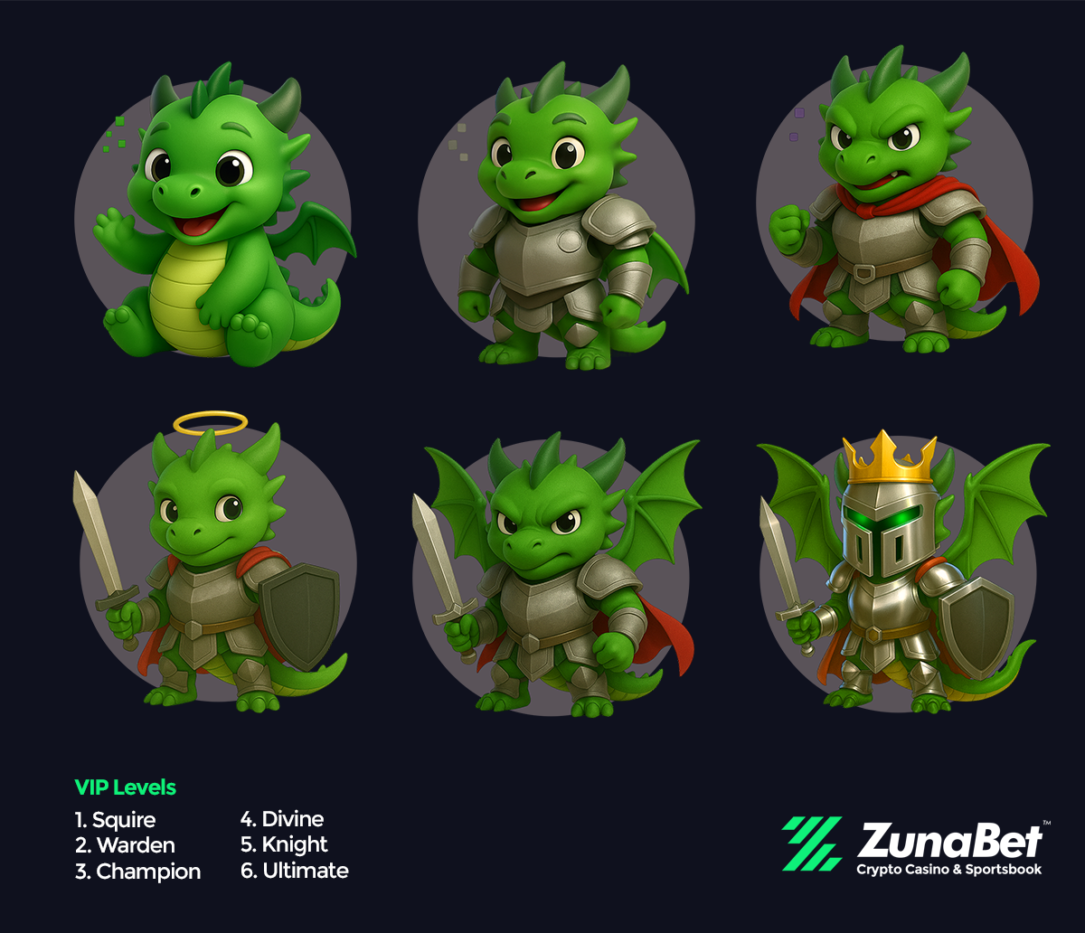
ZunaBet structured its loyalty offering around a dragon-themed progression with six levels and a gamified mascot named Zuno. The thematic presentation adds character — players advance through dragon-inspired ranks rather than generic numbered tiers — but the real substance lies in the rakeback percentages each level provides.
The entry level, Squire, delivers 1% rakeback. Warden provides 2%. Champion offers 4%. Divine grants 5%. Knight awards 10%. Ultimate tops out at 20%. Each advancement beyond the starting tier represents a substantial increase in returns, with the leap from Knight to Ultimate — doubling from 10% to 20% — particularly significant for high-volume players.
These percentages apply uniformly across all platform activity. Whether you’re spinning slots, playing live dealer tables, or wagering on the sportsbook makes no difference. The rakeback calculation applies to your total action regardless of where you place it. This universality transforms the program from a selective incentive that rewards specific behaviors into a genuinely comprehensive loyalty mechanism.
Supplementary perks enhance the core rakeback rather than substituting for it. Advanced tiers unlock up to 1,000 free spins, exclusive VIP club membership, and doubled wheel spin opportunities. These represent concrete additions layered atop a loyalty foundation already providing direct monetary returns. For players reaching top tiers, the combination of 20% rakeback plus escalating extras constitutes one of the industry’s more competitive loyalty packages, particularly in the crypto casino sector.
Real-World Comparison: Rakeback vs. Points
Placing ZunaBet’s structure beside traditional points systems reveals the practical distinction through straightforward scenarios.
Consider a player wagering $500 weekly — $2,000 monthly — on ZunaBet at the Champion tier. That player receives 4% rakeback, meaning $80 returned monthly, automatically, without redemption steps. Upon reaching Knight tier, identical volume generates $200 monthly. At Ultimate, it produces $400 monthly.
That same player on a traditional points platform accumulates points at game-dependent rates, converts them through variable redemption formulas, and receives something — perhaps bonus credits — with theoretical value but no cash withdrawal option. The actual financial benefit becomes difficult to quantify and generally falls below equivalent rakeback returns at similar volumes.
For occasional players, this distinction matters less. For consistent players maintaining regular volume, the gap between transparent rakeback and opaque points systems becomes substantial. It separates knowing your loyalty’s precise worth from hoping it has meaningful value.
The Foundation Supporting the Rewards
Loyalty programs only function effectively when built on solid platforms. ZunaBet operates under Strathvale Group Ltd ownership, holds an Anjouan gaming license, and maintains registration in Belize. The platform launched in 2026 backed by a team with more than 20 years collective industry expertise.
The gaming catalog contains 11,294 titles from 63 different providers — including slots, live dealer experiences, and RNG table games from Evolution, Pragmatic Play, Hacksaw Gaming, Yggdrasil, BGaming, and numerous others. The sportsbook encompasses major international sports alongside esports titles — CS2, Dota 2, League of Legends, Valorant — plus virtual sports and combat sports. Payment infrastructure supports over 20 cryptocurrencies with zero processing fees and rapid withdrawals. Applications function on iOS, Android, Windows, and MacOS platforms with around-the-clock live chat support.
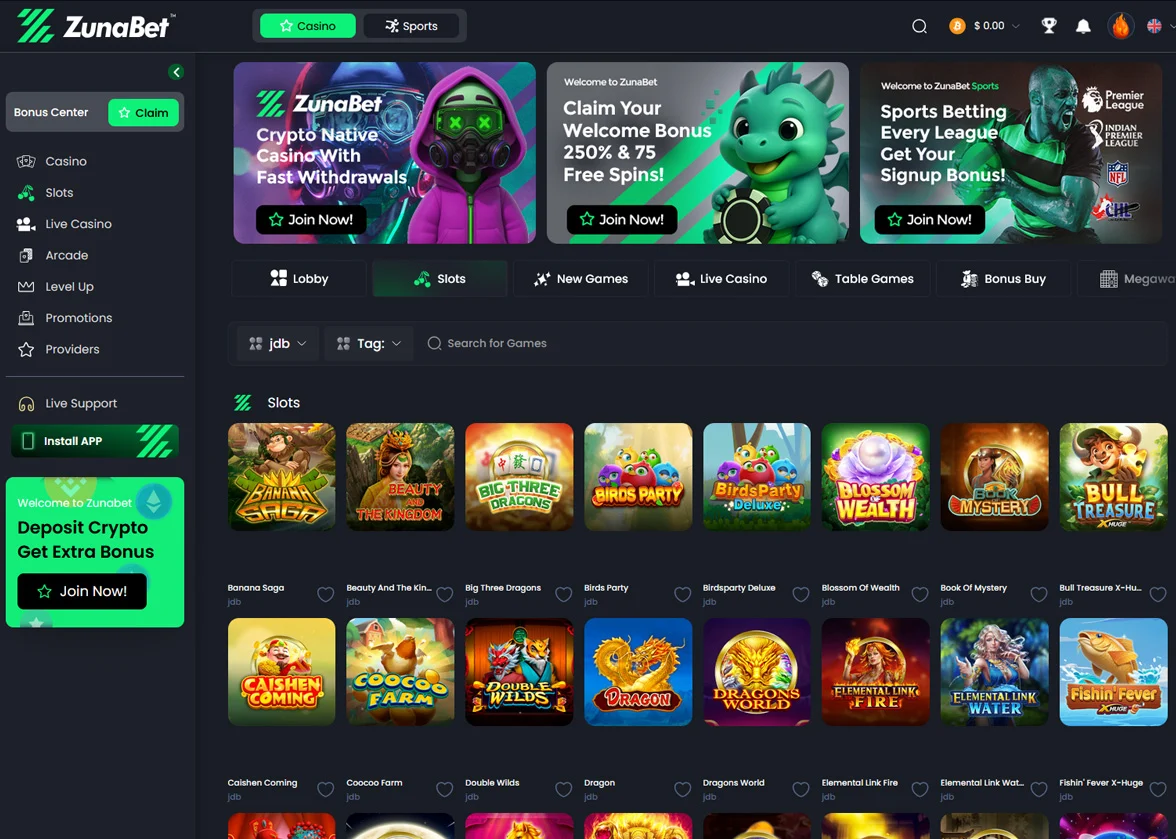
New accounts qualify for a welcome package spanning three deposits up to $5,000 combined plus 75 free spins — 100% match up to $2,000 with 25 spins on deposit one, 50% match up to $1,500 with 25 spins on deposit two, and 100% match up to $1,500 with 25 spins on deposit three.
The infrastructure is designed to accommodate regular, high-volume play — precisely the usage pattern that maximizes rakeback loyalty value. Even the most generous loyalty program loses relevance on platforms with limited game selections or unreliable payment processing. ZunaBet combines its loyalty framework with a comprehensive platform architecture that provides genuine reasons for player retention.
The Growing Demand for Loyalty Transparency
The industry shift toward rakeback and away from points reflects broader changes in user expectations for digital services. Transparency has evolved from competitive advantage to baseline requirement. Players already using cryptocurrency operate within an ecosystem where transaction values are publicly visible, fees are explicitly stated, and nothing hides behind institutional opacity. They naturally extend these expectations to loyalty programs.
Loyalty systems requiring spreadsheets and documentation to evaluate feel increasingly outdated. Programs that state percentages clearly and apply them consistently align with modern expectations. ZunaBet’s dragon evolution framework operates on this principle — and for players exhausted by points systems that promise more than they deliver, this straightforward approach offers compelling reasons to investigate.
As a platform launched in 2026, ZunaBet’s long-term performance record remains under development. This deserves acknowledgment. However, what it launched with — a loyalty program grounded in transparency, directness, and rates delivering genuine value at advanced tiers — demonstrates thoughtful consideration of what regular players genuinely value. For those players, it presents a persuasive argument.
