



Key Takeaways
- Solana is currently changing hands around $85, experiencing a roughly 2% decline in the past day
- The token remains confined within a trading range bounded by $82 floor and $89 ceiling
- Technical indicators show both key moving averages (50-day and 200-day) positioned above the current price level, indicating mild bearish sentiment
- Major validator clients Anza and Firedancer have rolled out a test implementation of Falcon, a quantum-resistant cryptographic signature system
- Technical analyst Ali Charts suggests SOL may be preparing for a 10% price swing as it nears a triangle pattern convergence point
At press time, Solana is hovering near the $85 mark, registering approximately a 2% pullback during the last 24-hour period. The digital asset has maintained relative stability even as wider crypto markets face headwinds.
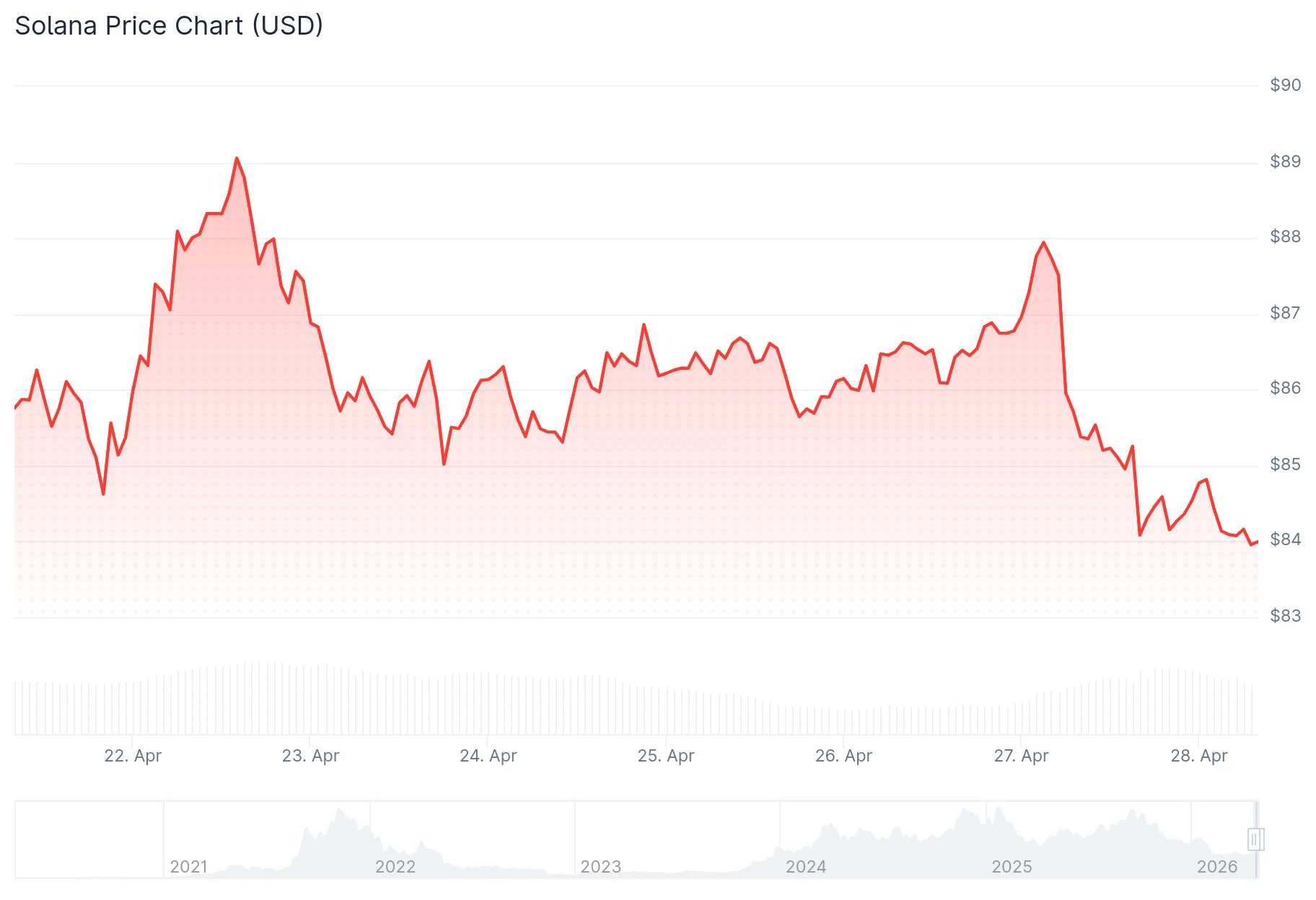
Current market dynamics show SOL locked within a sideways trading corridor, where $82 functions as critical support while $89 represents a stubborn resistance barrier. Multiple bounces from the $82 threshold indicate robust demand at this price zone.
Conversely, every rally attempt toward $89 has encountered selling pressure. This consistent pushback maintains a cautious near-term technical outlook.
From a moving average perspective, both the 50-period and 200-period SMAs are currently positioned above where SOL is trading. This configuration indicates the prevailing trend maintains a mildly bearish character.
The MACD momentum indicator has settled into consolidation territory near neutral ground. Diminishing histogram bars suggest weakening downside pressure — though no definitive bullish crossover signal has emerged.
The technical landscape suggests a neutral-to-moderately-bullish setup, contingent on the $82 support zone remaining intact.
Crypto analyst Ali Charts shared on X that Solana “could be setting up for a 10% move” as the price structure converges toward a triangle apex. The analysis stopped short of providing exact targets or timing.
Falcon: Solana’s Post-Quantum Security Layer
Earlier this week, Anza and Firedancer — two leading Solana validator client implementations — revealed they’ve deployed a testing version of Falcon, a cryptographic signature scheme designed to withstand quantum computing attacks.
The Falcon algorithm was selected specifically for its compact signature footprint among post-quantum cryptographic standards certified by the US National Institute of Standards and Technology (NIST). According to Jump Crypto, the development team responsible for Firedancer, Falcon’s verification process integrates smoothly into existing infrastructure, while signature generation occurs off the blockchain.
Developers emphasized the upgrade stands ready for deployment “if and when the time comes” — a reference to Q-Day, the theoretical moment when quantum computers achieve sufficient power to compromise conventional encryption methods.
Both development teams confirmed they pursued quantum-resistant solutions through independent research channels before converging on Falcon as the optimal choice. Public development commits in Anza’s GitHub repository indicate Falcon-related work commenced as early as January 27, 2026.
Solana’s Broader Quantum Security Context
This deployment marks another chapter in Solana’s ongoing quantum security initiatives. Blueshift’s Winternitz Vault introduced opt-in quantum protection features in January 2025, though that solution operated at the application layer rather than core protocol level.
Both Anza and Firedancer have verified that Falcon code is now publicly accessible in their respective GitHub repositories as an initial release candidate.
Meanwhile, official Solana communication channels have emphasized community engagement, highlighting an upcoming Solana Ecosystem Call rather than market performance commentary.
