



Key Highlights
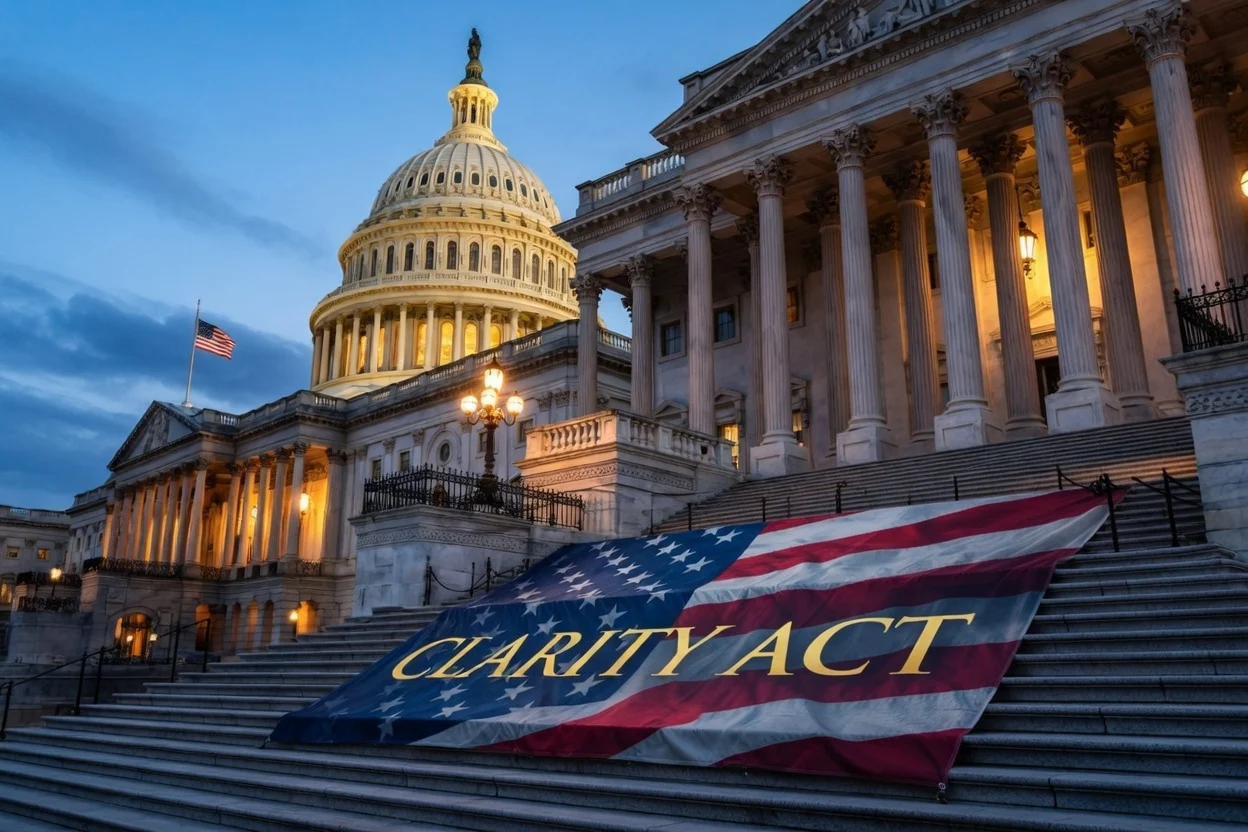
- The complete text of the Clarity Act was published by the Senate Banking Committee on Monday evening, just before the May 14 committee markup session.
- Key provisions address stablecoin interest payments and establish legal safeguards for decentralized finance developers.
- Traditional banking institutions are demanding stricter stablecoin regulations, claiming current rules create a competitive disadvantage that threatens deposit stability.
- An ethics clause designed to prevent government officials from profiting off crypto holdings remains absent from the current draft — a major concern for Democratic lawmakers.
- Prediction markets on Polymarket show a 64% probability that President Trump will sign the Clarity Act before year’s end.
Late Monday evening, the Senate Banking Committee published the complete 309-page text of the Clarity Act, mere hours before the markup hearing scheduled for May 14. This legislation represents one of the most comprehensive efforts yet to establish a clear regulatory structure for digital assets in the United States.
Banking Committee Chair Tim Scott emphasized that the legislation “puts consumers first, combats illicit finance, cracks down on criminals and foreign adversaries and keeps the future of finance here in the United States.”
While the document had been quietly shared among industry insiders in recent weeks, the official release allows for public scrutiny. Crypto advocacy organizations worked through the night analyzing the final language to verify that their key concerns were addressed.
The legislation tackles three primary areas: regulations governing stablecoin interest payments, liability protections for decentralized finance creators, and enhanced investigative powers for federal prosecutors targeting cryptocurrency-related financial crimes.
Banking Sector Clashes With Crypto Industry Over Stablecoin Incentives
Among the most controversial elements is the treatment of stablecoin rewards programs. The published version prohibits digital currency platforms from offering interest on dormant stablecoin holdings. Only rewards tied to specific user activities would be allowed.
Coinbase chief executive Brian Armstrong commented Monday that “not everyone got everything they wanted, but they got the must-haves.” He revealed that Coinbase is currently collaborating with no fewer than five major international banks to incorporate crypto functionality.
However, traditional financial institutions remain deeply unsatisfied. Rob Nichols, CEO of the American Bankers Association, distributed a letter to banking executives encouraging them to contact their senators prior to the committee vote.
Nichols cautioned that the existing provisions would “unnecessarily incentivize the flight of bank deposits into payment stablecoins, putting both economic growth and financial stability at risk.”
Multiple banking trade associations jointly submitted an additional letter to Banking Committee members requesting more stringent limitations on stablecoin reward structures.
Analysis from Galaxy countered these concerns, maintaining that the majority of stablecoin expansion will originate from international capital entering U.S. financial systems, rather than from domestic customers moving funds out of traditional banks.
Missing Ethics Language Creates Political Tension
Notably absent from the current draft is a conflict-of-interest provision that would restrict government officials from earning profits through cryptocurrency investments. This section falls beyond the banking committee’s authority and would need to be incorporated during later legislative stages.
Democratic senators have indicated the ethics provision is non-negotiable for securing their votes. Senator Elizabeth Warren characterized the bill as something that “turbocharges Donald Trump’s crypto corruption,” citing approximately $1.4 billion in digital asset profits reportedly earned by the president and his relatives since his inauguration.
White House cryptocurrency advisor Patrick Witt stated the administration supports uniform rules applicable to all government personnel, but opposes any language that targets specific individuals.
Senate Republicans are anticipated to move the bill forward during the May 14 markup session, likely along partisan lines. Following committee approval, the legislation must be reconciled with a separate version already approved by the Senate Agriculture Committee before proceeding to a full Senate floor vote.
Passage in the full Senate requires sixty affirmative votes, making bipartisan cooperation essential. The administration hopes to complete the legislative process by July 4. Senator Kirsten Gillibrand has projected passage could occur in early August.
Prediction markets on Polymarket currently assess a 64% likelihood that President Trump will sign the Clarity Act into law within the calendar year.
