



Quick Summary
- Shares of DHL declined 3% following the release of a 2026 profit forecast that fell short of analyst projections
- Management anticipates EBIT surpassing €6.2 billion in 2026, compared to €6.1 billion recorded in 2025
- Fourth-quarter operating profit decreased 1.3% to €1.83 billion, with the freight forwarding division seeing earnings plunge 36%
- Chief Executive Tobias Meyer indicated the projection is based on continued weakness in the global economic landscape
- Falling freight rates across air and ocean transport, combined with sluggish road freight activity in Europe, are pressuring performance
Shares of DHL experienced a 3% decline on Thursday following the German logistics powerhouse’s announcement of a 2026 profit forecast that disappointed market watchers.
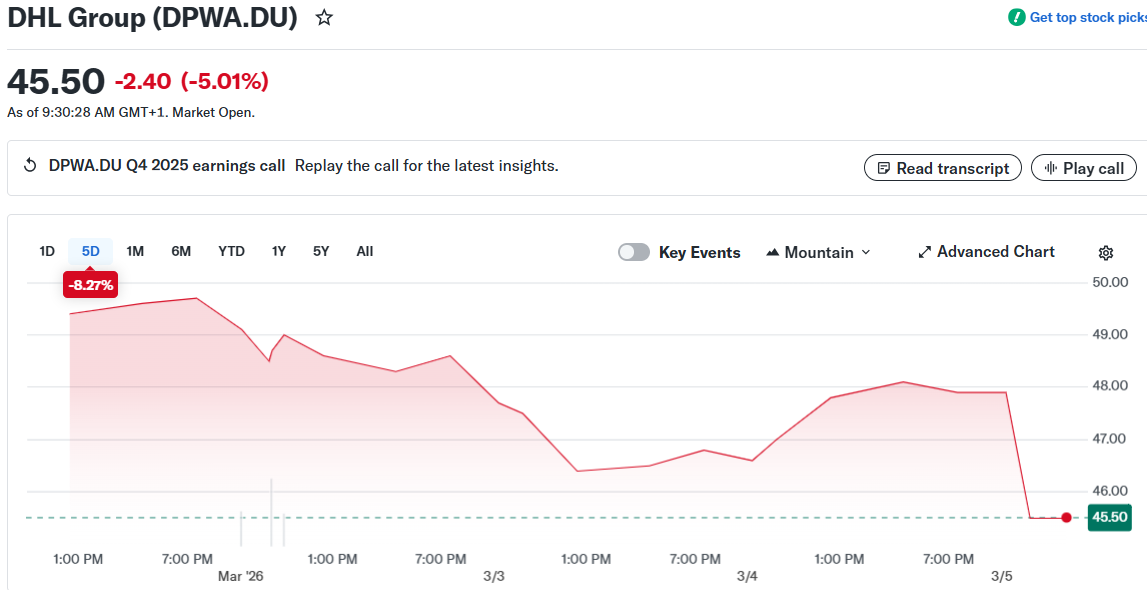
The company’s stock performance placed it at the lowest position among Germany’s DAX blue-chip index constituents by 0919 GMT.
According to DHL’s guidance, the company anticipates earnings before interest and taxes will surpass €6.2 billion ($7.2 billion) for the current year. This projection follows the logistics provider’s reported operating profit of €6.1 billion for the complete 2025 fiscal year.
The forward-looking statement registered below the consensus estimate compiled from the company’s analyst survey data.
Chief Executive Tobias Meyer spoke candidly about the outlook. “Our forecast does not assume any improvement in the global economic environment,” Meyer stated in an official company release.
Meyer pointed to geopolitical instability and market uncertainty already evident during January and February as primary drivers behind the conservative projection.
Freight Forwarding Segment Weighs Heavy in Q4
The company’s fourth-quarter operating profit registered a 1.3% decrease to €1.83 billion. This figure aligned closely with analyst projections.
The freight forwarding business unit bore primary responsibility for the decline, posting a dramatic 36% earnings drop during the quarter.
Freight forwarding represents a cornerstone of DHL’s worldwide operations, managing the logistics of goods movement through air, ocean, and ground transportation channels.
“In air and ocean freight, we see declining freight rates,” Meyer explained to investors during Thursday’s conference call.
The road freight sector faces similar challenges. “In road freight, we feel the weak economic situation in Europe, and especially in Germany,” Meyer elaborated.
Logistics providers across Europe have confronted a challenging operating environment — reduced customer demand and trade complications stemming from tariff policies enacted by U.S. President Donald Trump have intensified sector-wide pressures.
Middle East Operations Show Resilience
However, not all business segments face headwinds. Meyer highlighted that the company has traditionally outperformed competitors during periods of Middle East turbulence.
“We have a very well established road network in the Middle East which enables us to bring cargo to those airports that are open,” Meyer explained.
This capability provides valuable diversification as air and maritime route disruptions stemming from the ongoing Middle East conflict continue to impact international shipping operations.
Nevertheless, the overall market conditions remain challenging. Transportation and logistics companies worldwide are grappling with increasing disruptions affecting both air and maritime routes.
The 36% earnings contraction in DHL’s Q4 freight forwarding operations stands out as the most significant negative indicator from the company’s recent financial disclosure.
The EBIT guidance calling for results “exceeding €6.2 billion” in 2026 signals only marginal improvement compared to the €6.1 billion achieved in 2025.
