



Key Points
- Brent crude advanced 0.5% to reach $100.51 per barrel on Friday; WTI gained 0.4% to $95.19
- Military confrontation occurred between U.S. and Iranian forces in the Strait of Hormuz on Thursday
- President Trump characterized the incident as a “trifle” while confirming the cease-fire continues
- Washington is evaluating the resumption of “Project Freedom” to provide naval escorts for commercial vessels
- Weekly declines persist, with Brent falling from approximately $108 at Monday’s market open
Crude oil markets registered gains Friday morning following a military confrontation between U.S. and Iranian forces in the strategically vital Strait of Hormuz, adding strain to an already tenuous cease-fire arrangement between the nations.
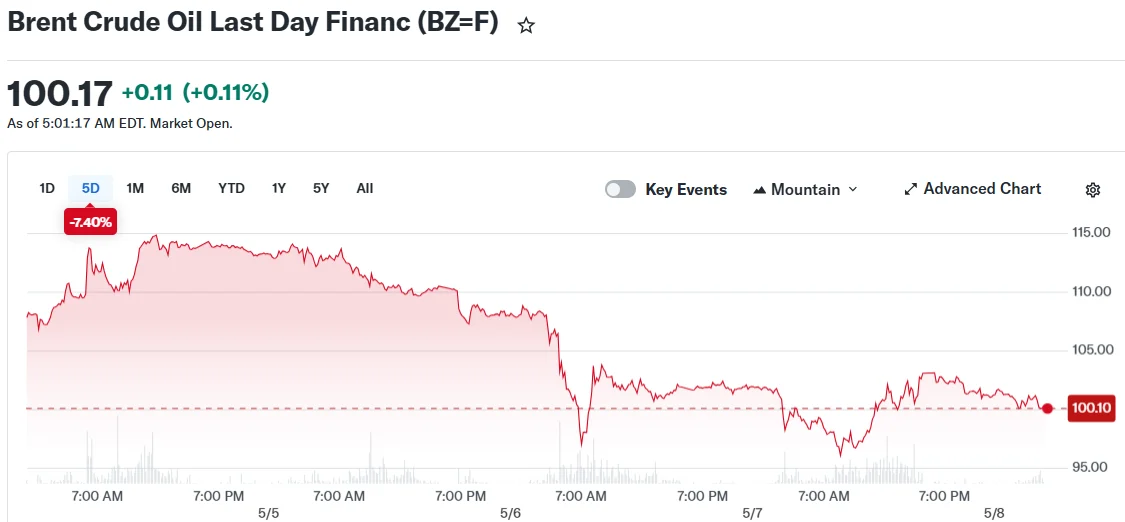
Brent crude futures climbed 0.5% to $100.51 per barrel during early European market hours. West Texas Intermediate futures advanced 0.4% to reach $95.19 per barrel.
During earlier trading, both benchmark contracts had surged more than 2%. Brent momentarily exceeded $102 per barrel in Asian markets before relinquishing some of those gains.
Notwithstanding Friday’s upward movement, oil remains significantly lower for the week. Brent commenced Monday’s trading near $108 per barrel, with WTI hovering close to $100. This trajectory positions Brent for an approximate $7 weekly decline.
The Strait of Hormuz represents a critical artery for global oil transportation. Approximately 20% of worldwide oil supplies typically transit through this narrow waterway.
Details of the Confrontation
Iranian forces deployed missiles, unmanned aerial vehicles, and small watercraft in attacks targeting U.S. naval vessels near the Strait of Hormuz, according to a U.S. Central Command statement cited by the Wall Street Journal.
U.S. military forces successfully intercepted the incoming threats and conducted retaliatory strikes against Iranian military installations responsible for initiating the attacks, according to the official statement.
President Trump minimized the significance of the encounter on Truth Social Thursday, describing it as a “trifle.”
“Just like we knocked them out again today, we’ll knock them out a lot harder, and a lot more violently, in the future, if they don’t get their Deal signed, FAST!,” Trump posted.
Trump additionally confirmed that the cease-fire arrangement remains effective notwithstanding the military engagement.
Commercial Escort Operations and Diplomatic Efforts
The Trump administration is considering relaunching “Project Freedom,” a naval initiative designed to provide armed escorts for commercial shipping traversing the Strait of Hormuz, according to Wall Street Journal reporting.
The Strait has been essentially inaccessible to routine maritime commerce, Saxo Bank analysts indicated Friday. They characterized the week as featuring an “almost $20 trading range as Middle East headlines swung sentiment between optimism and frustration.”
Investors continue monitoring developments regarding a potential resumption of direct diplomatic negotiations between Washington and Tehran.
ING analyst Francesco Pesole noted in research commentary that optimism exists for reaching an agreement prior to a scheduled U.S.-China summit on May 14-15, though he cautioned that “risks are clearly very binary.”
Pesole observed that market sentiment is “fading again” following the military clashes and the possible reinstitution of U.S. naval escort missions.
Saxo Bank analysts emphasized the fundamental challenge remains constant: “The Strait of Hormuz remains effectively closed, with renewed clashes between U.S. and Iranian forces lowering the prospect of a near-term reopening.”
As of early European trading Friday, Brent crude for July delivery had advanced 0.6% to $100.67 per barrel. WTI futures for June delivery were up 0.4% to $95.16 per barrel.
