




Key Takeaways
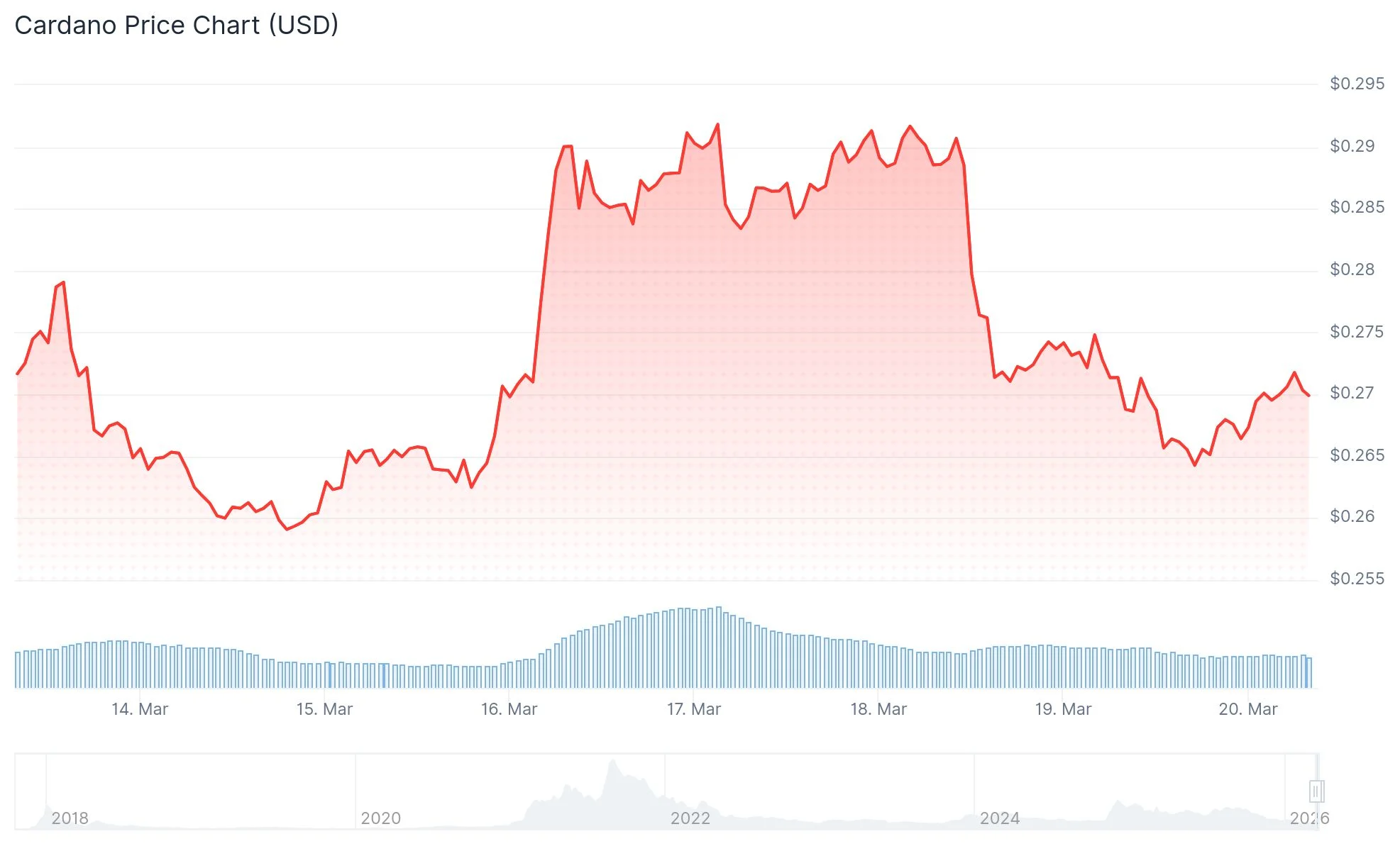
- Cardano has declined 1.86% in the last 24 hours, currently trading around $0.267 while maintaining the critical $0.26–$0.27 support zone
- Joint regulatory guidance from the SEC and CFTC has clarified classifications for crypto assets, including digital commodities and securities
- The upcoming Protocol 11 (van Rossem) hard fork is imminent, with Node 10.7.0 prerelease anticipated in the near term
- Bearish pressure persists; a break above $0.28 is needed for bulls to push toward $0.29–$0.30 resistance levels
- Technical analyst @alicharts identified a TD Sequential “buy signal” on the weekly timeframe, projecting potential targets at $0.32 and $0.37
Cardano (ADA) is currently positioned around $0.267, reflecting a 1.86% decline in the past 24 hours. The cryptocurrency continues to defend a crucial support zone spanning $0.26 to $0.27.
The wider cryptocurrency market experienced similar downward pressure during this timeframe. The global crypto market capitalization contracted by 1.26%, settling at $2.41 trillion.
Escalating geopolitical tensions in the Middle East contributed to rising crude oil valuations. This development reignited inflation worries and prompted investors to retreat from risk-sensitive assets, cryptocurrencies included.
Bitcoin managed to defend the $70,000 threshold despite modest daily losses. Ethereum remained anchored above $2,100 while XRP sustained its position above $1.40.
Examining the four-hour timeframe reveals that ADA bears reasserted control following an unsuccessful attempt to breach recent resistance. The MACD histogram displays red bars positioned beneath the signal line, while the RSI indicator rests below the neutral 50 mark—both suggesting near-term bearish momentum.
For bullish momentum to resurface, Cardano must successfully recapture the $0.28 level. A convincing break above this threshold would likely expose the $0.29 resistance, potentially paving the way toward $0.30.
Crypto analyst Ali Charts shared insights on X, highlighting that Cardano has generated a TD Sequential “black 9” buy signal on the weekly chart. According to the analyst, this technical pattern “typically anticipates 1–4 weeks of upward expansion,” with projected targets reaching $0.32 and $0.37, provided ADA maintains $0.23 on a weekly closing basis.
https://twitter.com/alicharts/status/2034859227110351302?s=20
Regulators Issue Unified Crypto Asset Framework
The U.S. Securities and Exchange Commission and Commodity Futures Trading Commission have jointly published guidance clarifying crypto asset classifications. The framework distinguishes between various categories such as digital commodities, collectibles, stablecoins, and digital securities.
The guidance further elaborates on circumstances under which a token constitutes an investment contract and when such classification may be revoked. The CFTC acknowledged that certain non-security tokens could qualify for commodity designation. Market observers suggest this regulatory clarity may influence sentiment surrounding ADA and future exchange-traded fund proposals.
Cardano’s Protocol 11 Upgrade Approaches
Cardano is advancing toward its next significant network enhancement. The intra-era hard fork introducing Protocol 11, designated as van Rossem, is anticipated within days.
https://twitter.com/IntersectMBO/status/2034598520892571701?s=20
This upgrade necessitates two sequential node releases. Node version 10.6.2 was deployed in February. Node 10.7.0 represents the concluding phase before the hard fork implementation can commence.
Intersect, a member-governed organization within the Cardano ecosystem, has announced that the Node 10.7.0 prerelease should arrive shortly.
Protocol 11 introduces several new Plutus built-in functions through multiple CIPs. These enhancements comprise an array data type (CIP-138), optimized MaryEraValue processing (CIP-153), modular exponentiation functionality (CIP-109), and multi-scalar multiplication capabilities for sophisticated cryptographic operations (CIP-133).
The upgrade maintains compatibility with existing transaction formats and smart contracts. Hardware wallet functionality remains unaffected. SanchoNet has been operating these capabilities in a testing environment.
Mainnet deployment will proceed following successful testnet hard fork completion.
