



TLDR
- Crude markets experienced significant volatility Monday amid emerging diplomatic efforts between Washington and Tehran
- Brent momentarily surged past the $110 threshold before retreating on speculation about a possible 45-day truce agreement
- President Trump established a Tuesday evening cutoff, warning of strikes targeting Iranian electrical facilities and transportation infrastructure unless maritime passage resumes
- Tehran’s Islamic Revolutionary Guard Corps cautioned it would escalate operations against American economic targets if attacks on civilian sites persist
- OPEC+ members approved a modest production boost of 206,000 bpd for May, though implementation remains questionable given regional constraints
Oil prices experienced dramatic fluctuations throughout Monday’s trading session as market participants attempted to balance escalating military threats from Washington against emerging diplomatic overtures.
Brent crude momentarily breached the $110 per barrel threshold before retreating from those peaks. Asian trading hours saw the benchmark settle near $109.80, representing a 0.7% advance. Meanwhile, West Texas Intermediate crude remained relatively unchanged at $111.62.
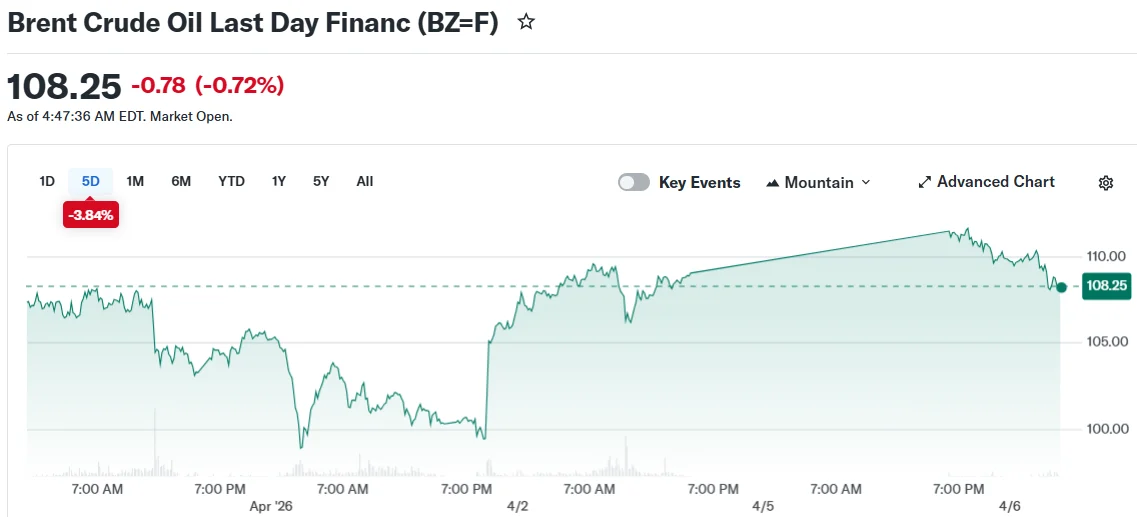
The pronounced volatility underscores how sensitive energy markets have become to each development in the escalating confrontation between Washington and Tehran, which erupted when American and Israeli military forces conducted coordinated operations against Iranian targets on February 28.
Prior to the conflict’s outbreak, Brent crude was exchanging hands at approximately $70 per barrel. The benchmark crossed the $100 milestone last week following Trump’s provocative statement about bombing Iran into oblivion.
During the weekend, Trump published a profanity-laced statement on his Truth Social platform, declaring that American forces would obliterate Iranian electrical generation facilities and critical transportation infrastructure unless Tehran reopened the strategic waterway by Tuesday evening U.S. time.
Trump’s post declared: “Tuesday will be Power Plant Day, and Bridge Day… Open the Fuckin’ Strait, you crazy bastards, or you’ll be living in Hell.”
Subsequently, he established the specific timeframe: “Tuesday, 8:00 P.M. Eastern Time.”
During a Fox News interview, Trump indicated there existed a “good chance” for reaching an agreement Monday. He additionally suggested the possibility of “blowing everything up and taking over the oil” should negotiations collapse.
Iranian officials dismissed the ultimatum outright. Senior military commander General Ali Abdollahi Aliabadi characterized the deadline as “helpless, nervous, unbalanced and stupid” and warned that “the gates of hell will open” for Trump.
Ceasefire Talks Emerge
According to reporting from Axios, American officials, Iranian representatives, and regional intermediaries are currently exploring a potential 45-day cessation of hostilities that could pave the way toward a permanent resolution. Reuters corroborated these reports, indicating both parties had received a preliminary framework that could potentially be implemented as soon as Monday.
The White House declined to provide immediate commentary on the reports. BBC News noted it had not independently confirmed the information published by Axios.
Tehran maintained military operations throughout the weekend, acknowledging responsibility for strikes targeting petrochemical installations across Kuwait, Bahrain, and the United Arab Emirates. The IRGC additionally issued a Monday warning that operations against American economic infrastructure would intensify should strikes against Iranian civilian facilities continue.
OPEC+ Output Hike Falls Short
OPEC+ members reached consensus Sunday to expand crude production by 206,000 barrels daily beginning in May. Nevertheless, industry analysts characterize the increase as predominantly symbolic. Multiple significant producers lack the capacity to implement production increases due to disruptions stemming from the regional conflict.
The Strait of Hormuz, a critical chokepoint normally facilitating approximately twenty percent of global energy transportation, has remained effectively closed for several weeks. The blockade has driven energy costs higher internationally and sparked inflation anxieties among nations dependent on Middle Eastern petroleum supplies.
Sushant Gupta from Wood Mackenzie consultancy projected that prices would maintain elevated volatility, responding to each successive development in the ongoing confrontation.
