




Key Takeaways
- Artificial intelligence companies are responsible for over 80% of S&P 500 appreciation in 2026; without them, the benchmark would show only 2% growth
- Investment bank Jefferies reports the surge is fundamentals-based, with AI representing “the cheapest sector to own” measured by PEG ratio
- Forward earnings projections for AI companies have climbed more than 30% since mid-2025, with anticipated EPS compound growth of 38.5% through 2027
- Samsung Electronics achieved $1 trillion market capitalization, entering an elite group alongside Nvidia, TSMC, and Broadcom in AI infrastructure
- First quarter 2026 saw 86% of S&P 500 constituents exceed earnings forecasts — the highest rate since the pandemic — driven by AI and commodity sectors
The dominance of artificial intelligence equities in 2026’s market performance continues to intensify. Research from Jefferies reveals these technology stocks have generated over four-fifths of the S&P 500’s year-to-date returns. Strip away the AI component, and the broader index shows minimal 2% advancement.
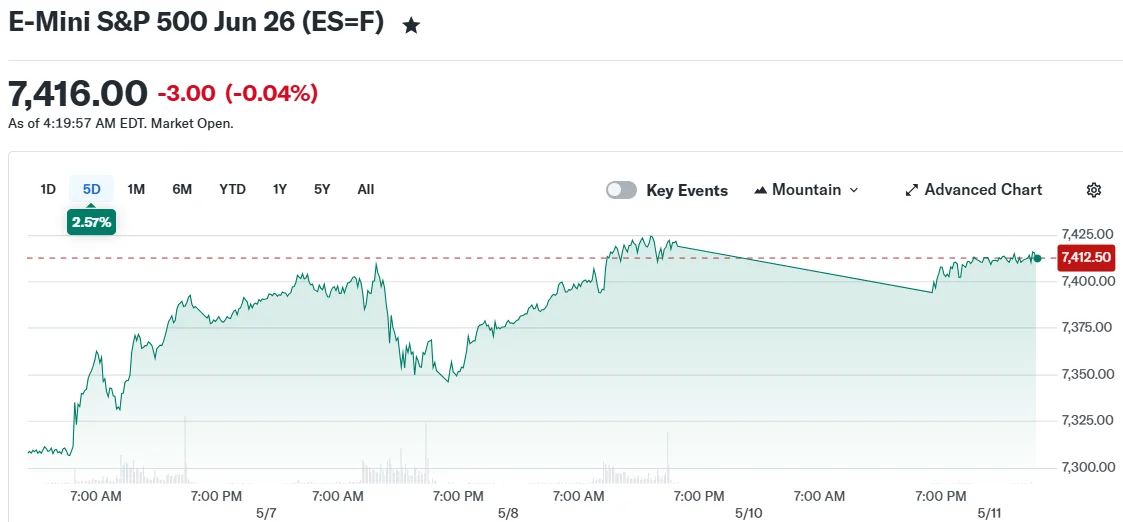
Such market concentration typically raises red flags among portfolio managers. However, Jefferies argues the underlying mechanics justify the trend.
The investment bank’s quantitative analysts examined the fundamental drivers behind these returns. Their conclusion: profit expansion, not valuation inflation, fuels the momentum. This differentiation proves critical for determining whether speculative excess exists.
The AI basket’s forward-looking profit forecasts have expanded over 30% since the middle of last year. Wall Street projects these companies will deliver 38.5% annualized earnings growth across 2026-2027. Traditional sectors outside AI show only 11.9% expected growth.
Despite this outperformance, AI stocks trade at approximately 25x forward earnings — beneath the sector’s one standard deviation threshold. The price-to-earnings-growth multiple stands at a modest 0.6x.
“AI is the cheapest sector to own in the U.S.,” Jefferies’ strategy team stated in their research commentary.
Performance Divergence Within AI Ecosystem
Results across AI subsectors show significant variation. Server infrastructure, optical networking components, and memory manufacturers have delivered the strongest gains this year. Cloud hyperscalers and chip architects have underperformed relative peers.
From a valuation perspective, memory producers and compute-focused companies present the most compelling opportunities on a PEG basis. Semiconductor manufacturing equipment and design firms carry premium multiples by comparison.
First quarter 2026 corporate results provided additional validation. An unprecedented 86% of S&P 500 members surpassed earnings projections — the highest beat rate since COVID-19, rising from 75% the prior quarter. Revenue surprises reached 82%.
The complication: these positive surprises rarely translated to stock outperformance. Companies delivering beats saw limited upside except in AI and select categories. Misses triggered severe selloffs, reflecting elevated market expectations.
Jefferies analyzed approximately 330 conference calls through the AlphaSense platform. Executive confidence registered at 95%. Analyst positivity also strengthened, with 58% of discussions carrying constructive tone compared to 48% in Q4 2025.
One recurring concern emerged: geopolitical tensions involving the U.S. and Iran. Nearly 44% of corporations identified this conflict as a headwind, citing supply chain complications and weakened consumer confidence.
Samsung Achieves Trillion-Dollar Valuation
The AI-driven market expansion extends beyond software platforms and chip designers. Hardware manufacturers are experiencing parallel gains. Samsung Electronics recently surpassed $1 trillion in market value, becoming the latest AI-connected enterprise to reach this threshold.
Samsung now stands alongside Nvidia, TSMC, and Broadcom — corporations manufacturing the processors, memory modules, and physical infrastructure supporting artificial intelligence deployment. Samsung’s elevation stems from its high-bandwidth memory production, a critical component in AI architectures.
The trillion-dollar category historically comprised consumer-facing technology giants. Apple, Amazon, Microsoft, Alphabet, Meta, and Tesla achieved this milestone through smartphones, cloud services, e-commerce, and software platforms.
The current wave shows a hardware orientation. Nvidia breached $1 trillion in May 2023. TSMC followed throughout 2024. Broadcom joined later that year. Samsung now represents memory technology in this exclusive group.
Berkshire Hathaway and Walmart have similarly entered this category, alongside Eli Lilly through pharmaceutical demand and energy titans Saudi Aramco and PetroChina. Yet the most dynamic segment remains AI infrastructure.
Earnings estimate revisions for the S&P 500 have climbed 6% during the past three months. Remove AI and commodity sectors, and that figure contracts to merely 0.3%.
