




Key Takeaways
- Charles Guillemet, Ledger’s chief technology officer, highlights that AI is drastically reducing barriers to launching cyberattacks against cryptocurrency platforms
- Digital asset theft exceeded $1.4 billion over the last 12 months, with artificial intelligence poised to accelerate losses
- Major security breaches this month include a $285 million drain from Drift protocol and a $25 million theft from Resolv
- Enhanced protection strategies include formal verification methods, dedicated hardware wallets, and cold storage solutions
- Crypto holders should operate under the assumption that most platforms will face security compromises
The emergence of advanced artificial intelligence tools is tilting the battlefield in favor of cybercriminals targeting cryptocurrency systems, according to Ledger’s top technology executive. The resources and expertise previously necessary to identify and leverage security weaknesses are diminishing rapidly, creating unprecedented challenges for the digital asset sector.
In a conversation with CoinDesk, Charles Guillemet outlined how processes that historically demanded months of work from specialized security researchers can now be completed almost instantaneously with AI assistance.
“The discovery and exploitation of system vulnerabilities has become remarkably simple,” Guillemet explained. “We’re witnessing attack costs approach zero.”
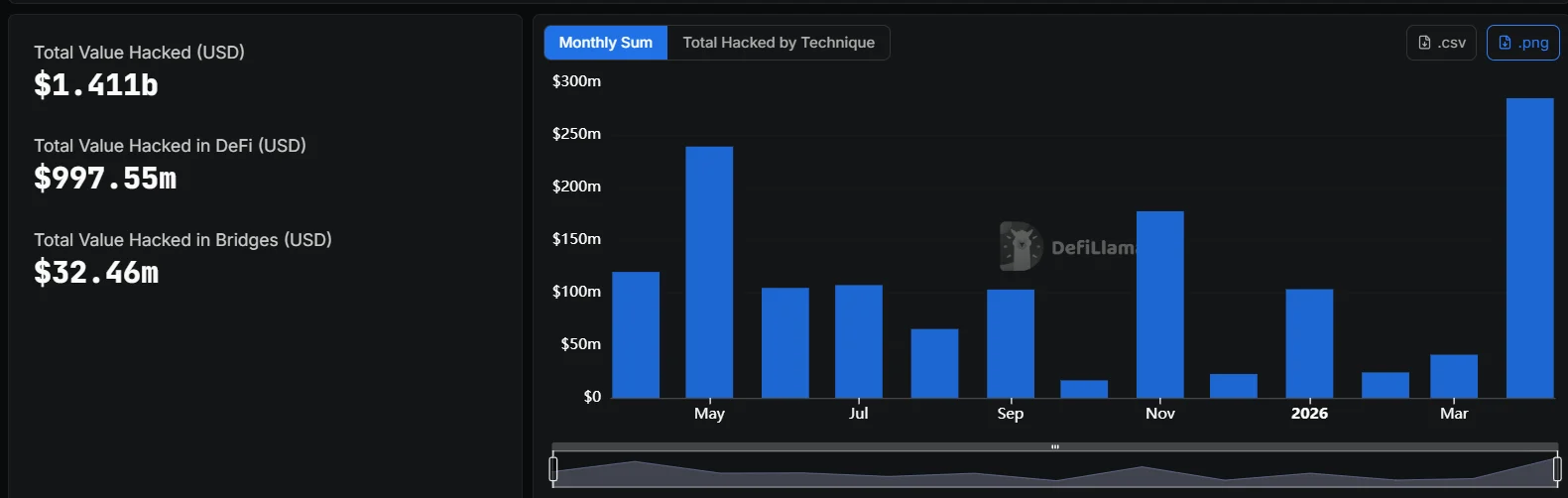
His statements arrive at a particularly relevant moment. The Drift protocol, operating on Solana’s blockchain, suffered a devastating $285 million exploit within the past several days. Seven days prior, another DeFi platform called Resolv experienced a $25 million security breach.
Data compiled by DefiLlama indicates that cryptocurrency losses from theft and exploits surpassed $1.4 billion during the previous year. Guillemet anticipates artificial intelligence will drive these figures even higher.
The fundamental issue centers on changing cybersecurity economics. Historically, defensive measures succeeded because mounting an attack required greater investment than potential gains. Artificial intelligence is dismantling this equilibrium.
Cryptocurrency protocols face particularly acute vulnerability since their smart contract code directly governs substantial financial reserves. Guillemet emphasized the demanding standard: “Perfection is the requirement.”
Dangers in AI-Assisted Development
The challenge extends beyond external threat actors. As software engineers increasingly turn to AI for code generation, security flaws can be embedded into systems from inception.
“No automated solution exists to ensure security,” Guillemet noted. “We’re heading toward widespread deployment of inherently vulnerable code.”
He further described emerging malware variants that systematically search infected mobile devices for wallet recovery phrases. Once located, attackers can empty accounts without requiring any victim interaction.
This evolution makes threats significantly harder to identify and prevent through conventional security measures such as third-party code reviews.
Recommended Defense Strategies
Guillemet advocated for formal verification methodologies as superior alternatives to conventional auditing practices. This technique employs mathematical proofs to validate code behavior, substantially reducing the possibility of undetected vulnerabilities.
He also emphasized the protective value of hardware wallet solutions. By maintaining private keys on isolated devices with no internet connectivity, users minimize exposure to remote attack vectors.
“A specialized device isolated from internet access offers inherently superior security,” he stated.
For typical cryptocurrency participants, his guidance was unambiguous: never presume the platforms you interact with are impenetrable.
“The vast majority of systems you depend on cannot be trusted,” Guillemet cautioned.
He predicts market bifurcation ahead. Wallet providers and established protocols will likely allocate resources toward enhanced security infrastructure and evolve their defenses. General-purpose software platforms may struggle to maintain comparable protection levels.
The latest major incident reinforces his warnings. This week’s $285 million Drift compromise ranks among 2026’s most significant cryptocurrency thefts to date.
