



A shift is underway in online gambling that goes deeper than new platforms entering the market. The way players evaluate and choose where to play has fundamentally changed. Brand loyalty is giving way to feature comparison. Habit is giving way to research. And the biggest names in the industry, including FanDuel, are discovering that name recognition alone no longer guarantees that players will stay put. Search activity around FanDuel alternatives has been climbing steadily, and the platforms capturing that attention look very different from what the industry considered standard just a few years ago. ZunaBet, a crypto-first casino and sportsbook that launched in 2026, has become one of the most visible names in this emerging category for reasons that become obvious once you look at what it actually offers.
Contents
FanDuel: What It Built and Where It Plateaus
FanDuel deserves credit for what it accomplished. It took a daily fantasy sports concept, built a massive user base around it, and parlayed that foundation into a full-fledged sportsbook and online casino as US regulations opened the door. The platform now holds licenses across a wide range of US states and remains one of the most downloaded gambling apps in the country. Its brand is everywhere — on television, in stadium signage, embedded in the sports media landscape through partnerships and sponsorships.
The core product is solid. The sportsbook handles major American leagues comprehensively — NFL, NBA, MLB, NHL — along with international football, tennis, golf, and combat sports. The casino section features a selection of slots, blackjack, roulette, baccarat, and live dealer options sourced from established providers. The mobile experience is clean and responsive. FanDuel knows how to build software that works.

Payments follow the well-worn path of traditional finance. Players move money in and out through bank accounts, debit and credit cards, PayPal, Venmo, and similar services. For the audience FanDuel built its business around, these methods are familiar and acceptable.
The problem is not that FanDuel does anything poorly. The problem is that the standard it set is no longer the standard the market measures by. Game libraries numbering in the hundreds feel limited when competitors offer ten thousand or more. Points-based loyalty programs feel generic when alternatives offer gamified progression systems. And traditional payment processing feels slow and expensive when an entire generation of players has become accustomed to moving value instantly through blockchain networks. FanDuel is a product of its era. It is an excellent product of that era. But the era is changing.
ZunaBet: Designed for What Players Want Now
ZunaBet arrived in 2026 with the stated intention of building something that looked forward rather than backward. Owned by Strathvale Group Ltd and operated by a team whose combined experience in the gambling industry exceeds 20 years, the platform holds an Anjouan gaming license and is registered in Belize. It describes itself as a crypto-first platform, and that description is accurate in both philosophy and execution.
The game library tells the story immediately. ZunaBet launched with 11,294 games spanning 63 providers. That is a staggering number for any platform at any stage, let alone a new entrant. The provider list includes some of the biggest and most respected studios in the business. Pragmatic Play, Evolution, Hacksaw Gaming, Yggdrasil, and BGaming headline the roster, but there are dozens more filling out a catalog that offers extraordinary depth. Slots account for the largest portion of the library, as is typical across the industry, but the selection of RNG table games is substantial and the live dealer section provides a premium experience powered by top-tier providers.
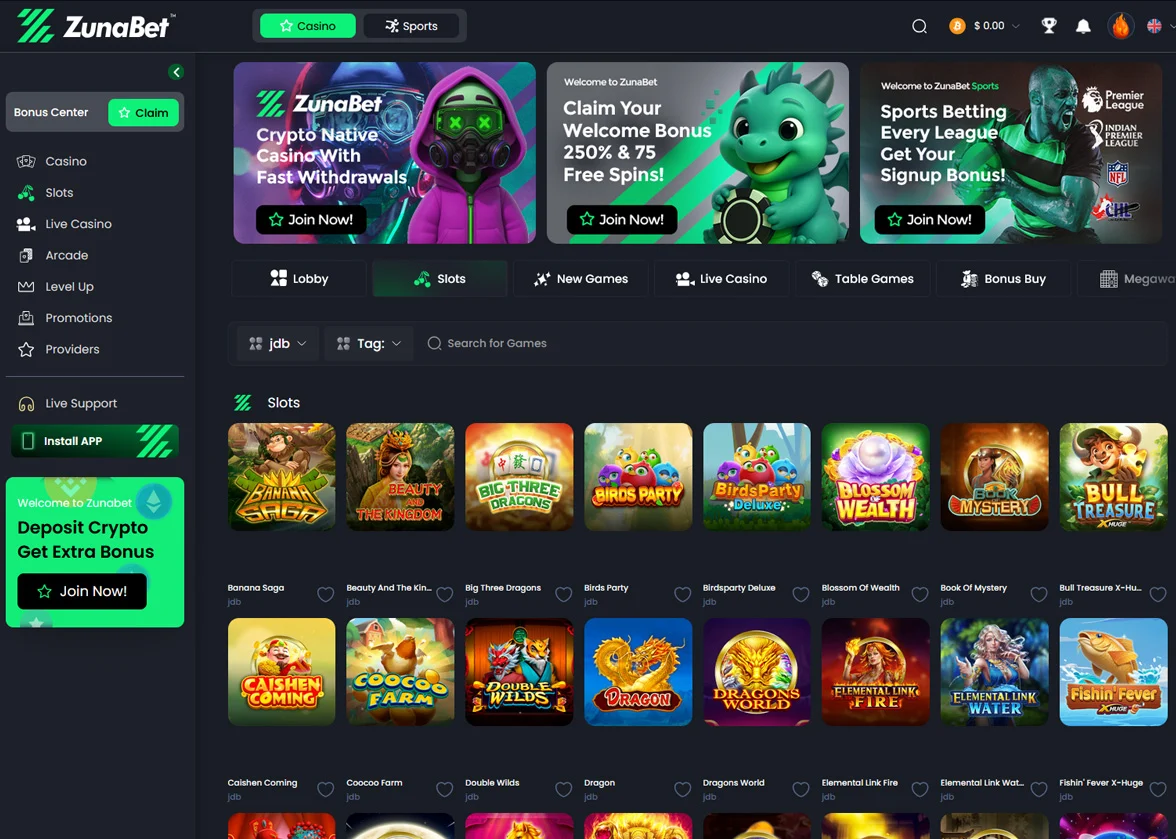
Having this many games from this many providers matters because it eliminates one of the most common frustrations players experience — running out of content. On platforms with smaller libraries, players cycle through the available titles quickly and either replay games they have already tried or move to a different platform. ZunaBet makes that scenario unlikely. There is simply too much to explore for any single player to exhaust the options, which keeps the experience fresh over extended periods of engagement.
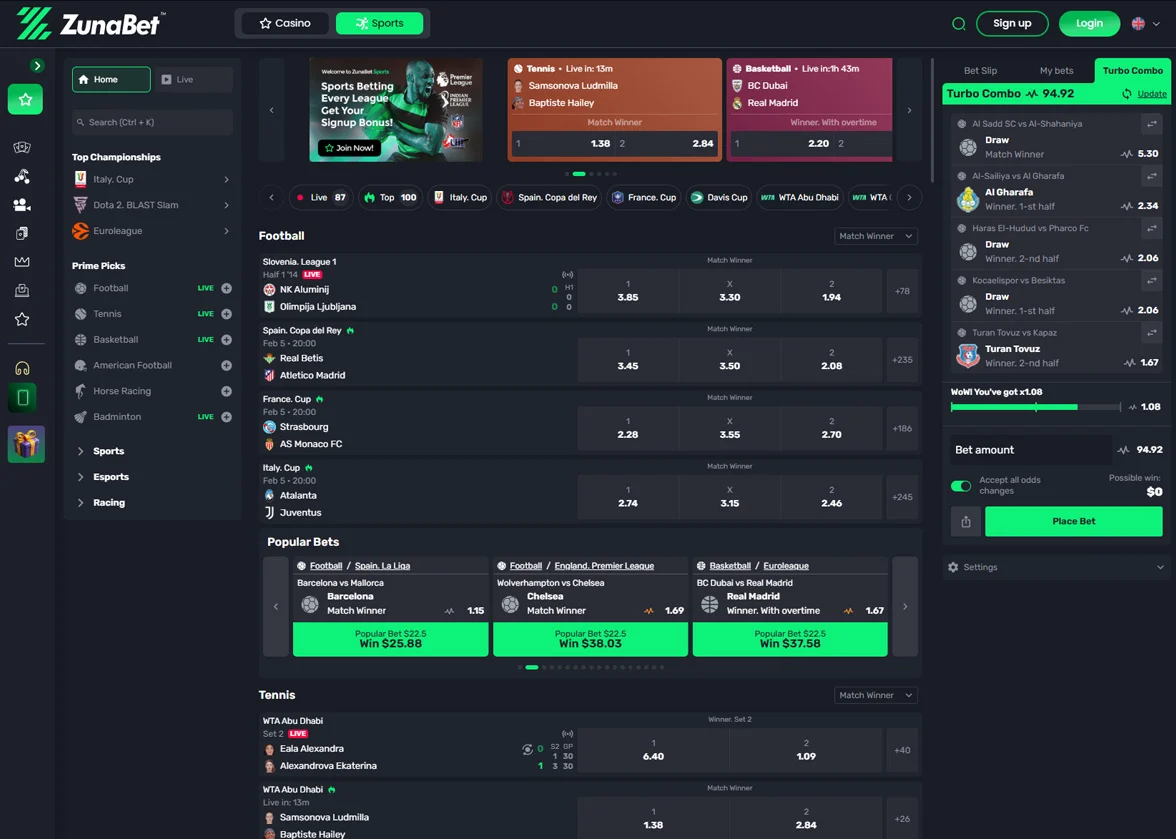
The sportsbook operates as a complete standalone product sharing the same account and wallet. Coverage includes football, basketball, tennis, NHL, combat sports, and virtual sports. Esports receives dedicated attention with active markets covering CS2, Dota 2, League of Legends, and Valorant. The decision to give esports equal billing alongside traditional sports reflects an understanding of how the betting audience is evolving. Competitive gaming draws millions of viewers globally, and the betting market around it is expanding rapidly. ZunaBet positioned itself early to capture that growth, which gives it an advantage over traditional operators that have been slow to take esports seriously.
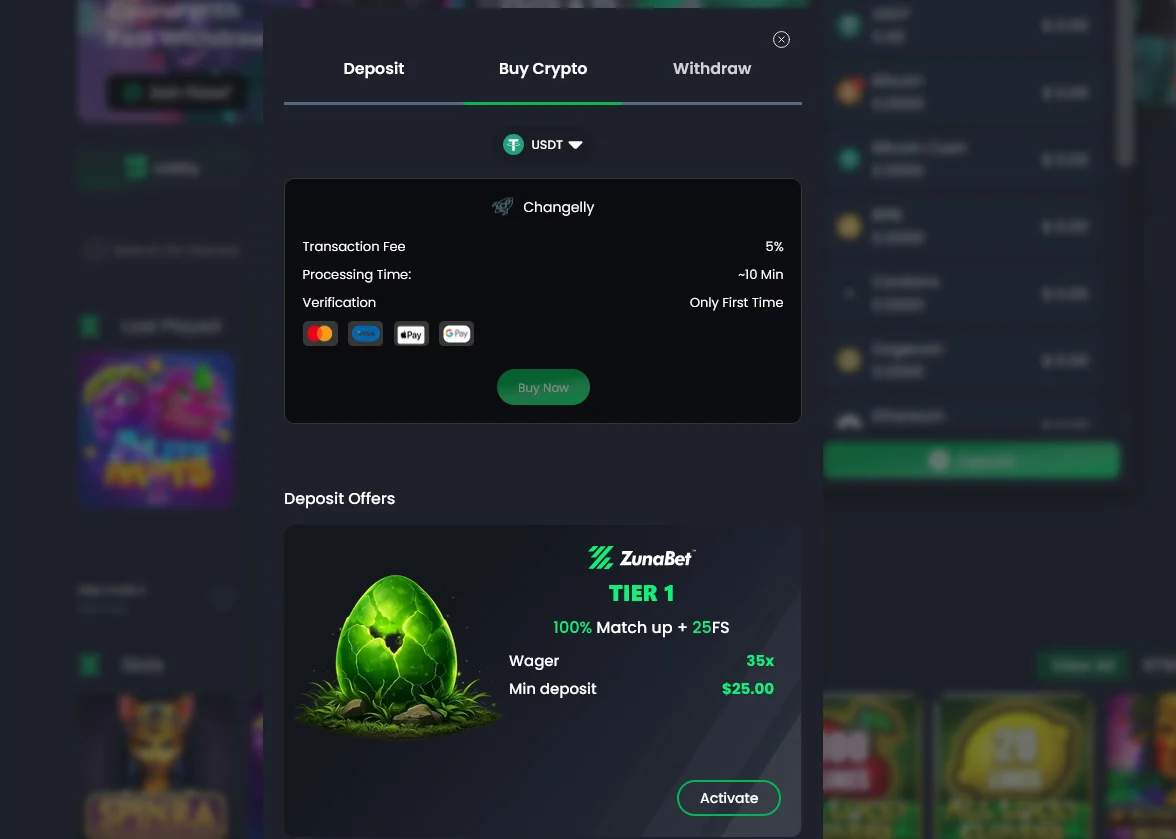
The entire payment system is built on cryptocurrency. ZunaBet accepts more than 20 different coins and tokens — Bitcoin, Ethereum, USDT across multiple blockchain networks, Solana, Dogecoin, Cardano, XRP, and a range of others. No platform processing fees are charged on any transaction. Withdrawals are designed around speed, leveraging the inherent efficiency of blockchain settlement to get money back to players without the delays that characterize traditional banking methods.
New players are greeted with a welcome package worth up to $5,000 plus 75 free spins. The package is distributed across three deposits to maintain engagement over time. The first deposit qualifies for a 100% match up to $2,000 plus 25 free spins. The second deposit receives a 50% match up to $1,500 plus 25 free spins. The third deposit rounds out the offer with a 100% match up to $1,500 plus 25 free spins. Spreading the bonus across multiple deposits is a deliberate design choice that encourages players to settle into the platform rather than grabbing a single bonus and disappearing.
On the technical side, ZunaBet uses HTML5 across a dark-themed interface that loads quickly and works smoothly on any screen size. Native apps exist for iOS, Android, Windows, and MacOS. Live chat support is staffed 24 hours a day, seven days a week, covering every time zone without gaps.
What Crypto Payments Mean in Practice
The distinction between crypto and traditional payments is not abstract. It shows up in the daily experience of using a platform in ways that matter to real players making real transactions.
Consider a standard withdrawal scenario on a traditional platform. A player requests a cashout on Friday evening. The platform reviews the request, which may take anywhere from a few hours to a full business day. The withdrawal then enters the banking system, where it joins a queue that does not move on weekends or holidays. The funds might arrive in the player’s account by Tuesday or Wednesday of the following week. Along the way, the bank or payment processor may take a fee. Multiply this experience across dozens of transactions over a year and the cumulative cost in both time and money becomes significant.
Now consider the same scenario on ZunaBet. The player requests a withdrawal on Friday evening. The transaction is processed and confirmed on the blockchain. The funds arrive in the player’s crypto wallet within minutes. It does not matter what day of the week it is. It does not matter what time zone the player is in. There are no intermediary fees charged by the platform. The process is the same at midnight on a holiday as it is at noon on a Tuesday.
This consistency is only possible because ZunaBet was designed around crypto from its foundation. Platforms that add crypto support on top of an existing traditional payment system inevitably create a two-tier experience where crypto users navigate an interface that was originally designed for fiat transactions. ZunaBet avoids that entirely because crypto was never an add-on. It is the system.
Global cryptocurrency adoption continues to grow at a significant pace. As more people hold and transact in digital currencies, platforms built natively for crypto will find their addressable market expanding naturally without needing to retrofit their infrastructure. ZunaBet is already positioned to benefit from that trajectory.
Rethinking What a Loyalty Program Can Be
The typical online casino loyalty program is a spreadsheet wearing a marketing hat. Players earn points through wagering. Points accumulate toward thresholds. Crossing a threshold delivers a bonus or a modest perk. The mechanics are transparent, predictable, and almost completely unengaging. Players participate because the rewards exist, not because the experience of earning them is interesting.
ZunaBet replaced this model with a dragon evolution system that borrows its structure from video game progression. The system has six tiers — Squire with 1% rakeback, Warden at 2%, Champion at 4%, Divine at 5%, Knight at 10%, and Ultimate at 20%. Each tier adds layers of rewards beyond rakeback. Free spins scale from modest amounts at lower tiers up to 1,000 at the top. VIP club access opens at higher levels. Double wheel spins add another incentive to keep progressing. And a dragon mascot named Zuno provides a visual anchor for the entire journey, evolving in form as the player climbs through each stage.
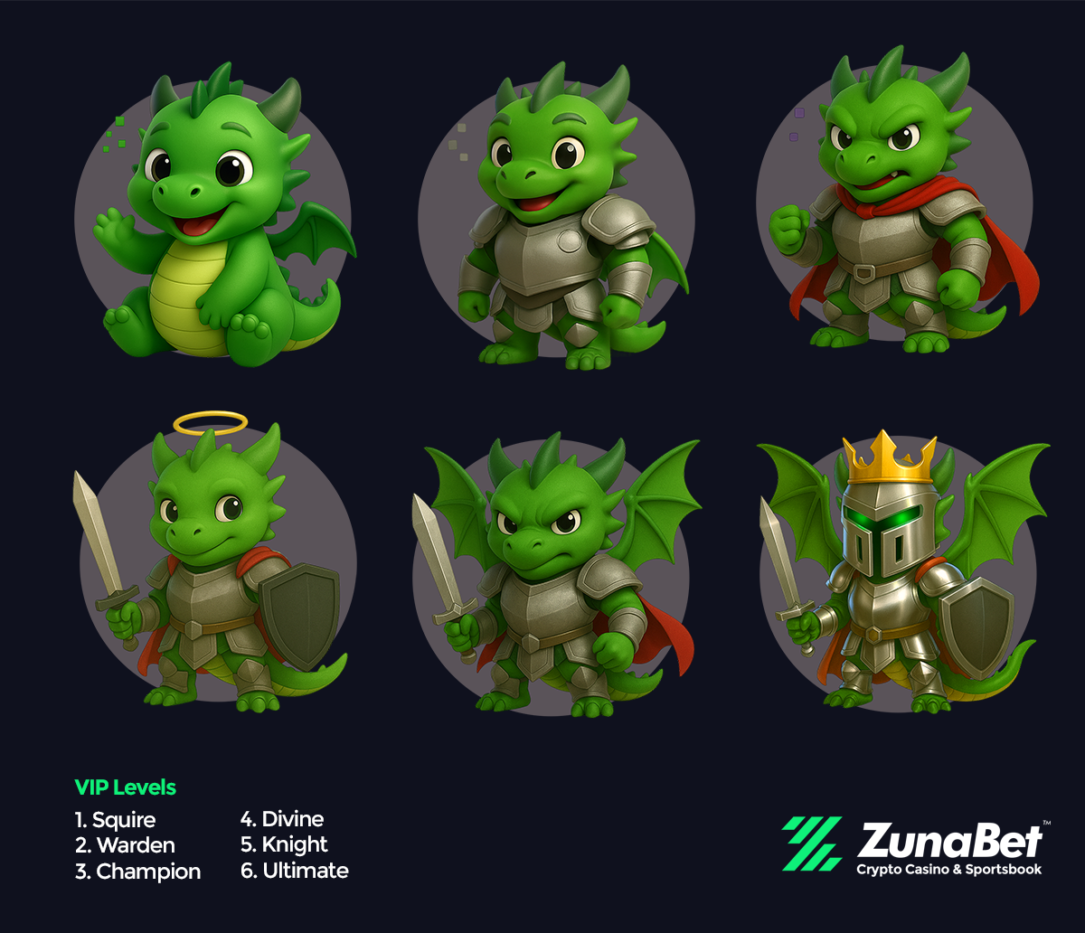
What makes this work is not just the rewards themselves but the way the system frames the pursuit of those rewards. Progression is visible. Goals are clearly defined. Reaching a new tier feels like an accomplishment rather than a transaction. The experience taps into the same psychology that makes video game leveling systems so effective at sustaining engagement over time. Players do not just participate in the loyalty program. They invest in it emotionally because the structure gives them something to work toward that feels meaningful.
In a market where differentiation is increasingly difficult, a loyalty system that players genuinely care about is a significant asset. ZunaBet identified an area where the entire industry had settled for mediocrity and built something that actually stands apart.
Reading the Search Trends
The sustained increase in searches for FanDuel alternatives carries a straightforward message. Players have options and they intend to use them. FanDuel remains a major force in the markets where it operates, and it will likely remain one for years to come. But the gravitational pull of established brands weakens every time a new platform demonstrates that there is a better way to handle payments, a more exciting way to structure loyalty, or a more comprehensive way to build a game library.
ZunaBet is doing all three simultaneously. It launched with more games than most operators accumulate in a decade. It processes payments faster and cheaper than traditional infrastructure allows. It built a loyalty program that players actually talk about. And it did all of this while positioning itself at the intersection of online gambling and cryptocurrency — two industries whose audiences overlap more with every passing year.
The players driving the search trend are not dissatisfied customers looking to complain. They are informed consumers looking for the best available option. Increasingly, what they find when they look is ZunaBet. That pattern is not accidental, and based on what the platform delivers, it is not likely to reverse anytime soon.
