



A DeFi protocol launches with a genuinely novel approach to cross-chain lending. The smart contracts are audited. The documentation is thorough. The rates beat every competitor. Six months later, total value locked sits at a fraction of what inferior protocols hold — protocols that launched earlier, got covered by three crypto news sites in their first week and never looked back.
An NFT platform ships creator tools that artists have been requesting for years. Customisable royalty splits. On-chain provenance tracking. A curation system that actually works. The platform attracts a loyal core of early users who rave about it in Discord. But the broader market of creators and collectors never hears about it because no publication they read has ever mentioned it.
A Web3 infrastructure project builds a data availability solution that halves costs for every rollup that integrates it. Two integrate. Dozens of others continue using a competitor that costs more and performs worse — because the competitor has articles on every major crypto and technology publication and the better project has none.
These are not hypothetical scenarios. They are happening across the DeFi, NFT and Web3 sectors right now. And they all share the same root cause: media invisibility.
Kooc Media, a PR distribution agency specialising in crypto, fintech, technology and iGaming since 2017, works with projects exactly like these. The agency provides guaranteed article placements on its own network of established news publications and distributes content through major business and finance newswire services. The goal is simple: make excellent projects findable by the audiences that should already know about them.
“We are not in the business of creating hype for empty projects,” said Michelle De Gouveia, spokesperson for Kooc Media. “We are in the business of making sure projects that have done the hard work of building something good get the visibility they have earned.”
Contents
The Attention Tax on Late Arrivals
Being first to market in DeFi, NFTs or Web3 provides an advantage that has nothing to do with technology and everything to do with information architecture. The first projects in any category accumulate media coverage simply by being new. Journalists cover them because there is nothing else to compare them to. Those early articles get indexed by search engines. They rank for the category keywords. They become the reference points that every subsequent article in the space links back to.
By the time a second or third project launches in the same category — even if it is technically superior — the information landscape is already occupied. Search results for the relevant keywords show the first movers. Journalists who covered the first project feel they have already written that story. The new project has to fight for attention that the incumbents received for free simply by being earlier.
This creates a compounding disadvantage. Less coverage means lower search visibility. Lower search visibility means fewer users discover the project organically. Fewer users means less traction. Less traction makes journalists even less interested in covering a project that appears to be losing to established alternatives.
Breaking this cycle requires deliberate, guaranteed media placement on publications with enough domain authority to compete in search results against the articles that already exist. This is precisely what Kooc Media’s crypto PR services deliver.
Publication Ownership Eliminates Uncertainty
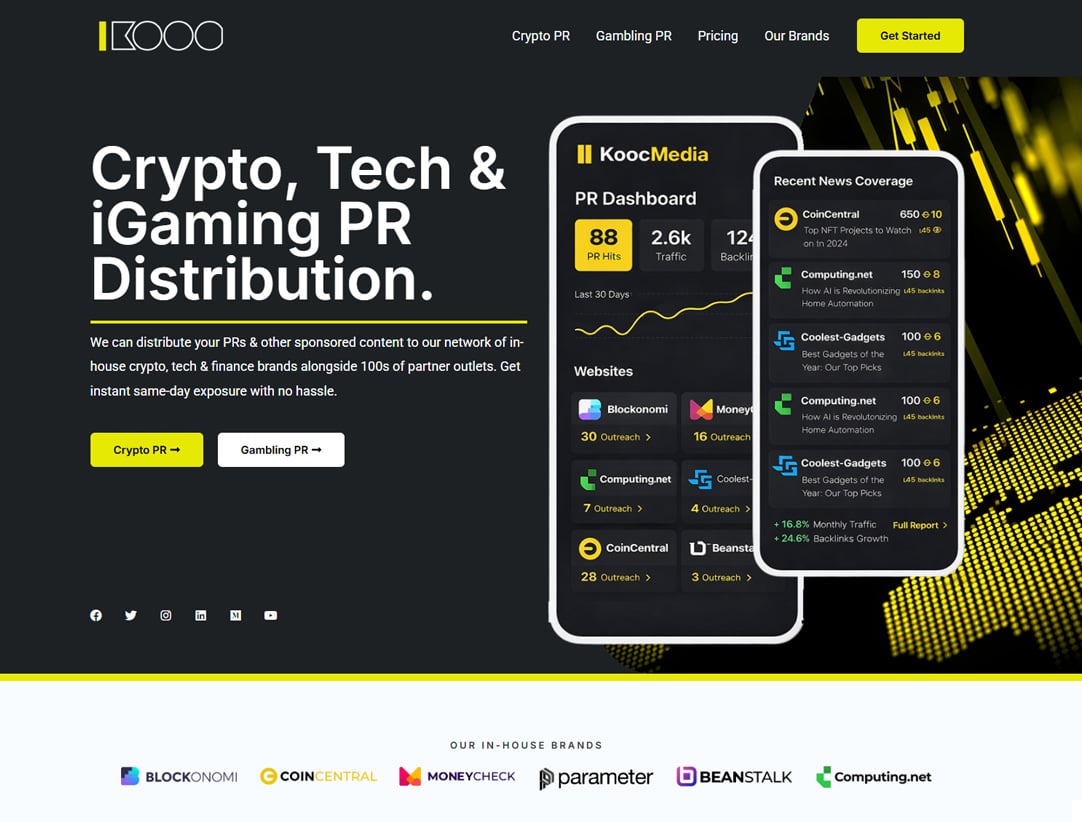
Kooc Media can guarantee results because it does not depend on external publications to deliver them. The agency owns and operates Blockonomi, CoinCentral, MoneyCheck, Parameter, Beanstalk and Computing — established news websites with years of daily content, strong domain authority, organic search traffic and genuine readerships spanning crypto, finance and technology.
When a DeFi protocol, NFT platform or Web3 project books a campaign, the publications carrying the article are confirmed before commitment. The content is produced by Kooc Media’s specialist editorial team and published directly — usually within hours. The client receives live links to each placement. The article is live, readable and permanent.
No journalist pitching. No editorial gatekeeping by people who may not understand concentrated liquidity positions or recursive zero-knowledge proofs. No paying a retainer for three months and having nothing to show for it. The published article on a named, established site is the deliverable. If it does not get published, the client does not pay.
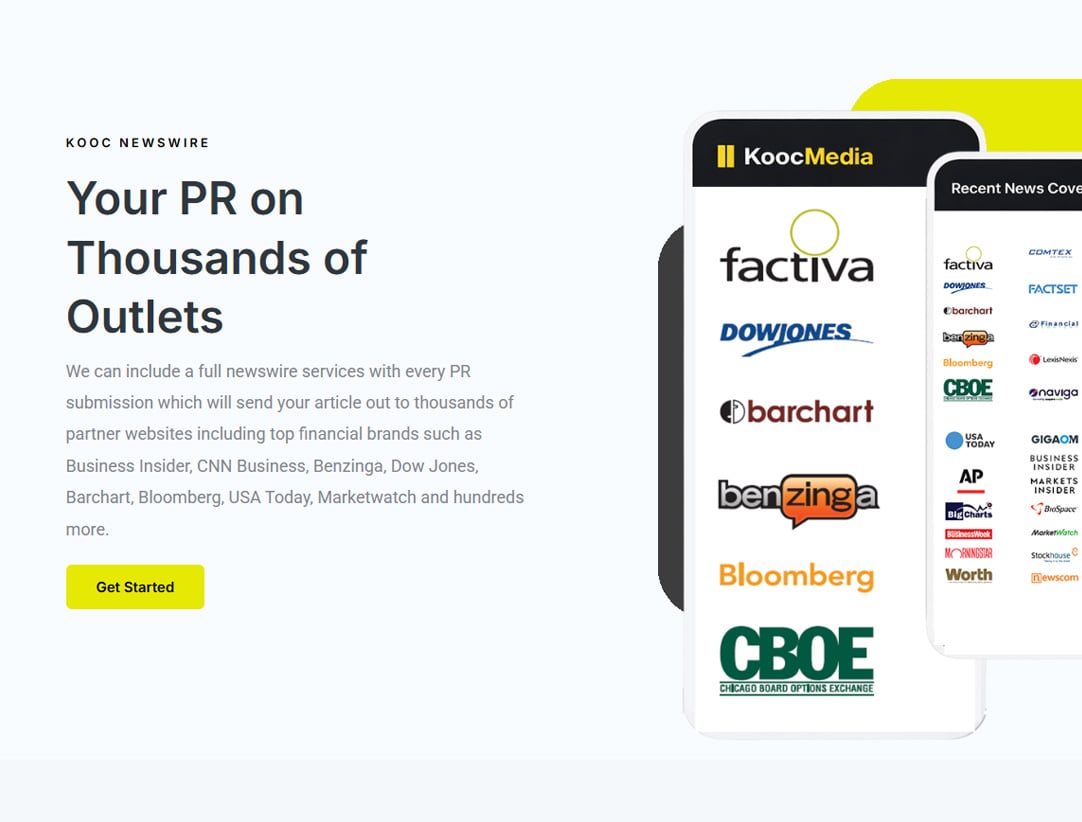
For mainstream exposure, Kooc Media distributes press releases through major newswire networks. Depending on the package, articles land on outlets including Business Insider, Bloomberg, Benzinga, MarketWatch, USA Today and Dow Jones feeds. A DeFi protocol approaching pension funds, an NFT platform pitching a collaboration with a fashion house or a Web3 project negotiating with enterprise IT departments can all use mainstream media presence to signal that they are serious businesses operating in legitimate markets.
Transparent reporting is standard. Live links. Named publications. Nothing to interpret.
Each Sector Gets Its Own Campaign
Kooc Media has spent years learning what works for DeFi, NFT and Web3 projects individually. The three sectors share a technology layer but share almost nothing else. Their users are different people with different motivations who read different publications and respond to different messages.
DeFi campaigns speak directly to capital allocators. A liquidity provider choosing between decentralised exchanges needs to see trading volume, chain support, LP incentive structures, impermanent loss mitigation and security audit results. A lender evaluating protocols needs interest rate curves, collateral options, liquidation mechanics and historical utilisation data. A treasury manager considering yield strategies needs composition details, risk modelling, backtested returns and dependency analysis. Kooc Media’s DeFi content delivers the specific, quantitative information these decision-makers require. Anything less precise wastes their time and the client’s money.
NFT campaigns speak to creators and communities. An artist considering a new marketplace needs to understand the minting experience, fee structure, royalty enforcement, discoverability tools and community character. A gamer evaluating an NFT platform needs gameplay descriptions, asset utility explanations, earning potential and cross-game portability details. A collector exploring a new platform needs rarity mechanics, trading features and community engagement opportunities. Kooc Media’s NFT content connects with these audiences through experience and story rather than raw specifications.
Web3 campaigns translate invisible infrastructure into tangible benefit. A developer evaluating a new storage solution needs benchmarks, pricing models, integration guides and reliability data. An enterprise buyer assessing a decentralised identity system needs compliance information, existing deployments, interoperability specifications and security certifications. A startup considering a new data availability layer needs to understand what their application can do with it that was not possible before. Kooc Media’s Web3 content makes the abstract concrete.
“We have covered all three sectors long enough to know that a message designed for a DeFi trader will bounce off an NFT artist completely,” said De Gouveia. “Every campaign we build starts with understanding who needs to read it and what will make them care.”
Technical Accuracy Is Not Optional
The audiences for DeFi, NFT and Web3 coverage are among the most technically demanding readers in any sector. They will catch errors. They will share them publicly. And they will associate those errors with the project rather than the writer.
A DeFi article that misrepresents how a protocol’s liquidation engine works does not just fail to help the project. It actively damages credibility with the exact users the project needs to attract. An NFT article that confuses token standards signals ignorance of fundamental concepts. A Web3 article that cannot accurately describe a consensus mechanism tells developers that the project itself does not understand what it has built.
Kooc Media’s managed PR creation service prevents these scenarios by keeping all content production in-house with specialist writers. The editorial team covers DeFi mechanisms, NFT ecosystems and Web3 infrastructure daily. They understand the difference between optimistic and zero-knowledge rollups. They know how tick-based liquidity works. They can explain decentralised physical infrastructure networks without resorting to analogies that obscure more than they clarify.
The process is designed to minimise the client’s time investment. The project provides its documentation, announcement and core messages. Kooc Media’s writers produce a finished article that meets both the editorial standards of the target publication and the technical expectations of its readership. For teams that are focused on building and cannot spare resources for marketing content — which describes the vast majority of DeFi, NFT and Web3 projects — this service converts zero internal effort into professional media coverage.
The Permanent Value of Consistent Coverage
Every article published on one of Kooc Media’s high-authority sites creates a permanently indexed page that ranks for relevant search terms. Each page is a new entry point through which potential users, investors and developers can discover the project.
For DeFi projects, those pages rank for decentralised lending, yield farming, DEX trading, liquidity protocol, DeFi platform and countless long-tail variations. For NFT projects, they rank for NFT marketplace, digital art, gaming NFTs, music NFTs, NFT creator platform and related queries. For Web3 projects, they rank for decentralised storage, blockchain identity, Web3 tools, decentralised computing and infrastructure-specific terms.
One article creates one entry point. A sustained campaign that places articles monthly across Blockonomi, CoinCentral, MoneyCheck and potentially Bloomberg, Benzinga and Business Insider creates an expanding network of entry points that grows with every placement. After several months, the project’s brand appears across multiple authoritative domains whenever anyone searches for its category.
This compounding search presence is arguably the single most valuable outcome of sustained PR. The articles published today will drive discovery for years. Each new article reinforces the authority signals from the ones that preceded it. The cumulative effect is a permanent organic visibility channel that operates independently of paid marketing and strengthens with time.
Every month a project delays building this presence is a month its competitors use to extend their own search footprint further. In markets where being discovered first usually means being chosen first — and DeFi, NFTs and Web3 are exactly those markets — starting early is not just advantageous. It is decisive.
About Kooc Media
Kooc Media was founded in 2017 as a specialist PR distribution agency for the crypto, fintech, technology and iGaming industries. The company operates its own network of in-house news websites and a large partner distribution network, delivering guaranteed media coverage across high-authority publications. Services include press release writing, sponsored articles, newswire distribution, homepage placements and full campaign reporting. Kooc Media serves clients across the crypto, fintech and gambling sectors.
Kooc Media’s Crypto PR packages are available now through the company’s website at https://kooc.co.uk.
