



FanDuel helped define what modern online gambling looks like in America. It took daily fantasy sports mainstream, rode the legalization wave into sports betting, and built one of the most-used gambling apps in the country. That is a genuine achievement. But markets do not stop evolving just because someone figured out the current version. A growing number of players are looking at what crypto-native platforms offer and wondering why their current sportsbook cannot do the same. ZunaBet, which launched in 2026, is the platform forcing that question into the open.
Contents
FanDuel: Dominant in Its Domain
FanDuel has been part of the American gambling conversation since its daily fantasy launch in 2009. The pivot to sports betting after 2018 turned it into a powerhouse. Flutter Entertainment’s ownership provides financial muscle that few competitors can match, and the brand has become nearly synonymous with legal sports betting in the US.
The sportsbook product is hard to criticize. Market depth across American and international sports is excellent, odds pricing stays competitive, and the app delivers one of the cleanest mobile betting experiences available anywhere. Casino gaming runs alongside the sportsbook in states that permit it, offering a serviceable collection of slots, table games, and live dealer content. It handles the basics without pretending to be the main attraction.
Financially, FanDuel is a fiat-only operation. Deposits arrive through bank transfers, debit cards, PayPal, Venmo, and the usual selection of mainstream payment tools. Withdrawals depend on the same channels and the same institutions, which means processing speeds are out of FanDuel’s hands once a request leaves the platform. Sometimes the money shows up the same day. Sometimes it takes considerably longer.
New player incentives focus primarily on sportsbook activity. Bonus bets and variations on protected first wagers are the standard tools. Casino promotions are less prominent and carry lower value. The loyalty program converts play into points that become bonus bets and credits over time. It functions within Flutter’s broader reward network and mirrors what virtually every other large US sportsbook does with its regulars.
FanDuel is a tier-one product for regulated US sports betting. That much is not debatable. What is worth examining is whether tier-one in that specific category still means tier-one across the broader gambling landscape.
ZunaBet: Rethinking the Entire Package
ZunaBet was created by Strathvale Group Ltd, licensed in Anjouan, and brought to market in 2026 by a team whose members collectively carry over 20 years of gambling industry experience. It did not grow out of another product or pivot from a different business. The entire platform was conceived as a crypto-first casino and sportsbook, and every decision about its design reflects that starting point.
Game selection immediately communicates ambition. ZunaBet holds over 11,000 titles from 63 providers in its library. Pragmatic Play, Evolution, Hacksaw Gaming, Yggdrasil, and BGaming lead the list, supported by dozens of additional studios spanning slots, RNG table games, and live dealer rooms. FanDuel’s casino catalog is a small fraction of that figure even in states where it operates a full casino product. For players who consider game variety a priority, there is no comparison between the two.
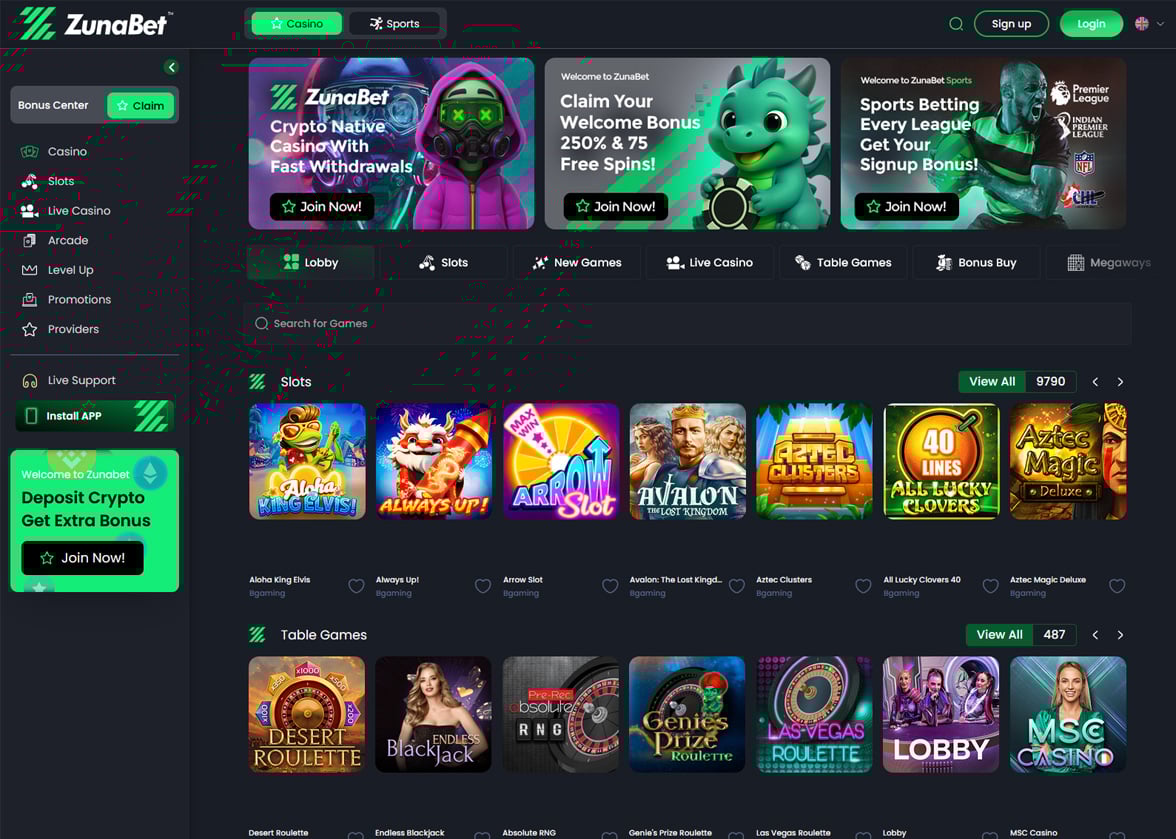
Sports betting occupies an equal position on the platform rather than serving as either the primary or secondary product. ZunaBet covers football, basketball, tennis, NHL, combat sports, and virtual sports. Its esports section provides serious market coverage for CS2, Dota 2, League of Legends, and Valorant — a category that FanDuel and most traditional operators continue to underserve. FanDuel retains a natural advantage in American league coverage and brand integration with domestic sports. ZunaBet compensates with broader global reach and a genuine commitment to esports as a betting vertical.
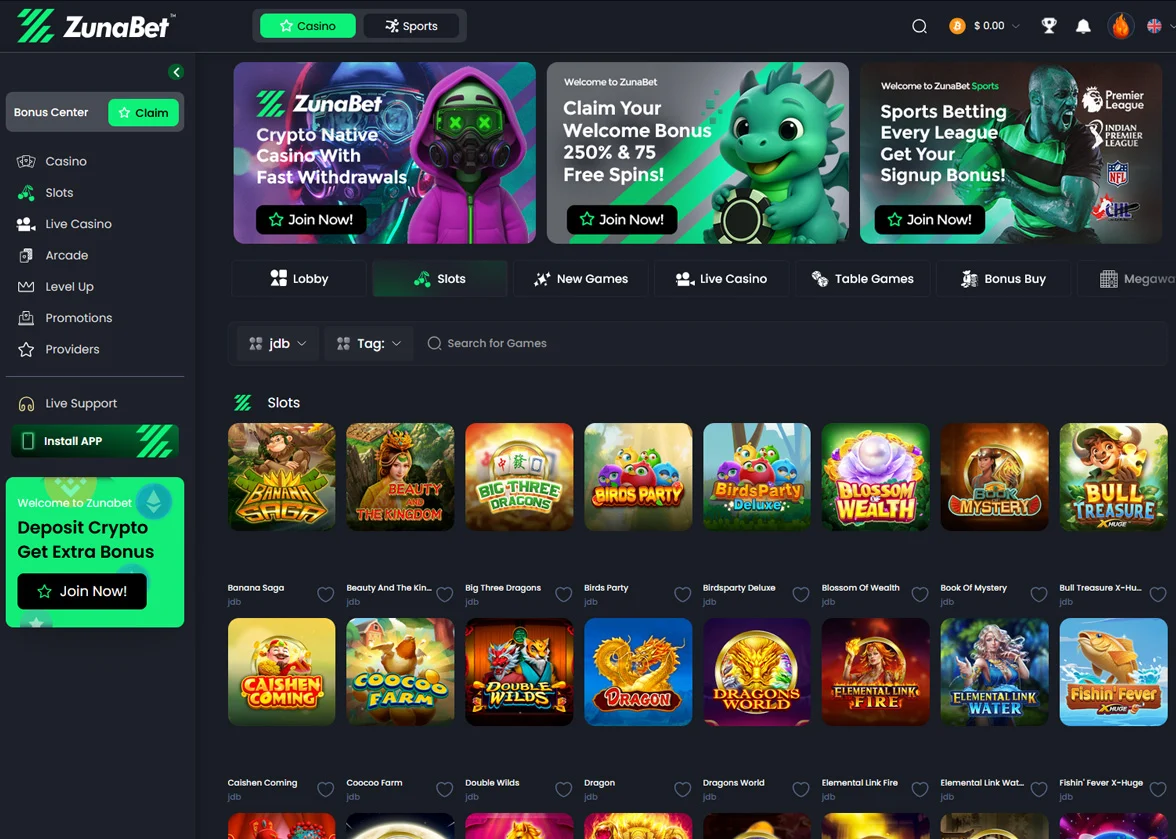
Cryptocurrency runs through every layer of the platform. Over 20 coins are accepted, including BTC, ETH, USDT on multiple blockchains, SOL, DOGE, ADA, XRP, and others. ZunaBet does not levy processing fees and handles withdrawals with the kind of speed that only becomes possible when banks are removed from the process
entirely. The payment experience alone separates ZunaBet from FanDuel more clearly than any other single factor.
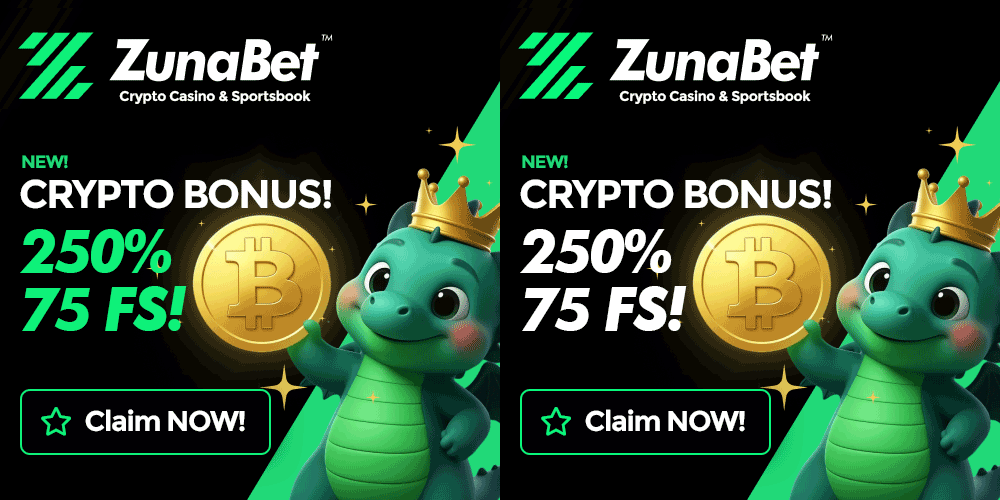
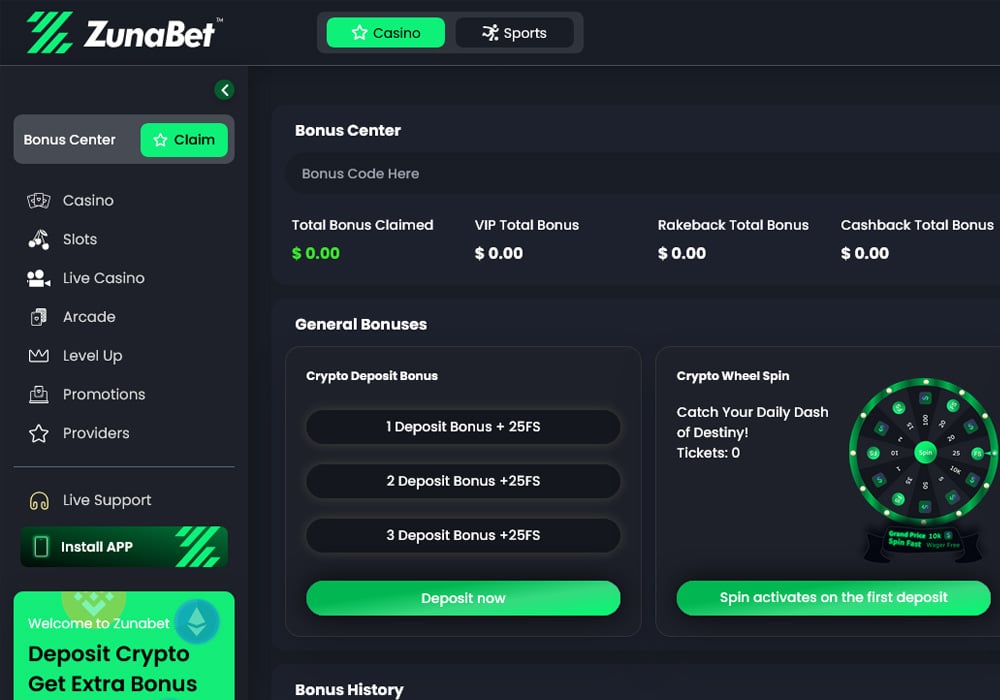
New accounts receive a welcome bonus totaling up to $5,000 in matched deposits plus 75 free spins across three deposits. That unfolds as a 100% match up to $2,000 with 25 spins on the first deposit, a 50% match up to $1,500 with 25 spins on the second, and a 100% match up to $1,500 with 25 spins on the third. FanDuel’s casino onboarding does not compete at this level.
The platform is built on modern HTML5 with a dark-themed design, quick load times, and fully responsive layout. Dedicated apps are available for iOS, Android, Windows, and MacOS. Live chat support operates continuously.
Rewards Programs That Reveal Priorities
How a platform structures its loyalty program tells you who it thinks its core audience is and what it believes keeps them engaged.
FanDuel answers that question with a points-for-credits system embedded in the Flutter rewards ecosystem. Bet, earn points, exchange them for bonus bets or site credit. Status levels exist but are geared toward sportsbook volume. The entire system runs quietly in the background, giving regular players something back without ever demanding their attention or sparking their interest. It is efficient in the same way that a utility bill is efficient — it does what it needs to do without anyone looking forward to it.
ZunaBet saw loyalty as an opportunity to build something players would actually talk about. Its dragon evolution program follows a mascot called Zuno through six tiers — Squire, Warden, Champion, Divine, Knight, and Ultimate. Rakeback grows from 1% to 20% across that progression. Free spins increase to 1,000 at the top levels. VIP club access and double wheel spins arrive as players advance.
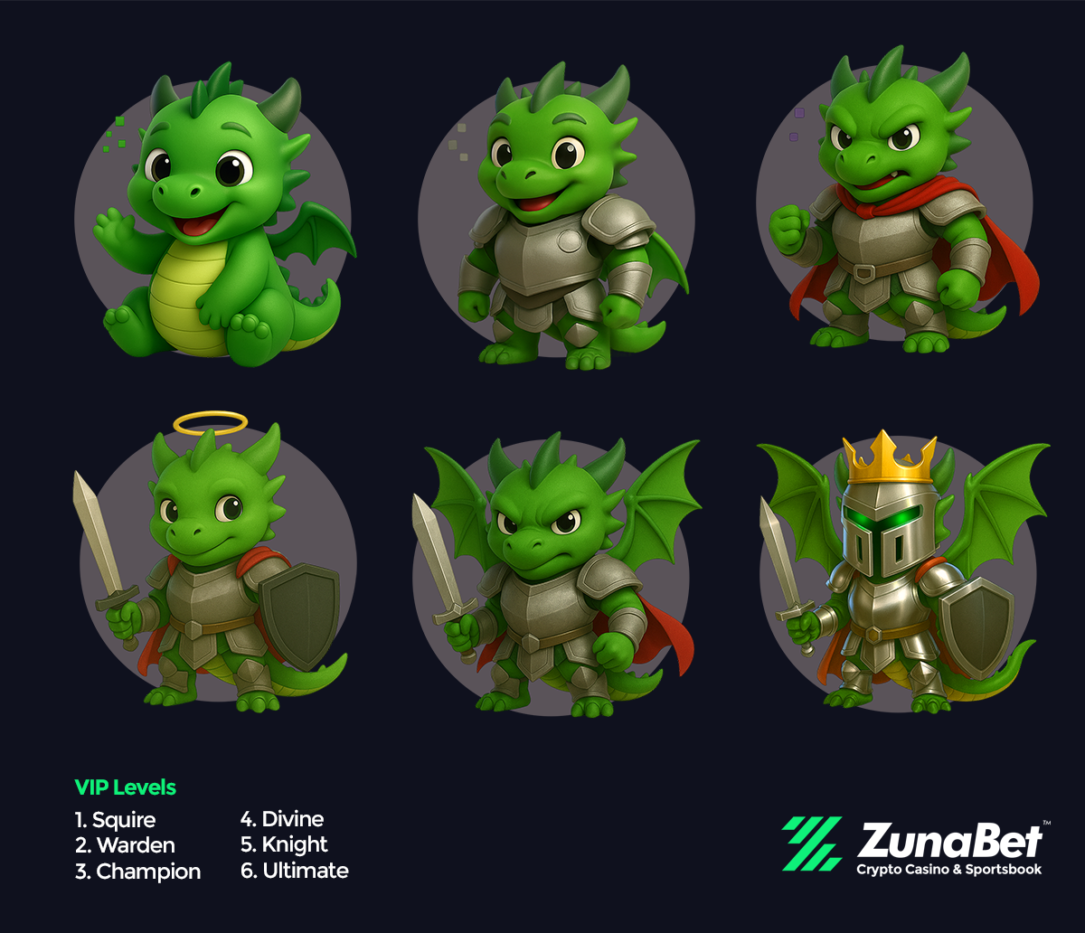
The system is built on visible, goal-driven progression. Players can see exactly where they stand, exactly what reaching the next tier requires, and exactly what it unlocks. That transparency combined with the gamified presentation creates genuine motivation to keep playing and advancing. It draws directly from how progression systems work in video games — clear paths, tangible rewards, and a constant sense of forward movement. FanDuel’s loyalty program tells you what you have earned. ZunaBet’s loyalty program shows you what you are building toward. The psychological difference between those two experiences is enormous.
The Transaction Experience Gap
Money is the most practical thing about gambling, and how a platform handles it shapes every interaction a player has.
FanDuel routes all transactions through established financial institutions. Deposits come from bank accounts and cards. Withdrawals return through the same channels. Every step involves a third party with its own timeline, its own verification processes, and its own fee structures. The player initiates a withdrawal and then waits for a chain of institutions to pass it along. Some days that chain moves quickly. Other days it does not. The player has no control over which day they get.
ZunaBet operates without that chain. Cryptocurrency moves between the player and the platform directly. No bank approves it. No processor batches it. No fee gets skimmed from it. Deposits confirm on the blockchain and appear in the account. Withdrawals follow the same path back to the player’s wallet. The experience is consistent every single time because there are no external variables to introduce inconsistency.
Players who have only ever used traditional payment methods may not immediately appreciate what that difference feels like in practice. Players who have used both systems rarely want to go back. The speed, the predictability, and the absence of fees create a transaction experience that makes bank-based withdrawals feel like an unnecessary inconvenience. As crypto adoption continues to broaden, the number of players who share that perspective will only increase.
FanDuel’s audience is defined by geography and regulation. American sports bettors in licensed states who use dollars and bank accounts and want to bet on NFL games through a polished app. That audience is massive and profitable, and FanDuel serves it better than almost anyone else.
ZunaBet’s audience is defined by behavior and preference. Players around the world who transact in crypto, who want access to tens of thousands of games, who bet on esports as naturally as they bet on basketball, and who respond to gamified progression systems that feel personal and engaging. That audience crosses borders and demographics, and it is growing in a way that no traditional operator can easily capture without fundamentally restructuring how their platforms work.
These two audiences overlap more than they used to. The American sports bettor who also holds Ethereum. The esports fan who also follows the NBA. The player who would happily use their existing sportsbook for everything if it supported crypto and had more than a few hundred casino games. Every one of those overlapping players represents someone whose needs are partially met by FanDuel and more fully met by ZunaBet.
The Takeaway
FanDuel earned its place at the top of US sports betting through smart execution at the right moment in regulatory history. It remains a world-class sportsbook and a dominant brand. That reality is not changing anytime soon.
But ZunaBet represents something that FanDuel and platforms like it are not equipped to offer — a gambling experience designed from the ground up for players whose habits and expectations were shaped by crypto wallets and gaming culture rather than bank accounts and broadcast sports. Over 11,000 games from 63 providers, more than 20 cryptocurrencies with zero fees, a $5,000 welcome package, a sportsbook with legitimate esports depth, native apps everywhere, and a loyalty program that makes progression feel meaningful rather than mechanical.
FanDuel helped create the market that exists today. ZunaBet looks like it was built for the market that is taking shape tomorrow. For players trying to decide which direction to face, that distinction matters more with each passing month.
