



TLDR
- Over 34.9 million XRP tokens were withdrawn from exchanges in what marked the 6th-highest outflow day of 2026
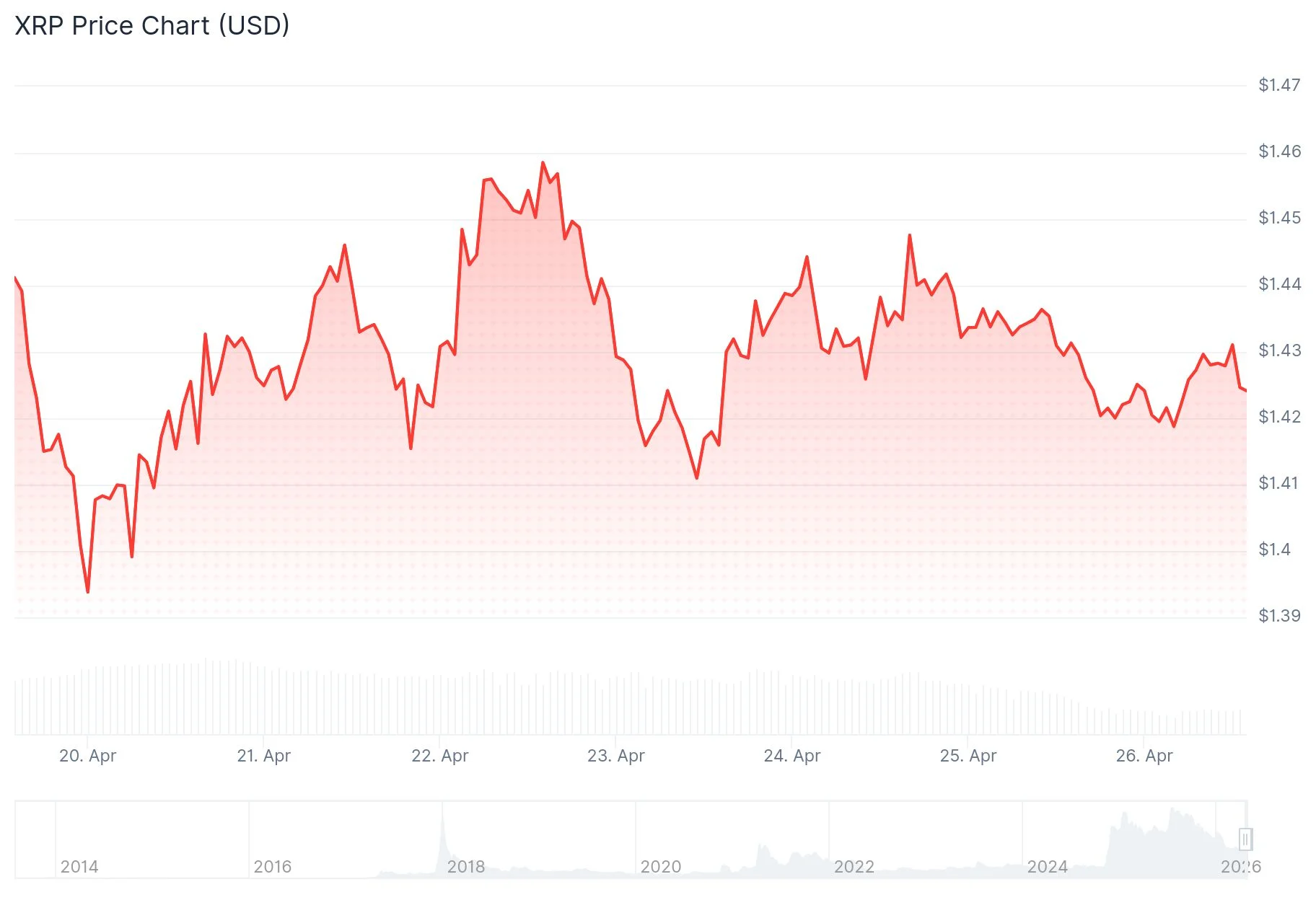
- The token is range-bound between $1.37 and $1.45, with $1.60 representing the critical resistance threshold
- A bullish MACD crossover occurred in mid-April, the first since January when XRP surged 25%
- The XRP Ledger captured $1.1 billion in 30-day net capital inflows, surpassing Ethereum and all other major blockchains
- Both the SEC and CFTC officially designated XRP as a digital commodity on March 17, 2026
Multiple bullish indicators are converging around XRP, though price action remains confined within a narrow trading band. The digital asset continues to consolidate while several technical and on-chain metrics suggest potential upside momentum is building.
A significant surge in exchange withdrawals has caught the attention of market observers. According to Santiment analytics, XRP experienced its 6th-largest single-day outflow of 2026, with more than 34.9 million tokens migrating off centralized platforms. Such movements typically indicate holders are moving assets into cold storage rather than preparing to sell, effectively reducing liquid supply available for trading.
Historical patterns show these withdrawal spikes often coincide with local price floors or the early stages of trend reversals. However, outflows represent conditions rather than confirmations — they create favorable setups but don’t guarantee immediate price action.
Market analyst Ali Charts provided a longer-term perspective via social media, highlighting a multi-year triangle pattern suggesting $0.90 as a possible bear market floor and $13 as a potential bull cycle target. This substantial range underscores the significant volatility and uncertainty that continues to characterize XRP’s trajectory.
Technical Setup and Critical Resistance Zones
XRP has been oscillating within a confined $1.37 to $1.45 corridor, with resistance consistently appearing at the upper boundary. Each retracement has established progressively higher lows — evidence that accumulation is occurring at incrementally stronger price levels.
Hourly chart analysis reveals the formation of a triangle consolidation pattern. Technical analysts project that a confirmed breakout from this structure could generate approximately 10% upward movement based on the pattern’s measured move.
The MACD momentum indicator generated a bullish crossover during mid-April, marking the first positive flip since January. When the identical signal appeared in early January, XRP climbed 25% to reach $2.40 within a week of trading. That said, the 50-day moving average remains positioned beneath the 200-day average, maintaining a bearish “death cross” configuration that reflects the prevailing downtrend.
A decisive move above $1.60 could unlock pathways toward $1.76 and subsequently $2.13. Conversely, losing the $1.30–$1.35 support zone would compromise the bullish thesis.
XRP Ledger Dominates Cross-Chain Capital Movement
Recent data from RWA.xyz reveals the XRP Ledger commanded the highest 30-day net capital inflows among all major blockchain networks, recording approximately $1.1 billion. Ethereum secured second position with $879 million, while Stellar captured $643 million and BNB Chain attracted $539 million.
Meanwhile, Solana registered $111 million in net outflows over the identical timeframe, alongside Base (-$101M) and Arbitrum (-$19M).
Tokenized U.S. Treasury instruments on the XRP Ledger have reached approximately $333 million. Spot XRP exchange-traded funds attracted $55 million during the week concluding April 18, representing the strongest weekly intake of 2026. Total cumulative ETF inflows now stand at $1.27 billion, with Goldman Sachs maintaining the largest institutional allocation among fund managers.
Large wallet holders accelerated accumulation throughout mid-April, acquiring 360 million XRP tokens within a seven-day period.
On March 17, both the Securities and Exchange Commission and Commodity Futures Trading Commission officially recognized XRP as a digital commodity, resolving prolonged regulatory ambiguity that had previously deterred institutional participation.
