



Key Takeaways
- Tesla shares jumped 7.6% to $392.04 on April 15, 2026, marking a 14.2% gain for the week.
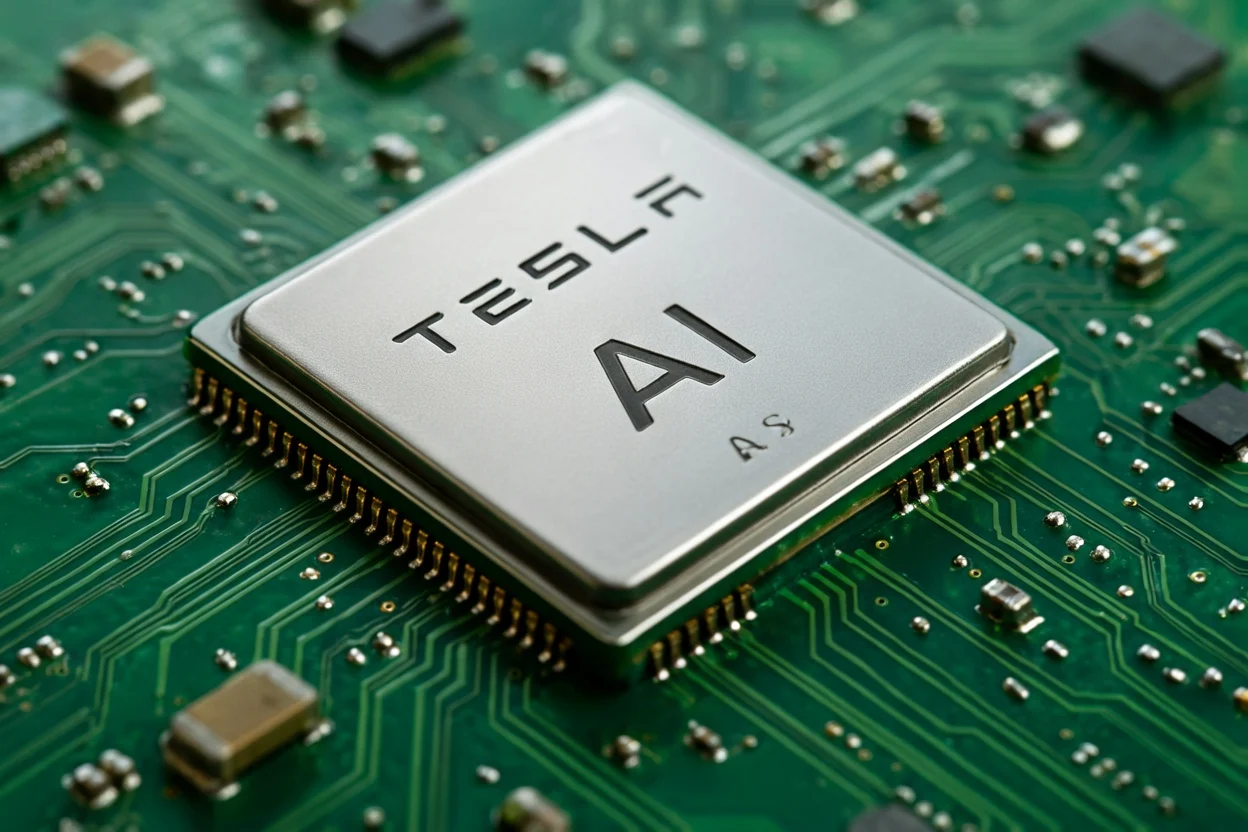
- Elon Musk announced the completion of design work on Tesla’s AI5 autonomous driving chip.
- Barclays maintained an Equalweight stance with a $360 target, highlighting Tesla’s transition into AI and robotics.
- UBS raised its rating to Hold from Sell, acknowledging improved risk-reward dynamics at present valuation.
- Company insiders offloaded $20.9 million in shares during the last quarter without any purchases.
Tesla delivered an impressive performance on April 15, 2026, as shares surged 7.6% to settle at $392.04. This rally extended the stock’s remarkable weekly momentum, pushing gains to 14.2% over the preceding seven trading days.
Broader market strength provided support for the electric vehicle maker. The S&P 500 inched up 0.2% during the session, approaching fresh intraday record territory. Meanwhile, the Nasdaq Composite advanced 0.5%. Market participants grew increasingly optimistic about a potential de-escalation of tensions involving Iran.
However, Tesla’s rally had company-specific catalysts driving momentum.
Elon Musk revealed through social media channels that Tesla’s AI chip engineering team successfully completed the “tape out” phase for the AI5 autonomous driving processor. He characterized this as a critical development milestone as the chip transitions toward manufacturing stages, expressing gratitude to Samsung and TSMC for their fabrication partnership.
Musk projected that AI5 could emerge as “one of the most produced AI chips ever,” anticipating mass production to commence in 2027. The processor is intended to eventually supplant the current AI4 chips deployed in Tesla’s vehicle fleet. He further hinted at possible tape-out for the subsequent AI6 generation chip by December 2026.
Analyst Community Responds
The Street’s reaction proved more measured.
Barclays analyst Dan Levy maintained his Equalweight recommendation alongside a $360 price target. He observed that Tesla’s fourth-quarter performance signaled the conclusion of Model S and Model X manufacturing — evidence the automaker is shifting focus from conventional vehicle production toward what it labels “Physical AI.”
Levy detailed Tesla’s expansive roadmap: a proposed “Terafab” infrastructure featuring 1 terawatt of AI computational power — approximately 50 times current worldwide AI compute capacity — alongside objectives to construct 100 gigawatts of solar generation. Barclays calculates the Terafab initiative alone could require trillions in capital investment.
Despite these bold ambitions, Barclays noted minimal tangible advancement on Robotaxi deployment, Full Self-Driving capabilities, and the Optimus humanoid robot initiative.
UBS took a contrasting approach. Analyst Joseph Spak elevated Tesla to Hold from Sell while maintaining a $352 price objective. Spak argued that present valuation levels “more evenly balance” short-term challenges, though he cautioned that volatility may persist — propelled primarily by market sentiment rather than fundamental performance.
UBS forecasts Tesla vehicle deliveries around 1.6 million units for 2026, essentially unchanged from the prior year, before expecting a 7% compound annual growth trajectory reaching approximately 2 million by 2030. This outlook falls significantly short of consensus market projections exceeding 3 million units.
Valuation Concerns Persist
Tesla’s trailing twelve-month P/E multiple stands at 363x — representing a 238% premium above its five-year median of 107.4x. GuruFocus analysis suggests a fair value estimate of $254.36, implying the current trading price carries a 54% premium.
Insider trading patterns warrant attention. Throughout the past three months, company insiders divested $20.9 million in equity holdings without any documented buying activity.
Tesla remains underwater for 2026, down 19% year-to-date, while the S&P 500 has registered a 2% gain during the comparable timeframe.
