




Key Highlights
- Equity futures advanced Tuesday morning with S&P 500 up 0.2% and Nasdaq futures climbing 0.5%
- President Trump indicated willingness for continued Iran negotiations, boosting ceasefire extension prospects
- Crude oil prices dropped under $100 per barrel, with Brent trading around $99 and WTI falling below $97
- The Nasdaq extended its winning run to nine consecutive sessions Monday, marking its longest advance since December 2023
- Banking sector earnings launched with JPMorgan posting a 13% profit increase; additional major financial institutions reporting this week
U.S. equity futures advanced Tuesday as market participants digested encouraging indications that Washington and Tehran might prolong their current ceasefire agreement and pursue a more comprehensive peace settlement.
S&P 500 futures increased 0.2%, while Nasdaq 100 futures rose 0.5%, and Dow Jones futures registered modest gains. The three primary indices all finished Monday’s session in positive territory, extending a period of measured confidence that has developed since the two-week ceasefire agreement was established on April 7.
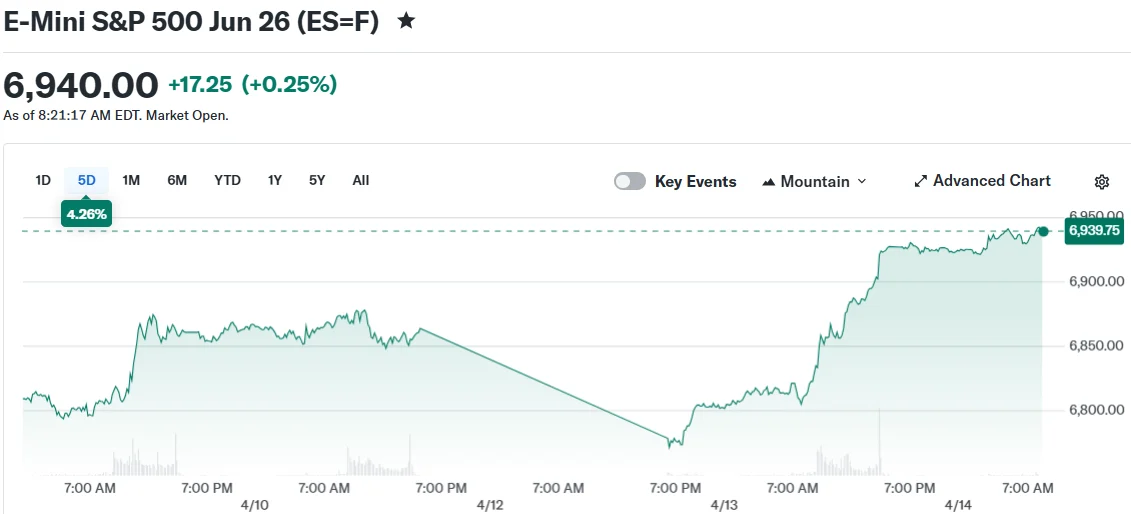
President Trump revealed Monday that “the right people” from Iran had initiated contact to negotiate an agreement. Financial markets interpreted this development favorably, despite weekend diplomatic discussions concluding without reaching a final resolution.
The S&P 500 essentially erased all declines accumulated since the conflict’s inception following Monday’s trading session. The Nasdaq marked its ninth consecutive day of gains, representing its most prolonged winning sequence since December 2023.
Henry Allen, a macro strategist at Deutsche Bank, noted that market sentiment “steadily improved after Monday’s open,” identifying Trump’s statements as the primary driver. He observed that oil futures continue to display a “heavily downward-sloping” trajectory, indicating market expectations that the conflict remains short-term.
Oil prices extended their decline Tuesday. West Texas Intermediate crude fell below $97 per barrel, declining approximately 2.1%. Brent crude retreated to roughly $99 per barrel. Both benchmark prices had traded above $100 for multiple weeks as the U.S. blockade of the Strait of Hormuz interrupted global energy supply chains.
Energy Markets and Inflation Concerns
Wall Street has maintained close surveillance of petroleum markets for approximately six weeks, worried that elevated energy costs might accelerate inflation. Tuesday’s producer price index data for March is anticipated to provide more definitive insight into how significantly the conflict has influenced pricing pressures.
The U.S. dollar weakened 0.2% versus a basket of major currencies as investors reduced safe-haven positions. The 10-year Treasury note yield declined 2 basis points to 4.27%. Gold climbed to $4,800, benefiting from dollar weakness.
European equity markets similarly advanced as petroleum prices pulled back, demonstrating a widespread change in investor sentiment.
Corporate Earnings Season Launches
The quarterly earnings period has commenced. JPMorgan Chase disclosed a 13% profit increase on Tuesday. Chief Executive Jamie Dimon recognized that the economy confronts an “increasingly complex set of risks.”
Johnson & Johnson also released results Tuesday. Bank of America, Wells Fargo, Citigroup, BlackRock, and Morgan Stanley are scheduled to announce earnings throughout the remainder of this week.
The U.S.-Iran ceasefire agreement is scheduled to conclude next week. Both Washington and Tehran are reportedly evaluating additional negotiations to extend the current arrangement.
The U.S. naval blockade targeting Iran’s energy export facilities remained active as of Tuesday morning.
