




Contents
TLDR
- SPX maintains its uptrend but approaches channel resistance between 7,100–7,250
- U.S. economic expansion decelerated to 0.5% annualized in Q4 2025 from Q3’s 4.4%
- Consumer price inflation accelerated to 3.3% in March, complicating Federal Reserve policy decisions
- Wall Street analysts forecast 18.6% earnings expansion for 2026, supporting equity valuations
- Breaking below 6,400–6,500 would signal the first major technical breakdown
The S&P 500 continues its upward trajectory, yet the investment landscape has become increasingly nuanced. Price pressures are intensifying, economic momentum is decelerating, and the benchmark index now confronts a pivotal resistance zone.
Here’s the current market situation.
The benchmark trades near the upper boundary of its multi-year ascending channel, approximately 7,100–7,250. This technical ceiling has previously stalled upward movements. While the market structure remains constructive, it no longer offers a favorable risk-reward entry point.
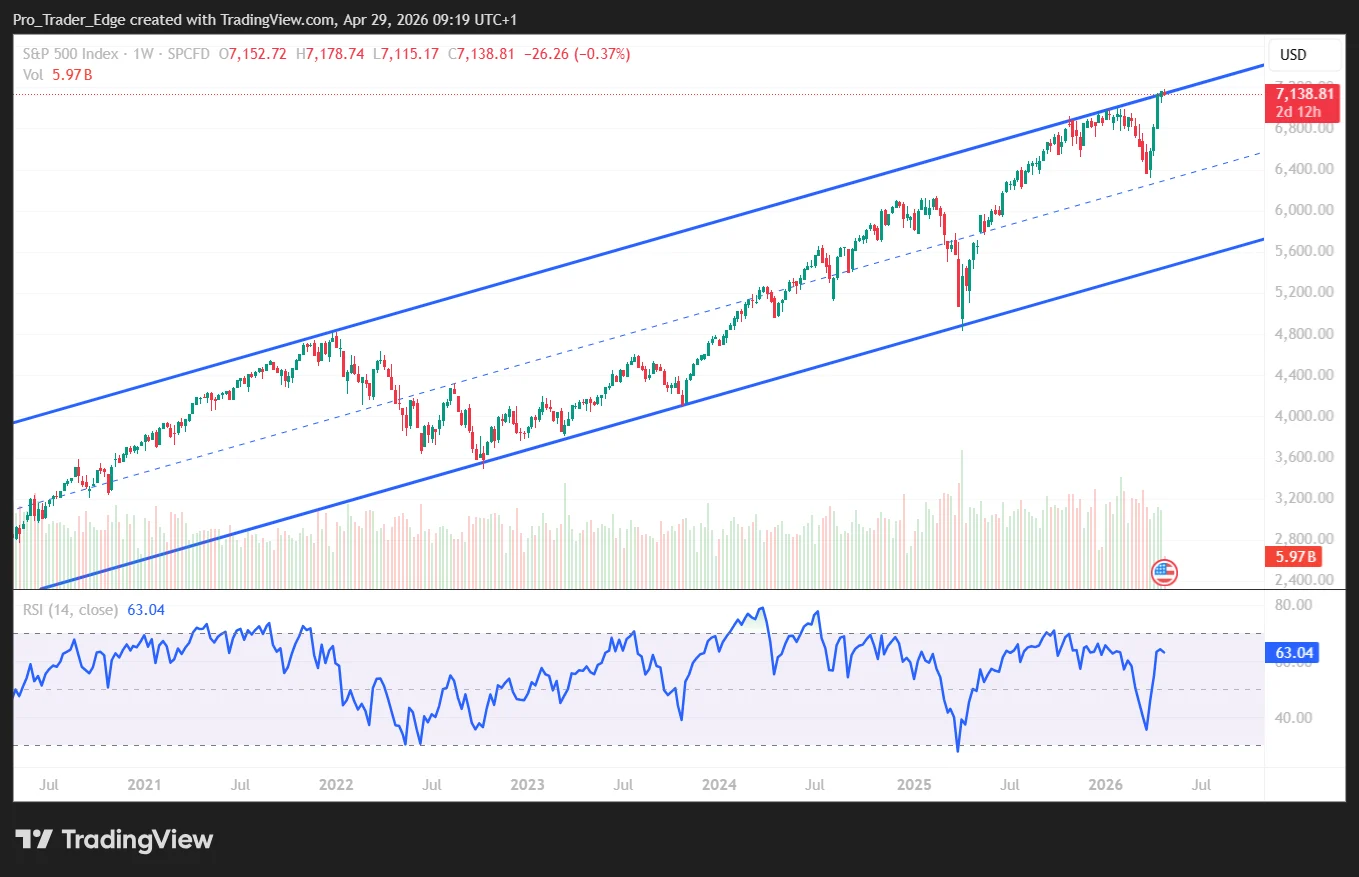
Immediate support emerges around 6,800–6,900. A retreat that finds buyers in this zone would represent typical consolidation behavior. The more significant support resides at 6,400–6,500, marking the launch point of the current advance.
According to Bureau of Economic Analysis data, U.S. real GDP expanded at just a 0.5% annualized pace during Q4 2025. This represents a dramatic deceleration from the previous quarter’s 4.4% growth rate. While expansion persists, the velocity has diminished notably.
Concurrently, inflation has reaccelerated. The Consumer Price Index climbed 3.3% year-over-year in March, jumping from February’s 2.4% reading. Core inflation registered at 2.6%. Energy costs were particularly impactful, with gasoline prices surging 18.9% annually.
The Federal Reserve maintains its target rate at 3.50%–3.75%. Given the renewed inflationary pressures, the rationale for aggressive rate reductions has diminished. Elevated borrowing costs continue to constrain equity valuations, particularly for growth-oriented enterprises.
The Bull Case
The optimistic scenario hinges on corporate profitability. FactSet data indicates S&P 500 constituents are projected to deliver 18.6% earnings growth throughout 2026. All eleven sectors have reported positive year-over-year revenue expansion during the current reporting period.
Should corporate profits meet expectations and inflation moderate following the energy-driven surge, equities can justify elevated prices despite above-average valuations.
A weekly settlement above 7,200–7,250 would constitute a constructive technical development. Subsequent upside objectives would target approximately 7,400, followed by 7,600.
The bullish narrative also requires recession probability to remain subdued. Provided employment conditions stabilize and credit markets function smoothly, investors will likely continue accumulating positions during temporary declines.
The Bear Case
The pessimistic perspective begins with valuation metrics. The S&P 500 currently trades at a forward price-to-earnings multiple of 20.9. This exceeds both the five-year average of 19.9 and the ten-year average of 18.9, per FactSet analysis.
Elevated valuations don’t guarantee declines. However, they provide minimal cushion should earnings disappoint or Treasury yields continue ascending.
The index simultaneously tests the upper boundary of its ascending channel. While not inherently bearish, this positioning offers limited margin of safety for new entrants.
A rejected breakout above 7,200–7,250 followed by a reversal beneath 7,000 would constitute an initial cautionary signal. A weekly close beneath 6,400–6,500 would represent a more substantial technical failure, suggesting the recent recovery has exhausted itself.
The most probable catalysts for downside action include persistent inflation, climbing Treasury yields, or disappointing earnings projections from market-leading corporations.
Final Thoughts
The S&P 500’s upward trend remains operational. Corporate earnings expansion is tangible, dip-buying behavior has persisted consistently, and recession probability appears moderate rather than imminent.
The subsequent critical data releases include forthcoming inflation reports and earnings guidance from prominent companies scheduled to report this quarter.
