



TLDR
- Mark Karpelès, former Mt. Gox CEO, has introduced a Bitcoin hard fork concept aimed at retrieving approximately 80,000 BTC stolen during a 2011 security breach, currently valued above $5.2 billion.
- The plan would enable fund movement without requiring the original private key, implementing a unique consensus mechanism for one specific wallet address.
- The concept was uploaded to GitHub as a preliminary discussion document, not as an official Bitcoin Improvement Proposal.
- Opponents warn the idea creates a risky precedent that could undermine Bitcoin’s fundamental immutability principle.
- These stolen funds are distinct from the approximately 200,000 BTC currently being returned to Mt. Gox creditors, with distributions scheduled through October 2026.
Mark Karpelès, who previously led the now-defunct Bitcoin exchange Mt. Gox, has unveiled a draft concept advocating for a Bitcoin hard fork. His objective is reclaiming approximately 79,956 BTC taken during a security breach over 15 years ago.
These digital assets, presently held in one wallet address, represent more than $5.2 billion based on current market valuations. The funds have remained untouched since their theft in June 2011.
According to existing Bitcoin protocol, cryptocurrency can only be transferred using its associated private key. That particular key has never been located.
Karpelès uploaded his concept to GitHub late last week. His vision introduces a novel consensus mechanism enabling fund transfer to a designated recovery address without requiring the missing key.
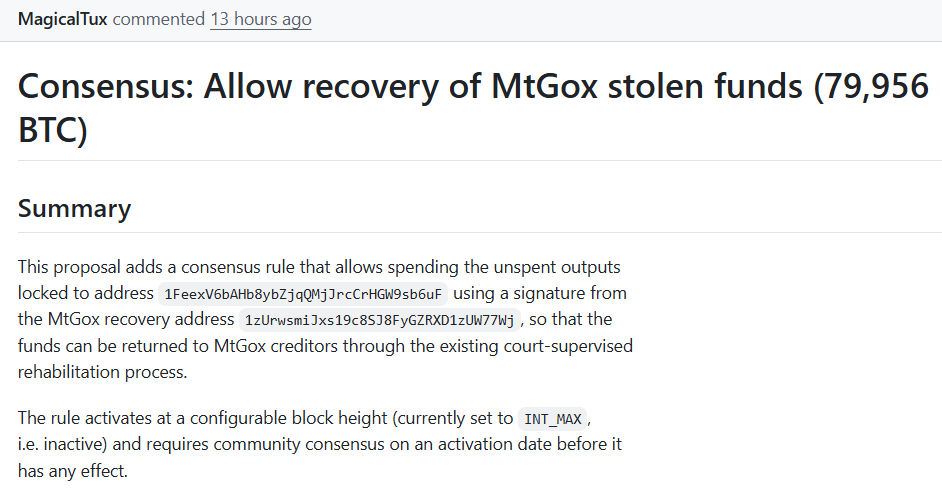
The proposed mechanism would exclusively target that individual wallet address. Implementation would occur at a predetermined block height, contingent upon network-wide acceptance.
Karpelès maintained transparency regarding his proposal’s implications. “I want to be upfront: this is a hard fork,” he stated clearly.
He characterized his submission as a method to overcome an impasse. Nobuaki Kobayashi, the Mt. Gox bankruptcy trustee, has refused to pursue blockchain-based recovery without guaranteed community consensus for a protocol modification.
Why Critics Are Pushing Back
The concept has encountered substantial opposition, primarily focused on Bitcoin’s immutability characteristic. Bitcoin operates on the principle that transactions remain permanent and cannot be reversed.
Numerous Bitcoin community members contend that modifying ownership protocols for a single address, despite involving obvious theft, establishes an undesirable precedent. Bitcointalk forum participants cautioned that such action might encourage comparable requests following future security breaches.
The draft itself recognizes this concern. It notes: “If it can be done once, the argument goes, it can be done again.”
A governance challenge also exists. Bitcoin lacks an established framework for determining which historical thefts warrant protocol rule modifications.
Successful hard fork implementation demands extensive consensus among miners, node operators, and cryptocurrency exchanges. History shows that achieving Bitcoin consensus on divisive modifications proves exceptionally difficult.
How This Fits Into Broader Mt. Gox Repayments
The 80,000 BTC held in the compromised wallet remain separate from cryptocurrency currently being distributed to creditors. Those distributions originate from a different reserve of roughly 200,000 BTC recovered following the platform’s 2014 shutdown.
Creditor distributions commenced in mid-2024, with the deadline now extended through October 2026. The stolen cryptocurrency remains completely beyond trustee jurisdiction.
Mt. Gox initiated bankruptcy proceedings in Tokyo on February 28, 2014, following the loss of approximately 750,000 customer bitcoins. During its operational peak, the platform facilitated 70% of worldwide Bitcoin transactions.
Several creditors have expressed endorsement for the concept. One individual identifying as a creditor mentioned recovering roughly 15% of their Bitcoin through bankruptcy proceedings and indicated willingness to support court action claiming the remaining stolen assets.
The proposal currently exists as a discussion draft without official endorsement or implementation schedule.
