



TLDR
- Mark Karpelès, the former chief executive of Mt. Gox, has introduced a controversial Bitcoin hard fork proposal designed to recover roughly 80,000 BTC stolen in a 2011 hack, worth over $5.2 billion today.
- The proposed solution would allow these stolen funds to be moved without the original private key by implementing a unique consensus rule targeting one specific wallet address.
- Karpelès published the concept on GitHub as a discussion document, not as a formal Bitcoin Improvement Proposal.
- Critics warn the proposal sets a dangerous precedent that could compromise Bitcoin’s core principle of immutability.
- The stolen bitcoins are separate from approximately 200,000 BTC being returned to Mt. Gox creditors, with distributions extending until October 2026.
Mark Karpelès, the former chief executive of the now-defunct Mt. Gox cryptocurrency exchange, has introduced a controversial draft proposal calling for a Bitcoin hard fork. The plan aims to recover approximately 79,956 BTC stolen in a hack that occurred more than 15 years ago.
The cryptocurrency remains inaccessible in a single wallet address, worth over $5.2 billion at today’s prices. Since the theft in June 2011, these funds have never been moved.
Bitcoin’s standard protocol mandates the original private key to authorize transactions. That essential key was lost and never recovered.
Last Friday, Karpelès published his concept on GitHub. The proposal outlines a new consensus mechanism that would permit transferring the funds to a designated recovery address without requiring the lost private key.
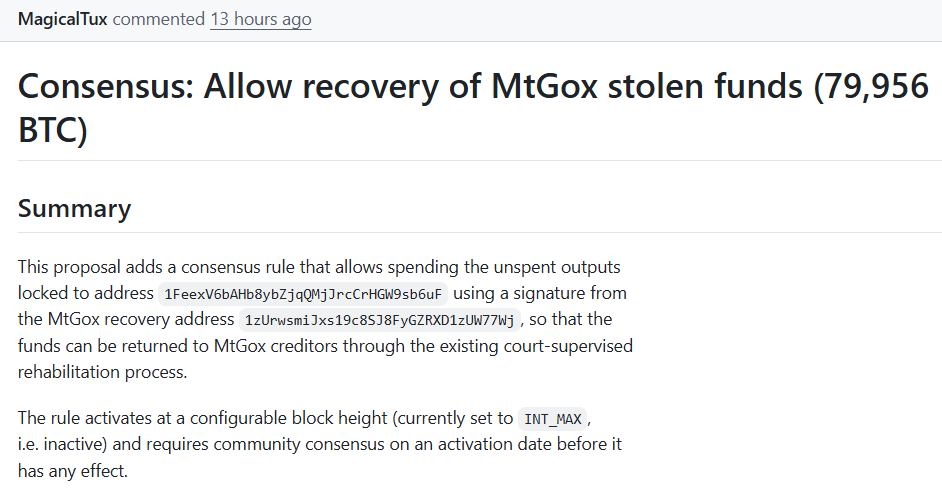
The proposed rule would apply exclusively to this single wallet address. If adopted network-wide, it would activate at a specific future block height.
Karpelès was candid about the proposal’s implications. “I want to be upfront: this is a hard fork,” he acknowledged.
He framed the submission as an attempt to resolve a longstanding deadlock. Nobuaki Kobayashi, the Mt. Gox bankruptcy trustee, has declined to pursue blockchain-level recovery without assured community backing for such a protocol change.
Why Critics Are Pushing Back
The proposal has generated significant controversy, particularly concerning Bitcoin’s immutability. Bitcoin is built on the foundational principle that validated transactions remain permanent and unalterable.
Many community members argue that creating special ownership rules for any individual address, even in theft cases, creates a problematic precedent. Discussion forum participants on Bitcointalk have warned this could open the door to similar demands after future hacks.
The proposal itself acknowledges this criticism. It states: “If it can be done once, the argument goes, it can be done again.”
Governance questions also arise. Bitcoin has no established framework for deciding which historical thefts justify changing protocol rules.
Implementing any hard fork requires broad consensus among miners, node operators, and exchanges. Throughout Bitcoin‘s history, reaching agreement on contentious changes has proven extremely difficult.
How This Fits Into Broader Mt. Gox Repayments
The 80,000 BTC in the compromised wallet are completely separate from funds currently being distributed to creditors. Ongoing repayments come from a different pool of approximately 200,000 BTC recovered after the exchange collapsed in 2014.
Creditor repayments began in mid-2024, with the final deadline now extended to October 2026. The stolen coins remain entirely outside the trustee’s control.
Mt. Gox filed for bankruptcy in Tokyo on February 28, 2014, after losing around 750,000 customer bitcoins. At its peak, the exchange handled 70% of global Bitcoin trading volume.
Some creditors have voiced support for the initiative. One person claiming to be a creditor stated they received approximately 15% of their Bitcoin through the bankruptcy process and would support a legal mechanism to recover the remaining stolen funds.
The proposal remains a preliminary discussion document with no official backing or implementation timeline.
