




TLDR
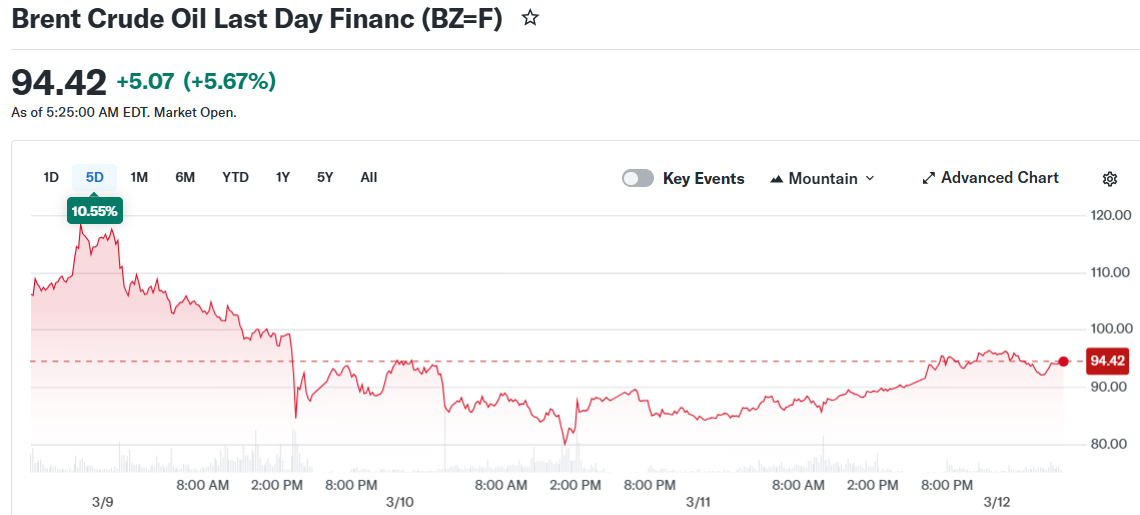
- Brent crude momentarily exceeded $101/barrel on Thursday before closing near $98, marking a 6.6% daily increase
- Iraqi waters in the Persian Gulf saw two oil vessels attacked, resulting in at least one crew fatality
- Oman conducted precautionary evacuations of all ships from its Mina Al Fahal export facility
- China implemented a ban on refined petroleum product exports for March to safeguard domestic reserves
- The IEA unveiled an unprecedented 400 million barrel strategic reserve deployment to stabilize markets
Crude markets experienced another dramatic rally on Thursday following fresh vessel attacks and terminal shutdowns that intensified concerns over Middle Eastern energy supplies.
Brent crude climbed to a session high of $101.59 per barrel during early trading hours before retreating to approximately $98. West Texas Intermediate advanced more than 6% to reach $92.61. These benchmarks had previously approached $120 earlier in the week.
Two petroleum tankers came under attack in the northern Persian Gulf within Iraqi territorial waters. Online footage captured the burning vessels. The Wall Street Journal quoted Iraqi port director Farhan al-Fartousi confirming one sailor’s death while rescue operations worked to extract remaining crew members. All Iraqi oil export facilities were subsequently closed following the incident.
Separately, Oman conducted a complete evacuation of vessels from its Mina Al Fahal export facility as a protective measure following the series of regional shipping attacks. This terminal represents one of the limited remaining channels for Middle Eastern crude to access international markets. Normal operations resumed later.
The Strait of Hormuz, a critical chokepoint handling approximately 20% of worldwide oil flows, remains essentially blocked. Iranian authorities have declared no crude shipments will transit the waterway. The blockade has compelled Gulf nations including Iraq, Kuwait, and Saudi Arabia to reduce production.
China Tightens Fuel Export Curbs
China declared an immediate prohibition on refined petroleum product exports effective March. Chinese refining companies also began canceling previously agreed shipments of gasoline and diesel. The nation’s leading processors had already received instructions to halt new contract negotiations.
Goldman Sachs cautioned that oil prices could surpass the 2008 record of $147.50 per barrel should Hormuz passage remain blocked throughout March.
ANZ analysts suggested markets were inadequately accounting for the probable length of supply interruptions. “Once a conflict extends beyond the initial shock phase, oil markets tend to shift from pricing uncertainty to pricing endurance,” they wrote.
Emergency Reserve Releases Limit Further Gains
The International Energy Agency is organizing an unprecedented deployment of 400 million barrels from emergency stockpiles. U.S. President Donald Trump announced Wednesday that America would contribute 172 million barrels from the Strategic Petroleum Reserve.
Despite those moves, analyst Neil Beveridge of Sanford C. Bernstein said reserve releases were “nothing compared with the 20 million barrels” per day of disruption caused by the Hormuz closure.
The conflict reached its thirteenth day Thursday with no resolution apparent. Iran stated any ceasefire would necessitate assurances from both the U.S. and Israel against future strikes on Iranian territory. Washington has not accepted these conditions.
Trump told a crowd in Kentucky on Wednesday the war would end soon, but added the U.S. “would stay as long as it takes.”
U.S. petroleum inventory figures published Wednesday revealed a greater-than-anticipated increase of 3.8 million barrels during the previous week.
