




TLDR
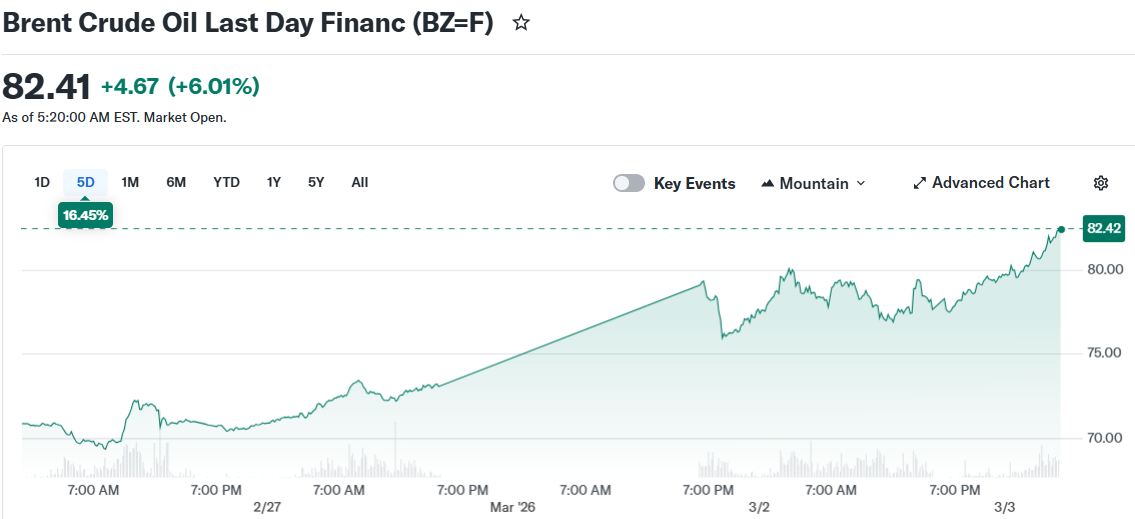
- Brent crude surged past $80 per barrel while WTI reached $73 following coordinated US-Israeli military operations against Iran that resulted in Supreme Leader Khamenei’s death.
- Tehran issued warnings about closing the Strait of Hormuz, effectively stopping tanker movement through the critical passage responsible for transporting 20% of worldwide oil supplies.
- Major energy infrastructure took hits: Saudi Aramco suspended operations at Ras Tanura refinery while Qatar shut down a key LNG production facility following drone and missile attacks.
- Financial analysts at JPMorgan projected that Persian Gulf oil producers might face mandatory production cuts within approximately 25 days should the strait remain inaccessible.
- Banking institution OCBC Bank forecasted Brent potentially exceeding $100 per barrel under worst-case conditions; Washington announced forthcoming measures to address rising energy expenses.
Crude oil markets experienced significant volatility this week following a coordinated military operation conducted by the United States and Israel against Iran during the weekend, which resulted in the death of Supreme Leader Ayatollah Ali Khamenei.
Brent crude futures pushed beyond the $80 per barrel threshold on Tuesday, extending Monday’s 7% rally. Meanwhile, West Texas Intermediate traded in the vicinity of $73.
Tehran’s response included explicit warnings about shutting down the Strait of Hormuz, the strategically vital waterway located off Iran’s coastline that facilitates the transport of approximately 20% of global seaborne petroleum and comparable volumes of liquefied natural gas.
Iranian authorities declared their military would engage any vessel attempting passage through the strait. Maritime traffic involving oil tankers has essentially ground to a halt through this critical chokepoint.
The regional crisis escalated rapidly beyond the original military strikes. Tehran launched two drone attacks targeting the American embassy in Riyadh, Saudi Arabia, resulting in limited structural damage and a minor fire.
Saudi Aramco suspended activities at its Ras Tanura refinery complex after a drone strike occurred in proximity to the facility. Qatar terminated production at the planet’s most significant LNG export terminal following an Iranian assault.
Israeli forces maintained aerial bombardment campaigns in Lebanon directed at Hezbollah positions. The Leviathan natural gas development project situated off Israel’s Mediterranean coast likewise ceased production operations.
What Analysts Are Saying
Financial experts at JPMorgan issued warnings that the Strait of Hormuz has essentially become non-operational, projecting that regional Gulf petroleum producers might face forced well closures within roughly 25 days as domestic storage capacity reaches maximum levels.
Shipping expenses for crude oil transport from Middle Eastern ports to China achieved unprecedented levels on Monday. Benchmark route daily earnings skyrocketed to $424,000, based on Baltic Exchange market data.
OCBC Bank projected that Brent crude could breach the $100 per barrel mark should the Hormuz obstruction continue. The financial institution noted that OPEC’s available excess production capacity might provide cushioning under baseline scenarios that don’t involve extended closures.
Analysts from ING identified the greater danger as potential Iranian attacks on additional energy infrastructure throughout the region, which would likely generate more prolonged supply interruptions than partial strait disruptions.
CMC Markets’ global head of markets projected that heightened risk premiums within energy commodities would persist until tangible signs emerge indicating either conflict de-escalation or establishment of alternative supply corridors.
US Response and Diplomacy
Secretary of State Marco Rubio announced the military operations would escalate in intensity, prioritizing the elimination of Iran’s naval forces, unmanned aerial vehicle fleet, and ballistic missile capabilities.
Rubio further indicated that Washington would unveil strategies aimed at mitigating increased energy expenses affecting consumers, with implementation scheduled to commence on Tuesday.
The Trump administration clarified it had no immediate intentions to access the Strategic Petroleum Reserve. Any potential SPR deployment would likely involve coordination with International Energy Agency member nations.
The United Arab Emirates and Qatar are conducting discreet diplomatic efforts with allied nations to encourage President Trump toward pursuing a condensed military campaign against Iran instead of extended conflict engagement.
China, representing the world’s largest petroleum importing nation, issued appeals to all involved parties demanding guaranteed safe passage through the Strait of Hormuz while calling for immediate cessation of military activities.
