




TLDR
- BTC experienced a rapid decline of approximately 5%, falling to around $63,000 following joint U.S.-Israeli military operations against Iran
- This marks the cryptocurrency’s lowest valuation since the market turbulence on Feb. 5, when prices temporarily fell beneath $60,000
- Israel’s Defense Minister Israel Katz announced a nationwide emergency status throughout Israeli territory
- The continuous trading nature of Bitcoin markets makes it a primary outlet for risk aversion when traditional markets remain closed
- Market participants offloaded bitcoin positions as it represented one of the limited high-liquidity assets accessible during weekend hours
The leading cryptocurrency by market capitalization experienced a significant downturn on Saturday, February 28, 2026, plummeting toward $63,000 following coordinated military strikes executed by the United States and Israel against Iranian targets.
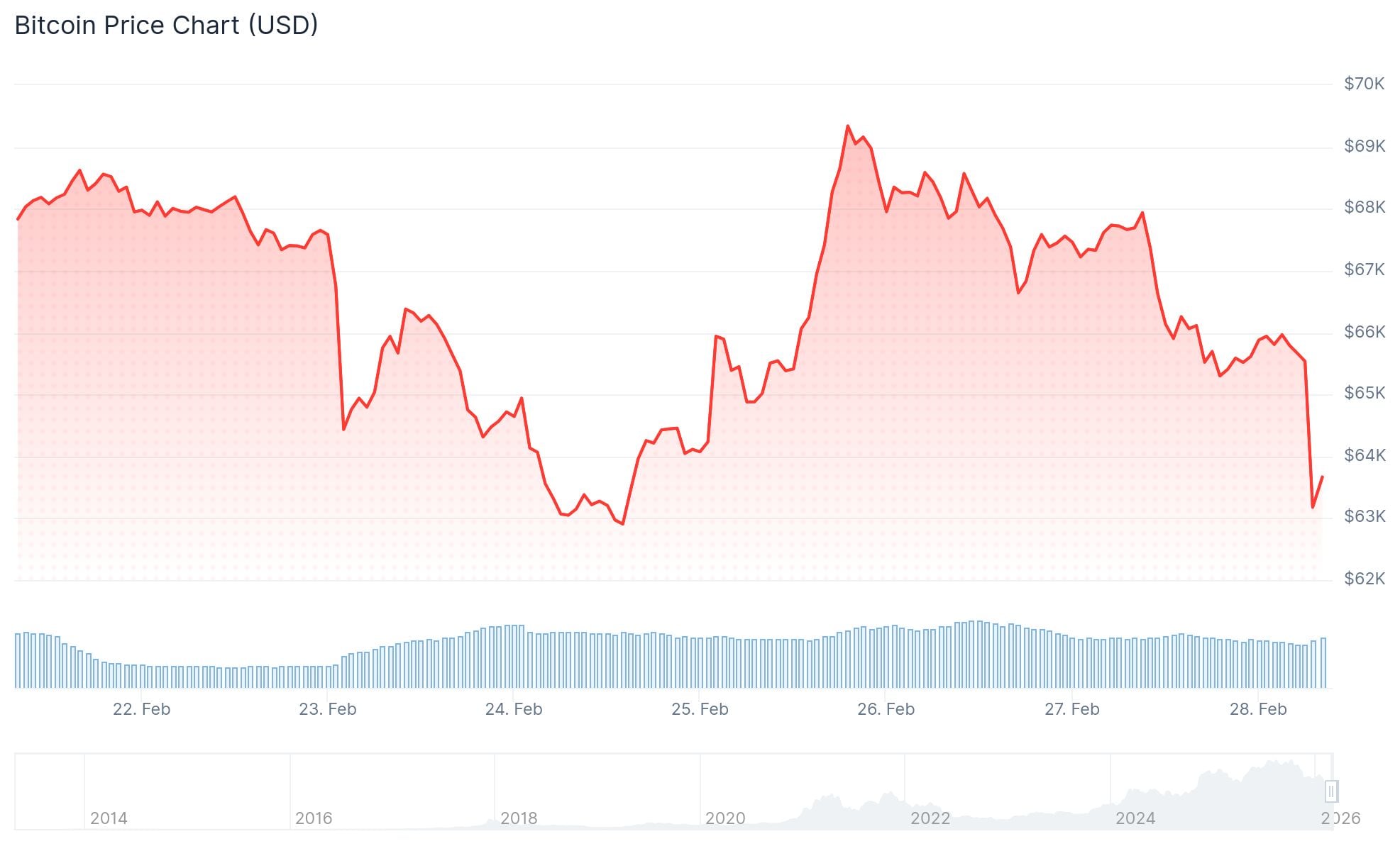
The cryptocurrency witnessed a steep decline of approximately 5% within just minutes, catching many investors off guard.
This downturn pushed bitcoin to price levels not observed since the market correction on February 5, when the digital asset momentarily traded below the $60,000 threshold.
Following the commencement of military operations, Israeli Defense Minister Israel Katz issued a declaration establishing emergency protocols across the entire nation of Israel.
American involvement in the offensive was verified by a United States official, as documented in reporting from The Wall Street Journal.
Israeli authorities characterized the military action as a “preemptive strike,” according to Reuters, which cited official statements from the nation’s defense leadership.
Why Bitcoin Sold Off First
Unlike traditional equity exchanges and fixed-income markets that close for weekends, Bitcoin operates continuously without interruption throughout every day of the week.
This perpetual availability positions it as among the few substantial, highly-liquid instruments that market participants can divest when risk escalates during periods when conventional financial markets are inactive.
This behavioral pattern has emerged repeatedly in the past. Bitcoin frequently experiences rapid sell-offs during geopolitical disruptions, though it commonly rebounds once standard market hours resume.
“Bitcoin just dropped off a cliff,” one market observer shared on X, further noting that “Monday will be a bloodbath in the market.”
Geopolitical Context
The military operations arrive after several weeks characterized by increasing U.S. military deployment and deteriorating nuclear diplomacy efforts with Tehran.
Market analysts had previously been evaluating potential implications of Iranian conflict scenarios for bitcoin, precious metals, and equity markets.
The offensive action elevates concerns regarding potential expansion into a wider regional confrontation within one of the globe’s most strategically critical zones.
Bitcoin’s performance has diverged from gold’s trajectory in recent months, which has challenged its narrative as a protective hedge or “digital gold” alternative.
As of Saturday morning hours, bitcoin was changing hands near the $63,000 level, with additional volatility anticipated when conventional financial markets resume operations on Monday.
