



TLDR
- Q1 order intake surged 104.5% year-over-year to €269.7 million, surpassing analyst expectations by approximately 4%
- Net income climbed 63.8% to €51.6 million; sales increased 28.3% to €184.9 million
- Growth fueled by hybrid bonding technology and equipment for AI chip assembly
- Q2 sales projected to rise 30% to 40% sequentially, with gross margin forecast at 64–66%
- A second client initiated qualification testing for high bandwidth memory (HBM) hybrid bonding solutions
BE Semiconductor Industries delivered impressive first-quarter results, with order intake more than doubling and net income surging nearly 64% as artificial intelligence continues to fuel demand for cutting-edge chip packaging technology.
The Netherlands-based equipment manufacturer recorded Q1 2026 order bookings of €269.7 million, representing a 104.5% increase from the €131.9 million reported in the same period last year. This performance exceeded Wall Street consensus estimates by approximately 4%, according to data from J.P. Morgan.
Quarterly sales reached €184.9 million, marking a 28.3% year-over-year advancement. The company’s net income hit €51.6 million, compared to €31.5 million in Q1 2025, benefiting from revenue expansion and recent operational efficiency initiatives.
The firm’s order backlog more than doubled during the three-month period to €268.7 million. Company executives attributed this performance to robust shipment volumes for premium mobile devices and 2.5D AI computing solutions.
Hybrid Bonding Technology Momentum Accelerates
Hybrid bonding — an advanced packaging technique that directly connects two semiconductor dies face-to-face — continues to serve as a primary growth catalyst for Besi. Industry experts view this technology as essential for next-generation artificial intelligence processors and high bandwidth memory products.
During the quarter, a second major customer initiated qualification procedures for Besi’s hybrid bonding systems in the high bandwidth memory sector. Market analysts view this development as an encouraging indicator of broader HBM technology adoption.
J.P. Morgan analysts characterized the quarterly performance as evidence that hybrid bonding implementation is accelerating within the memory chip segment, describing it as “a positive print” from the equipment maker.
Besi’s early-adopter advantage in hybrid bonding technology has positioned the company to capitalize directly on the expanding AI semiconductor infrastructure. The customer roster includes industry leaders TSMC, Intel, and Samsung Electronics — all of which are investing in capacity expansion.
TSMC and Samsung have both recently announced intentions to further boost production capabilities, which analysts expect will translate into additional equipment purchases from Besi in coming quarters.
Strong Sequential Growth Expected in Q2
For the current quarter, Besi projected sequential revenue expansion of 30% to 40% from the Q1 baseline of €184.9 million. This guidance suggests Q2 sales in the approximate range of €240 million to €259 million.
Gross profit margins are anticipated to expand to the 64% to 66% range in the second quarter. Management forecasts substantial net income growth as well.
The outlook underscores persistent strength in AI-related semiconductor demand, despite ongoing weakness in other chip market segments including automotive electronics, personal computers, and consumer memory products.
In related European semiconductor news, STMicroelectronics similarly reported first-quarter earnings that exceeded market projections, suggesting emerging recovery trends in its core business areas.
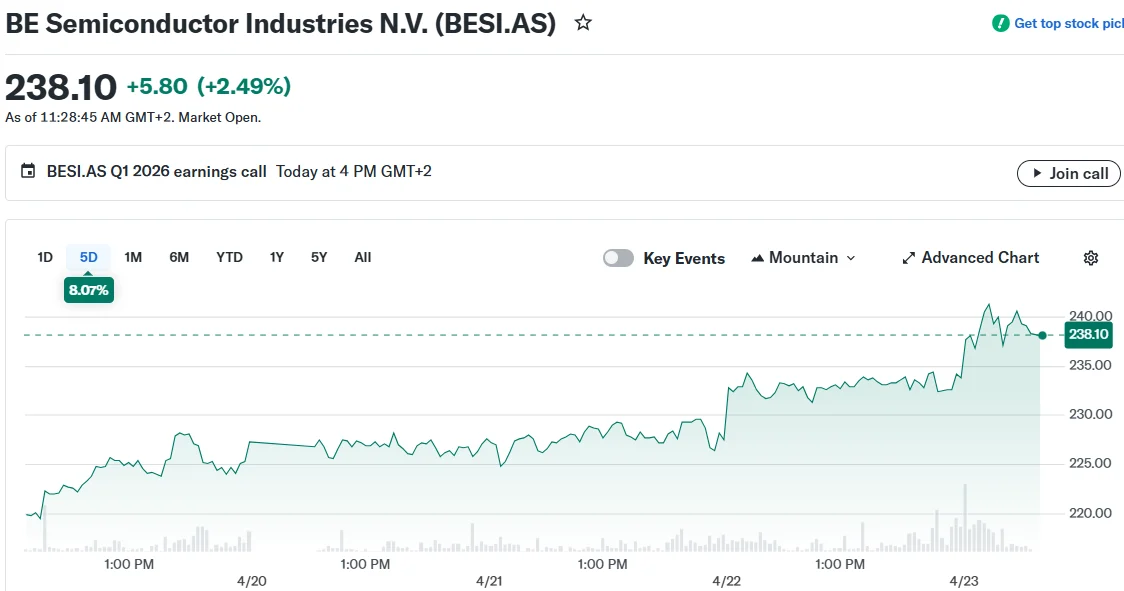
BESI shares advanced approximately 3% during early Thursday trading in Amsterdam, outperforming the broader Dutch AEX benchmark index. Including Thursday’s gains, the stock has appreciated roughly 79% since the beginning of the year.
