



Contents
Key Takeaways
- AeroVironment reported a 143% surge in revenue, reaching $408M, backed by a $1.1B funded backlog
- Rockwell Automation delivered 12% sales growth alongside a 36% increase in operating earnings
- Symbotic achieved profitability with $630M in revenue, marking a 29% year-over-year increase
- Tesla’s Optimus humanoid robot continues attracting investor interest with Q1 2026 earnings scheduled for April 22
- Honeywell and Teradyne continue expanding their automation offerings with earnings catalysts on the horizon
The Transformation of Robotics from Concept to Reality
For years, robotics remained stuck in the realm of futuristic speculation rather than practical investment territory.
That narrative is rapidly evolving.
Businesses across sectors are confronting identical challenges: rising labor costs, increasingly complicated supply networks, and relentless pressure to boost operational efficiency. Simultaneously, breakthroughs in artificial intelligence have transformed robots from rigid machines into adaptable systems capable of functioning in diverse real-world settings.
What once meant simple repetitive factory operations now encompasses logistics operations, distribution centers, medical facilities, military applications, and consumer products.
This evolution matters because it transforms robotics from a specialized niche into a widespread, cross-industry expansion opportunity.
Rather than a small group of experimental ventures, we’re witnessing established corporations generating substantial automation revenue, while emerging companies rapidly scale as market adoption accelerates.
Investor sentiment on Wall Street is shifting accordingly, but the criteria have evolved.
Investors have moved beyond chasing robotics purely based on theoretical future potential. The emphasis now centers on organizations already demonstrating quantifiable achievements—whether through expanding revenues, margin improvements, substantial order backlogs, or identifiable near-term growth drivers.
This shift makes it significantly easier to pinpoint which companies warrant immediate attention, rather than gambling on distant possibilities.
AeroVironment (AVAV)
AeroVironment offers investors robotics exposure through military-grade drones and autonomous aircraft systems. During its fiscal third quarter, the company reported revenue that surged 143% year over year, reaching $408 million.
The funded backlog climbed to $1.1 billion, providing substantial clarity on incoming business. Leadership has established a fiscal 2026 revenue target ranging from $1.85 billion to $1.95 billion.
Rockwell Automation (ROK)
Rockwell Automation stands as one of the most reliable players in industrial automation technology. During fiscal Q1 2026, the company posted sales of $2.105 billion, representing a 12% year-over-year gain.
Rockwell Automation, Inc., ROK
Total segment operating earnings climbed 36%, while annual recurring revenue expanded 7%. Demand for both hardware and software solutions remains robust as manufacturing facilities pursue modernization initiatives.
Symbotic (SYM)
Symbotic represents one of the most direct warehouse automation investments available. The company reported revenue of $630 million in fiscal Q1 2026, up 29% from the previous year.
Symbotic Inc., SYM
The company also crossed into profitability territory, recording net income of $13 million versus a $17 million net loss in the comparable period. Management issued Q2 revenue guidance of $650 million to $670 million.
Bottom Line
Wall Street has stopped rewarding robotics investments based solely on enthusiasm and promises. The market now demands tangible evidence: actual revenue expansion, profitability improvements, strong order books, or identifiable upcoming catalysts. Each of the six companies discussed here currently satisfies at least one of these requirements.
Special Report: Additional Robotics Stocks Beyond This Analysis
Our research covered significantly more robotics companies than those featured in this article.
The three highlighted here represent only a fraction of our findings—numerous others demonstrated equally compelling, and sometimes superior, characteristics based on momentum, growth trajectories, and overall market positioning. 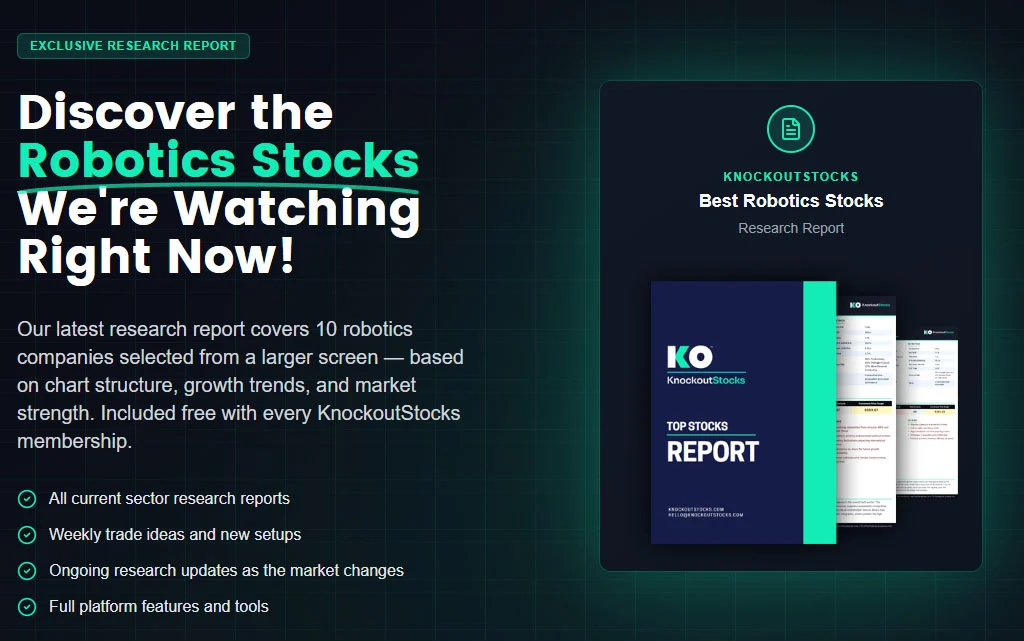 Some of these companies haven’t gained widespread analyst coverage yet, which is precisely why they attracted our attention during the evaluation process. Rather than making everything publicly available, we compiled a comprehensive report examining 10 robotics stocks that appear high-potential according to our internal ranking system and current research.
This represents the same watchlist we’re monitoring internally, complete with technical charts, critical price levels, and detailed company notes.
👉 If you want access to the complete list before it gains broader market attention, you can download the Robotics Stocks report here
