



Key Takeaways
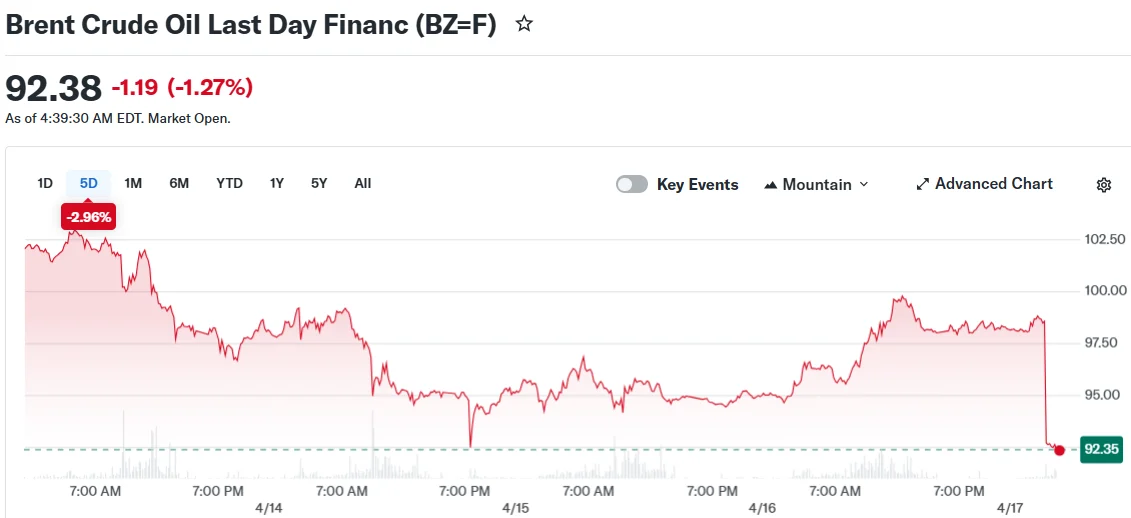
- Crude benchmarks declined over 3% weekly, with Brent approaching $98 and WTI near $93
- White House announced 10-day Israel-Lebanon truce and claimed Tehran accepted critical negotiating points
- Tehran has made no public statement confirming any agreements, especially regarding Hormuz access
- International Energy Agency projects oil infrastructure restoration could require two years
- Major forecasting agencies predict subdued global petroleum demand ahead
Oil prices retreated Friday as Washington issued encouraging statements about potentially resolving the standoff with Tehran, which has now extended nearly seven weeks.
Brent benchmark crude declined 1.1% to approximately $98.32 per barrel, while its American counterpart, West Texas Intermediate, slipped 1.3% to $89.95. Week-over-week, both benchmarks registered losses exceeding 3%.
The confrontation initiated in February following coordinated American-Israeli military operations against Iranian targets. In response, Iran effectively closed the Strait of Hormuz to most maritime traffic, choking off approximately one-fifth of worldwide petroleum shipments. Washington subsequently imposed its own naval restrictions.
President Donald Trump projected confidence Thursday, asserting that Iranian officials had conceded to previously rejected conditions, notably reopening the strategic waterway. Tehran has issued no public verification of these claims.
The president simultaneously unveiled a 10-day cessation of hostilities between Israel and Lebanon, extending invitations to Israeli Prime Minister Benjamin Netanyahu and Lebanese President Joseph Aoun for White House discussions.
Lebanon’s participation in any ceasefire framework represented a fundamental prerequisite Iran established for entering comprehensive talks. Through Friday morning, the arrangement appeared to hold.
“Market sentiment has shifted decisively from escalation concerns toward stabilization prospects,” observed Priyanka Sachdeva, senior market analyst with Phillip Nova. “Anxiety fueled the price surge, while diplomatic momentum is now triggering the reversal.”
Full Resolution May Require Extended Timeline
Several Gulf and European officials suggested a comprehensive Washington-Tehran agreement could necessitate approximately six months. These leaders encouraged both nations to prolong existing truces throughout negotiations.
OCBC market strategists highlighted that Washington’s naval enforcement entered its fourth consecutive day, maintaining Hormuz shipping volumes at historically suppressed levels. Petroleum transit through the chokepoint remains dramatically below pre-conflict benchmarks.
Trump expressed optimism that ceasefire extensions would prove unnecessary, forecasting resolution “fairly soon.” He mentioned potential travel to Pakistan, where initial negotiations occurred, contingent on finalizing an agreement.
Following weeks of extraordinary market turbulence, price fluctuations have moderated considerably. Brent traded within roughly a $10 per barrel bandwidth this week, sharply contrasting with March’s unprecedented $38 intraday swing.
Infrastructure Recovery Faces Prolonged Timeline
IEA Executive Director Fatih Birol cautioned that restoring significant portions of interrupted petroleum and natural gas output could extend two years. Any production restoration would materialize incrementally, he emphasized.
Both the International Energy Agency and OPEC released projections indicating diminished worldwide oil consumption in upcoming months, compounding downward price momentum.
“Despite encouraging geopolitical developments, we haven’t witnessed tangible improvements in actual shipping volumes,” stated Rebecca Babin, senior energy trader at CIBC Private Wealth Group.
Authority over Strait of Hormuz operations remains contested. Iranian officials have indicated intentions to impose transit fees on vessels even following conflict resolution.
The present US-Iran ceasefire expires April 21.
