




TLDR
- Approximately 1.40 million SOL tokens were deposited onto exchanges over a 72-hour period, equating to roughly $110 million in potential sell-side pressure.
- Technical analysis reveals a bear flag breakdown on daily charts, with SOL losing a critical structural level around $85.
- Immediate support holds at $77, while a breach could send prices toward a stronger support zone ranging from $66 to $70.
- A bearish moving average crossover on the 4-hour timeframe (SMA-20 crossing below SMA-50) indicates weakening bullish momentum.
- Network fundamentals remain strong, with real-world asset tokenization exceeding $2 billion and SoFi deploying enterprise banking infrastructure on Solana.
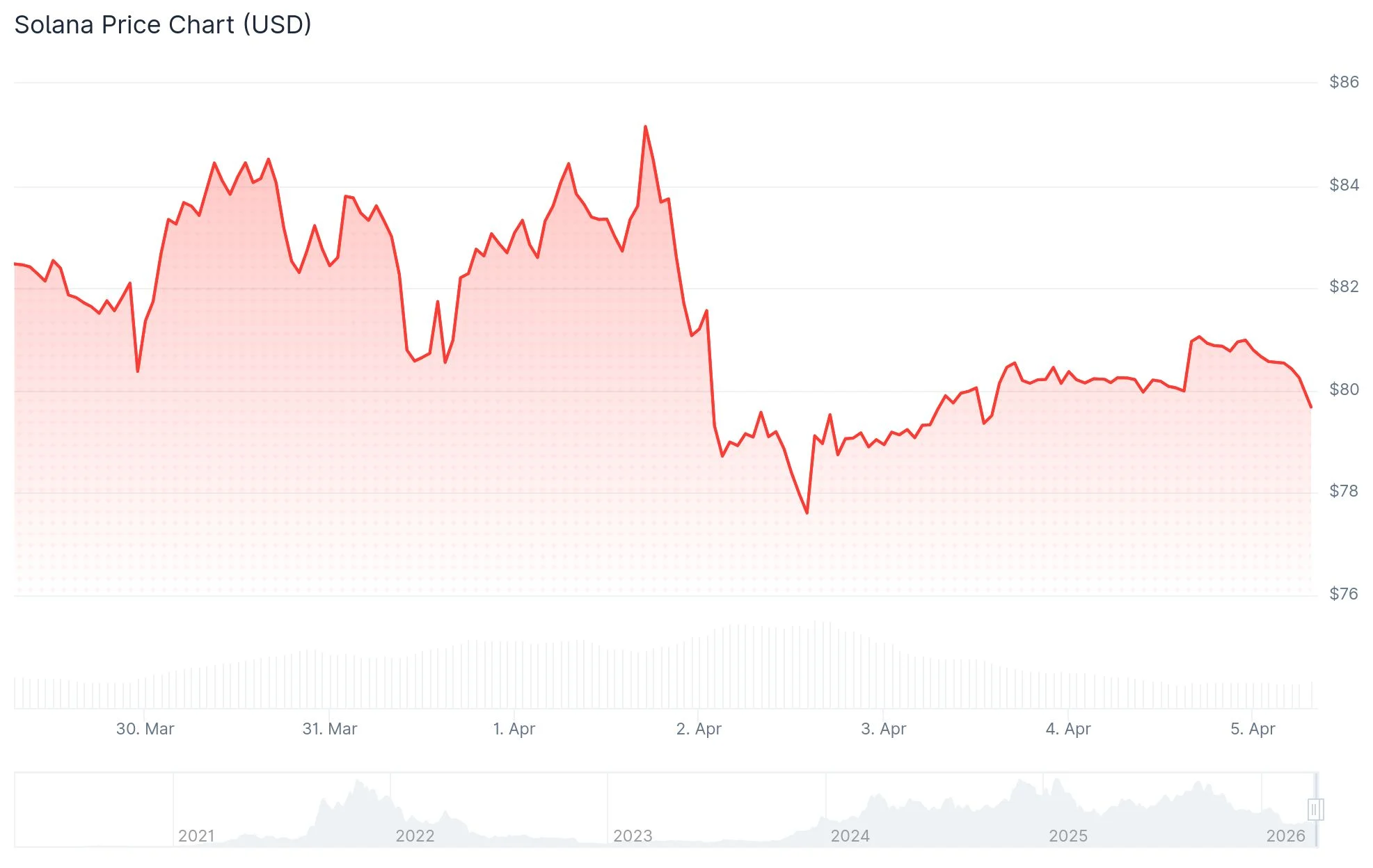
Solana (SOL) is grappling with heightened selling pressure following a substantial influx of tokens to centralized exchanges, compounding an already fragile technical outlook. The cryptocurrency is currently changing hands in the $79–$81 range, reflecting a 2.95% decline over the past seven days.
On-chain analytics from Ali Martinez revealed that roughly 1.40 million SOL tokens were transferred to exchanges within a three-day span. This movement represents approximately $110 million worth of SOL entering the market. Significant exchange deposits typically indicate that token holders are positioning to liquidate their holdings.
The chart structure reinforces the bearish narrative. According to Crypto_Scient, SOL has broken down from a daily bear flag formation, surrendering a crucial market structure level near $85. This threshold previously served as the dividing line between bullish and bearish control, and its loss has exposed lower price targets.
Additionally, a bearish crossover has materialized on the 4-hour chart, where the SMA-20 has dipped beneath the SMA-50. This pattern historically precedes additional downward movement. SOL is now trading beneath a significant supply zone, with the market accepting progressively lower valuations.
Critical Support Zones Under Watch
Short-term demand has been providing a floor around the $77 level, which has absorbed recent selling in the past few sessions. Should this support fail, analysts are eyeing a secondary support band in the $63 to $67 area.
Analyst Marcus Corvinus observed that the $92–$95 zone previously served as a robust defense level, but selling pressure intensified at that range, driving SOL into the $75–$78 territory. He characterized this area as a pivotal battleground where the market’s response will likely dictate the next significant price swing. A breakdown from here could accelerate losses, whereas a successful defense might ignite a sharp short squeeze.
The next substantial support zone is positioned between $66 and $70, consistent with observations from Crypto_Scient. Any rally toward the $84–$89 range might simply represent a retest of the breached structure rather than a genuine trend reversal.
Institutional Momentum Persists
Notwithstanding the price deterioration, Solana’s network continues attracting meaningful real-world adoption. SoFi recently unveiled an enterprise banking platform constructed on Solana’s blockchain infrastructure, facilitating both fiat and stablecoin settlement capabilities. The value of tokenized real-world assets on the network has crossed the $2 billion threshold, with major payment processors leveraging Solana for stablecoin transactions.
Crypto Patel emphasized that Solana has received commodity classification from regulators, positioning it within a favorable regulatory framework. The token currently trades approximately 77% below its historical peak.
Analyst RoccobullboTTom pointed out that sustained long-term support is developing in the $75 to $85 corridor. A recapture of the $100 level would signal a momentum shift, with subsequent resistance targets at $120 and $125.
A recent $285 million security breach affecting Drift Protocol and impacting 20 separate protocols has contributed to elevated near-term risk perception across the network.
Daily trading volume currently stands above $1.68 billion, demonstrating that market engagement remains robust despite the downward price trajectory.
