



Key Highlights
- Bitwise Asset Management and Lombard have joined forces to enable institutional Bitcoin holders to generate yields and access liquidity without transferring assets from custody
- The solution leverages “Bitcoin Smart Accounts” technology to bridge institutional custody systems with blockchain-based finance
- Morpho, a decentralized lending platform, will supply the underlying borrowing technology
- Approximately $500 billion in institutionally-held Bitcoin remains largely disconnected from DeFi opportunities, according to Lombard’s estimates
- Launch timeline targets Q2 2026, with plans to integrate additional custodians following initial deployment
Lombard, which specializes in Bitcoin lending infrastructure, has unveiled a strategic alliance with Bitwise Asset Management designed to enable institutional investors to activate their Bitcoin holdings while maintaining existing custody arrangements.
The collaboration was announced at New York’s Digital Asset Summit. The offering specifically addresses the needs of asset management firms, corporate treasury departments, and ultra-high-net-worth clients holding substantial Bitcoin positions with limited return-generating alternatives.
According to Jacob Phillips, Lombard’s Chief Executive Officer, the breakthrough centers on what the company calls “Bitcoin Smart Accounts.” This technology creates a bridge between institutional custody infrastructure and blockchain-based financial services—two ecosystems that have remained largely disconnected.
Bitwise will develop and manage the yield-generation strategies. The approach will integrate decentralized finance lending mechanisms with tokenized traditional assets. The borrowing framework will be powered by Morpho, a decentralized protocol specializing in Bitcoin-backed loans.
The technology stack employs Bitcoin-specific instruments, including partially signed Bitcoin transactions (PSBTs) and timelock mechanisms, to authenticate collateral positions. This architecture enables onchain representation of lending positions without requiring actual movement of the underlying Bitcoin assets.
Phillips emphasized that the system simultaneously eliminates three major risk factors: custody risk, bridge risk, and counterparty risk. These concerns have traditionally posed significant barriers to institutional participation in Bitcoin lending markets.
Lombard’s research indicates approximately $500 billion in Bitcoin value currently resides in institutional custody arrangements. The vast majority of these holdings remain isolated from blockchain financial markets and produce zero yield.
Bitcoin’s DeFi Presence Remains Modest Despite Recent Growth
Currently, Bitcoin’s total value locked across DeFi protocols stands at approximately $2.93 billion, based on DefiLlama tracking data. While this represents a modest fraction of Bitcoin’s roughly $1.4 trillion total market capitalization, the figure has demonstrated consistent expansion.
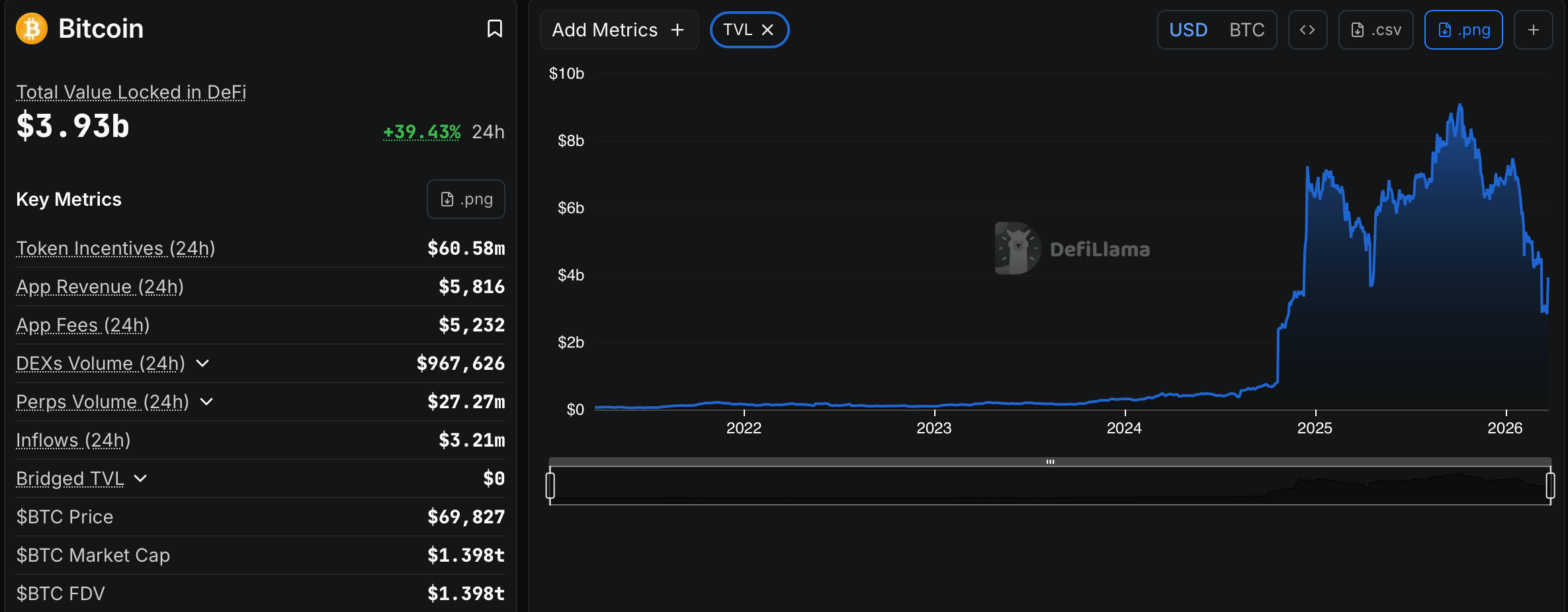
Babylon Protocol dominates Bitcoin DeFi with approximately $2.8 billion in total value locked. Lombard holds the second position with roughly $744 million.
Additional market developments signal growing momentum. Telegram incorporated yield-generating vault functionality into its cryptocurrency wallet during February, supporting Bitcoin, Ether, and USDT. The following month, Babylon integrated with hardware wallet manufacturer Ledger, enabling users to generate returns while maintaining self-custody through hardware-secured transaction signing.
Bitwise had previously collaborated with Morpho in January to introduce non-custodial vaults focused on yield generation through overcollateralized lending arrangements.
Implications for Institutional Market Participants
Institutional investors have faced constrained options until now. Traditional methods of generating Bitcoin yields or accessing liquidity have required exiting custody arrangements, accepting counterparty exposure, or creating taxable events.
The Lombard-Bitwise framework is engineered to circumvent all three limitations. By preserving Bitcoin within original custody structures, institutions avoid modifications to their asset holding protocols.
Phillips characterized the innovation as transforming Bitcoin from static value storage into productive investment capital. The product launch is scheduled for Q2 2026, with Lombard committing to expand custodian partnerships and protocol integrations following the initial release.
