



Key Takeaways
- JPMorgan reduced its year-end 2026 S&P 500 forecast from 7,500 to 7,200
- Crude oil prices have climbed more than 40%, with global supply disruptions reaching 8 million barrels daily
- Market participants remain highly leveraged despite hedging activity, with exposure near record levels
- Sustained oil prices around $110 per barrel could reduce S&P 500 earnings forecasts by 2–5%
- The bank recommends overweight positions in Defense, Energy, Utilities, and Cybersecurity
JPMorgan has revised its S&P 500 price projection for year-end 2026 downward to 7,200 from a previous estimate of 7,500. The financial institution warns that equity markets are underestimating the combined threats posed by Middle Eastern instability, elevated crude prices, and excessive investor confidence.
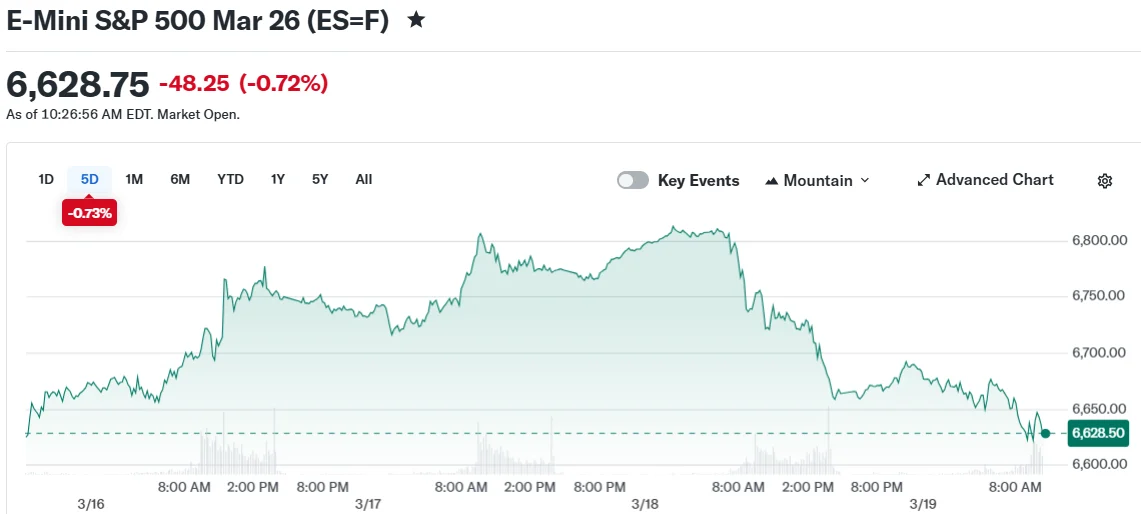
Analyst Dubravko Lakos-Bujas authored the research note, observing that the S&P 500 has declined merely 3% despite crude oil soaring over 40%.
He credited this relative stability to capital flows seeking safety in American assets. However, he cautioned that this apparent composure might be deceptive.
According to Lakos-Bujas, market participants have predominantly employed hedging strategies rather than meaningfully cutting risk exposure. Gross leverage sits near the 95th percentile when viewed historically, representing a significant vulnerability.
JPMorgan’s analysis suggests markets are betting on a swift resolution to Middle Eastern hostilities and a prompt reopening of critical shipping routes. The firm characterized this expectation as “high-risk.”
Historical patterns show oil and stock prices typically diverge when crude rallies exceed 30%. That critical inflection point has already been breached.
Global Oil Production Faces Unprecedented Disruption
Oil supply interruptions have hit 8 million barrels per day, marking an all-time high. JPMorgan projects this figure could escalate to 12 million barrels daily, representing approximately 11% of worldwide production capacity.
The bank emphasized that inflation isn’t the primary concern. Instead, the greater danger lies in extended disruptions suppressing demand, which would compress GDP growth, corporate revenues, and profitability through what the firm describes as “forced demand destruction.”
Should crude maintain levels near $110 per barrel, JPMorgan projects that Wall Street’s S&P 500 earnings expectations could face reductions ranging from 2 to 5%.
Additional challenges confront the benchmark index. Lakos-Bujas pointed to turbulence in private credit markets, indications that artificial intelligence momentum is waning, and deteriorating consumer purchasing power.
Critical Levels JPMorgan Is Monitoring
Should the S&P 500 break below its 200-day moving average, JPMorgan identifies minimal technical support until the 6,000–6,200 zone. Such a decline would constitute a substantial pullback from present valuations.
While not forecasting a market collapse, the bank advocates for defensive positioning. It suggests investors rotate into Low Volatility and Quality Growth equities.
Sector preferences highlighted in the research include Defense, Energy, Utilities, Materials, Cybersecurity, and Hyperscalers.
Though the analysis didn’t explicitly address cryptocurrency markets, escalating energy costs and macroeconomic instability have traditionally impacted risk-oriented assets like Bitcoin and alternative digital tokens.
JPMorgan’s adjusted 7,200 target represents its most current official projection as of March 19, 2026.
