



TLDR
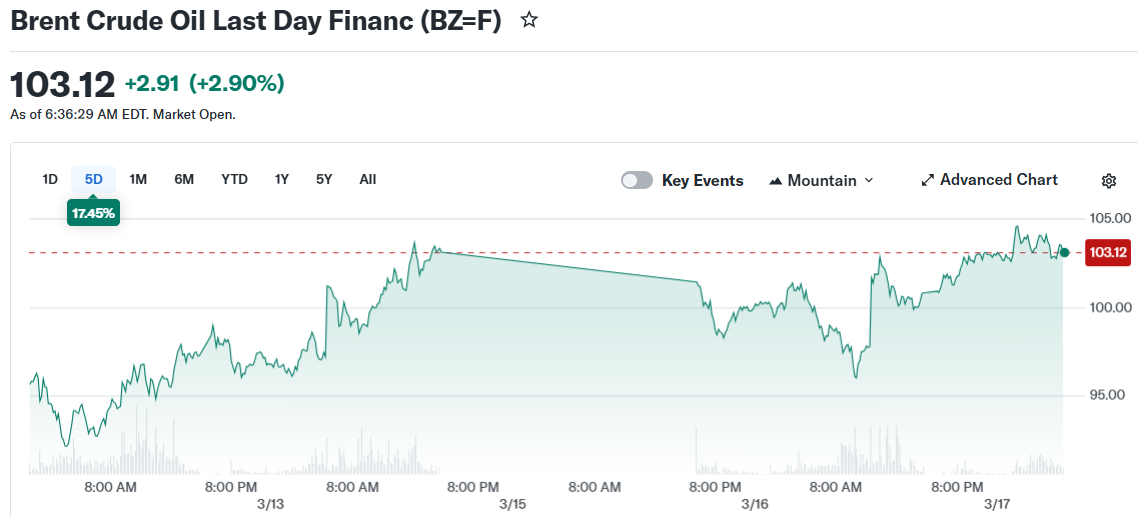
- Brent crude surpassed $104 per barrel while WTI hit approximately $97 amid continued Iranian strikes on Middle Eastern energy facilities
- UAE’s Shah gas field operations were suspended and crude shipments from Fujairah port came to a halt
- The critical Strait of Hormuz waterway continues to face significant blockades, impacting approximately 20% of worldwide oil transportation
- Energy prices have surged over 40% in the three weeks since hostilities commenced
- Key global central banks, including the Federal Reserve, ECB, and Bank of Japan, convene this week amid mounting inflation anxieties linked to energy costs
Energy markets experienced renewed volatility on Tuesday as crude prices rallied sharply following a temporary decline, while the three-week-old conflict involving the United States, Israel, and Iran shows no indication of de-escalation.
Brent crude pushed beyond the $104 per barrel threshold while West Texas Intermediate approached $97. The recovery came after both benchmarks experienced declines of approximately 3-5% during Monday’s trading session.
Iranian forces maintained their assault on energy infrastructure throughout the Middle East region. Operations at the United Arab Emirates’ Shah gas field were brought to a standstill. An oil facility in Iraq also suffered damage from drone and missile attacks.
Shipments of crude from Fujairah, the UAE’s strategic port facility, were suspended once more, as reported by Inchcape Shipping Services in their latest advisory. Both the UAE and Kuwait have implemented additional production cuts in response to the persistent security threats.
Oil values have climbed more than 40% since combat operations initiated, despite Monday’s temporary decline following Washington’s announcement regarding the initial deployment of strategic petroleum reserves.
Hormuz Strait Emerges as Critical Flashpoint
The strategically vital Strait of Hormuz, responsible for transporting roughly 20% of global petroleum supplies, continues to experience severe disruptions. Iranian authorities effectively closed the critical shipping corridor earlier this month.
Limited progress emerged Monday when vessels flying Indian and Pakistani flags managed successful passage through the waterway. Tehran has indicated its willingness to permit transit for ships from select nations while maintaining restrictions on vessels connected to Washington and its coalition partners.
Analysts at JPMorgan noted that passage through the strait appears destined to become “increasingly conditional,” with Iranian authorities granting or denying access based on a ship’s national registry.
Several vessels have successfully navigated the waterway by utilizing routes that pass remarkably close to Iranian territorial waters, according to ship-tracking information compiled by Bloomberg.
Saudi Arabia has accelerated efforts to increase export capacity through alternative transportation corridors that completely circumvent the Hormuz chokepoint.
US President Donald Trump appealed to at least seven nations, including China, to assist in reopening the strategic waterway. His requests received minimal positive response. Trump has warned of expanded military operations targeting Kharg Island and Iranian petroleum infrastructure, despite previously avoiding strikes on energy-related assets in the area.
Treasury Secretary Scott Bessent informed CNBC that Washington is permitting Iranian crude shipments to continue transiting the waterway and has refrained from intervention in energy derivatives trading.
Rising Energy Costs Spark Global Inflation Concerns
The dramatic escalation in petroleum prices has intensified anxieties regarding energy-fueled inflation pressures. Multiple prominent central banking institutions, including the Federal Reserve, European Central Bank, and Bank of Japan, have scheduled policy meetings for this week.
Numerous Asian economies face particular vulnerability due to their substantial reliance on petroleum imports that typically transit through Hormuz, making the ongoing disruption especially problematic for regional markets.
Israeli authorities announced Tuesday that senior Iranian officials, including security chief Ali Larijani, were eliminated in recent operations. Iranian sources had not verified these claims as of Tuesday evening.
The volume of Iranian vessels traversing the waterway reached a wartime peak on Monday, including a crude tanker bound for Chinese ports, according to maritime data compiled by Bloomberg.
