



Key Highlights
- Circle’s USYC token has expanded to $2.2 billion in supply, surpassing BlackRock’s BUIDL to claim the top position among tokenized U.S. Treasury products
- BlackRock’s BUIDL fund has experienced a decline in market dominance from 46% at its height to approximately 18%
- Binance integrated USYC as off-exchange collateral on BNB Chain, contributing to $1.84 billion of USYC’s total supply on that blockchain
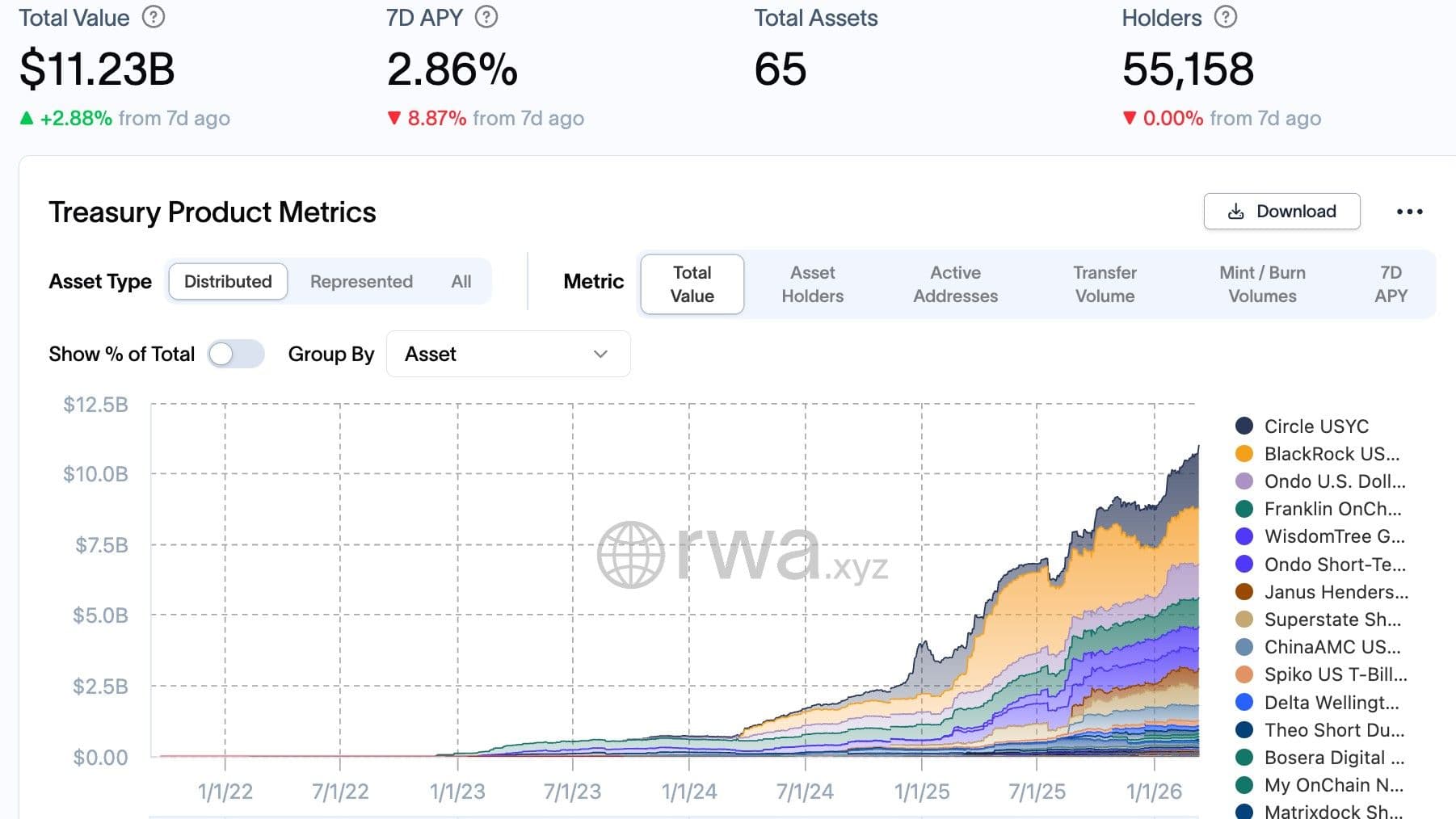
- The tokenized U.S. Treasury sector has reached an all-time high of $11 billion, representing a 27% increase year-to-date
- Market expansion accelerated during January’s crypto market correction as capital flowed into yield-generating blockchain-based products
In a significant milestone for blockchain-based financial products, Circle’s USYC token has claimed the position of the world’s largest tokenized U.S. Treasury offering, displacing BlackRock’s BUIDL fund from the top spot. This development signals a transformative moment in the rapidly expanding sector dedicated to digitizing traditional financial instruments on blockchain infrastructure.
According to data from RWA.xyz, USYC currently maintains approximately $2.2 billion in total supply. This figure positions it marginally ahead of BlackRock’s USD Institutional Digital Liquidity Fund, which currently stands at roughly $2 billion in assets.
Circle made its entrance into the tokenized fund ecosystem at the beginning of 2025 following its acquisition of Hashnote, which originally created USYC. The offering provides investors with access to U.S. Treasury yields while maintaining their holdings on blockchain technology.
BlackRock introduced BUIDL in early 2024 through a collaboration with blockchain tokenization specialist Securitize. During its peak performance in May 2024, BUIDL commanded a dominant 46% portion of the tokenized Treasury sector. However, that market position has contracted to approximately 18% as additional providers have launched competing products.
Tokenized Treasuries function by converting U.S. government debt into digital tokens on blockchain platforms. This structure enables investors to generate yields while simultaneously utilizing the tokens as collateral for trading activities — a capability not readily available with conventional Treasury investments.
Binance Partnership Drives USYC Expansion
A substantial portion of USYC’s recent momentum can be attributed to its integration with Binance. The cryptocurrency exchange incorporated USYC as off-exchange collateral for institutional derivatives trading on BNB Chain in July 2024.
This arrangement allows USYC to be maintained through Binance Banking Triparty or through Ceffu, Binance’s institutional custody solution. Following this integration, USYC’s circulation on BNB Chain has surged to $1.84 billion.
Circle CEO Jeremy Allaire described the utilization of tokenized Treasuries as collateral as “a major emerging use case” in a statement posted on X Friday.
The capacity to generate yields while simultaneously deploying an asset as trading collateral is viewed as a significant benefit compared to maintaining stablecoins or cash reserves, which generally provide no returns.
Tokenized Treasury Sector Hits All-Time High
The aggregate tokenized U.S. Treasury market has achieved a record valuation exceeding $11 billion, based on data from RWA.xyz. This milestone reflects a 27% expansion, equating to approximately $2.5 billion in additional value, since the beginning of 2026.
Market growth intensified throughout January’s cryptocurrency market decline. This trend indicates that certain investors redirected capital into tokenized Treasuries to secure consistent returns while positioned on the sidelines of the crypto market.
In contrast to conventional financial systems, blockchain-based tokens enable near-instantaneous settlement, verifiable reserves, and continuous accessibility — characteristics that are attracting institutional participants.
Securitize, which co-issues BUIDL, had not provided a response to requests for comment at the time of publication.
As of mid-March 2026, USYC maintains the leading position in a market that has now expanded beyond $11 billion in total assets under management.
