



Key Market Highlights
- Bitcoin maintains stability around $69,639 with a 1.2% gain despite escalating geopolitical tensions in the Middle East
- Crude oil surpassed the $100 per barrel threshold following a US military operation that destroyed 16 Iranian vessels near the Strait of Hormuz
- Equity index futures showed weakness on Thursday morning, with Dow, S&P 500, and Nasdaq contracts declining approximately 0.9–1%
- February’s Consumer Price Index registered 2.4% annually, aligning with analyst predictions, though market attention shifts toward oil-related inflationary pressures
- Congressional leaders are pursuing renewed momentum for the crypto CLARITY Act, with ongoing negotiations centered on stablecoin yield provisions
Bitcoin maintained its position near $69,639 during Wednesday’s trading session, posting a 1.2% daily increase. This performance unfolded against a backdrop of heightened Middle Eastern geopolitical risks and an inflation report that aligned with market forecasts.
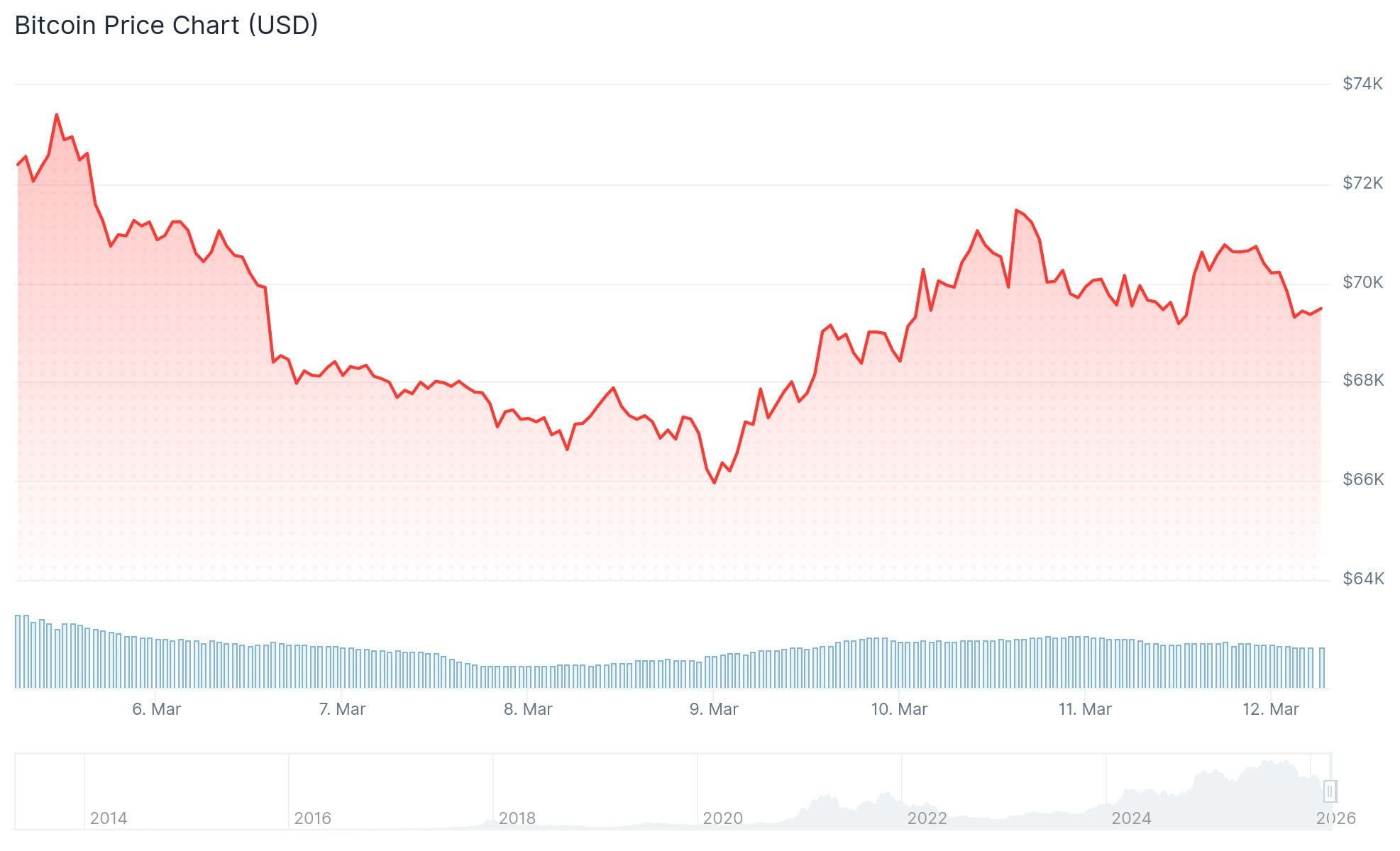
The aggregate cryptocurrency market capitalization remained anchored around $2.38 trillion, mirroring year-end 2024 valuations.
Dessislava Ianeva, an analyst at Nexo Dispatch, observed that funding rates are showing “neutral to slightly positive” characteristics across major digital assets, indicating controlled leverage levels throughout the market. Bitcoin perpetual futures open interest currently hovers around $28 billion, remaining beneath its October 2025 high-water mark.
Ethereum climbed 1.2% to reach $2,067. XRP registered a modest 0.1% uptick to $1.39. Solana advanced 1.2% while Cardano posted a 0.4% gain.
Crude Oil Breaches $100 Threshold as Middle East Tensions Intensify
US military forces reportedly destroyed 16 Iranian vessels believed to be deploying mines in the vicinity of the Strait of Hormuz. Additionally, two oil tankers sustained attacks in the Iraq Ports loading zone, prompting authorities to shut down Iraqi port operations.
Both West Texas Intermediate and Brent crude benchmarks surpassed $100 per barrel during early Thursday trading, following Wednesday’s settlement that saw gains exceeding 4%. Earlier in the week, oil prices had temporarily approached the $120 per barrel level.
The International Energy Agency disclosed plans for member nations to deploy approximately 400 million barrels from strategic reserves—a record-breaking release—yet prices maintained their upward trajectory.
President Trump indicated Wednesday that the US intends to “finish the job” within a compressed timeframe.
Equity Futures Decline as Market Participants Exercise Caution
US equity index futures retreated during early Thursday trading hours. Dow futures declined 1%. Contracts for both the S&P 500 and Nasdaq 100 dropped approximately 0.9%.
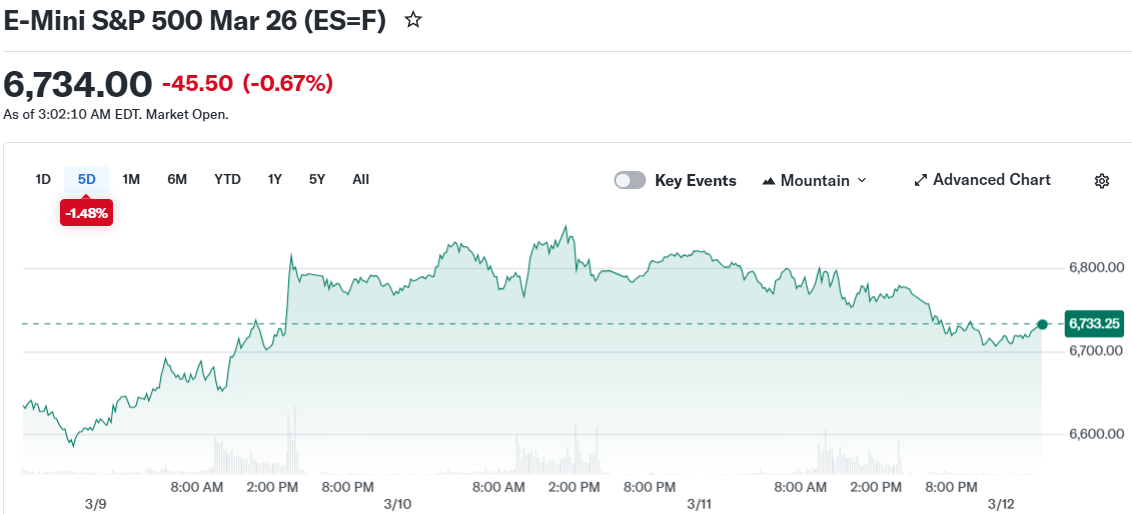
This marked consecutive trading sessions of predominantly negative performance on Wall Street.
February’s Consumer Price Index advanced 0.3% on a monthly basis and 2.4% year-over-year, perfectly matching economist projections. Core inflation metrics, excluding volatile food and energy components, registered 2.5% on an annual basis.
Sarah House, an economist at Wells Fargo, highlighted that February’s inflation data may already appear outdated, considering oil prices have surged approximately 25% since the conclusion of the previous month.
Financial markets are not anticipating any policy rate adjustments at the Federal Reserve’s March 18 meeting. September emerges as the next probable timing for a rate reduction, with roughly 43% probability assigned to an additional cut materializing before year-end.
Adobe and Dollar General are scheduled to release quarterly earnings results following Thursday’s closing bell.
On Capitol Hill, senators are investigating potential compromise language for the crypto CLARITY Act, with particular focus on regulatory frameworks governing yield generation on stablecoins. The proposed legislation seeks to establish clearer regulatory guidelines for digital asset oversight.
