




TLDR
- Wall Street strategist Ed Yardeni increased the likelihood of a U.S. equity crash to 35% from 20%
- Crude oil surpassed $100 per barrel, intensifying inflation concerns and growth slowdown worries
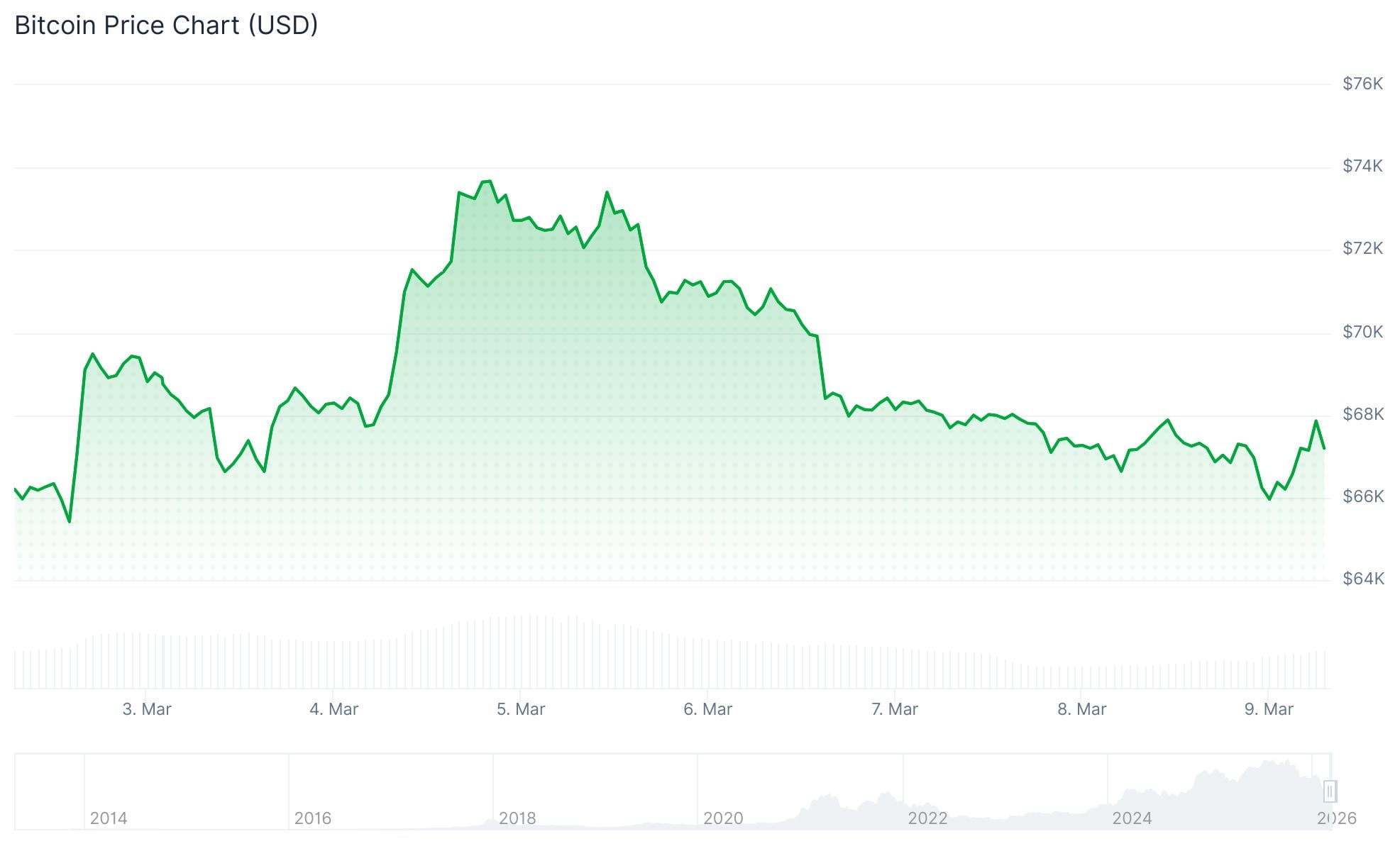
- Bitcoin maintains position around $67,000, showing resilience amid declining worldwide equities
- Research from NYDIG indicates just 25% of Bitcoin’s volatility correlates with stock market movements
- Iran appointed a new supreme leader, indicating ongoing geopolitical tensions and market instability ahead
Prominent Wall Street analyst Ed Yardeni has dramatically increased his forecast for a potential U.S. stock market crash to 35% through the remainder of 2025, a significant jump from his previous 20% projection. Simultaneously, he slashed his bullish market rally prediction to merely 5%, down from 20%.
This revised outlook emerges as crude oil prices breached the $100 per barrel threshold. Elevated energy prices heighten inflationary pressures while simultaneously constraining economic expansion, creating headwinds for both equity and cryptocurrency markets.
Yardeni characterized the situation succinctly: “The U.S. economy and stock market are stuck between Iran and a hard place. So is the Fed.”
Tensions between the U.S. and Iran remain on an upward trajectory. President Trump has issued warnings of additional military action following Iran’s refusal to de-escalate. The Middle Eastern nation also appointed a new supreme leader, Mojtaba Khamenei, successor to his father Ali Khamenei, who perished in a U.S. military operation. A senior Iranian security official declared that Trump “must pay the price” for the ongoing conflict.
Bitcoin was changing hands at approximately $67,378 on Monday, registering a modest gain of slightly over 1% across 24 hours. This represents remarkable stability considering the volatility sweeping through conventional financial markets.
S&P 500 futures plummeted more than 2% during Asian market hours. The VIX volatility index, commonly referred to as Wall Street’s fear gauge, reached its highest reading since the tariff-induced turmoil of April 2024. Meanwhile, the U.S. dollar recorded its strongest weekly performance in twelve months.
International markets experienced severe losses. The MSCI all-country world index declined 3.7% over the previous week. South Korea’s markets continue struggling to recover from unprecedented two-day losses. Institutional investors increased bearish positions in U.S. equity exchange-traded funds.
Market participants have also adjusted their Federal Reserve rate cut expectations, now anticipating the next reduction in September. Prior to the conflict’s escalation in late February, traders had fully anticipated a policy easing by July.
Bitcoin’s Price Is Not Fully Tied to Stocks
Analysis conducted by NYDIG reveals that approximately 25% of Bitcoin’s price fluctuations can be attributed to its relationship with U.S. equities. The remaining 75% stems from dynamics unique to the digital asset ecosystem.
Greg Cipolaro, NYDIG’s head of research, explained that Bitcoin’s recent correlation with software sector stocks reflects common sensitivity to prevailing economic conditions rather than a fundamental connection.
Nevertheless, Bitcoin has declined in tandem with equities during every significant risk-aversion episode since 2020.
Crypto-Linked Stocks Also Feel the Pressure
Equities connected to cryptocurrency have experienced substantial volatility as investor sentiment grows increasingly defensive. Bitcoin mining company Core Scientific liquidated portions of its digital asset reserves while pivoting toward an artificial intelligence-centered business model. The company’s shares declined around the timing of this transaction.
Ether gained 2.3% to trade near $1,981. Solana advanced 1.8% to $83.69 but continues to underperform among major cryptocurrencies on a seven-day basis, maintaining a 1.5% weekly decline.
Ten-year Treasury yields increased six basis points as bond markets factored in elevated inflation risks stemming from rising energy costs.
The S&P 500 fell 2% during the previous week, a relatively modest decline compared to international peers, partially due to America’s substantial domestic energy production capacity.
