




TLDR
- PI climbed as much as 16%, reaching a three-month peak above the $0.23 mark
- V20.2 protocol enhancement was successfully deployed on March 7, requiring all nodes to upgrade by March 12
- Proof-of-concept testing demonstrated Pi Nodes can facilitate decentralized AI training through idle computational resources
- The $0.28 threshold represents critical resistance, where previous rallies encountered selling pressure in Q4 2025
- March 14 Pi Day celebration may feature major updates including validator incentive structures and possible Kraken exchange integration
Pi Network’s native cryptocurrency has delivered consecutive double-digit percentage increases, climbing to levels not seen in approximately three months. The rally coincided with two significant technical developments within the ecosystem.
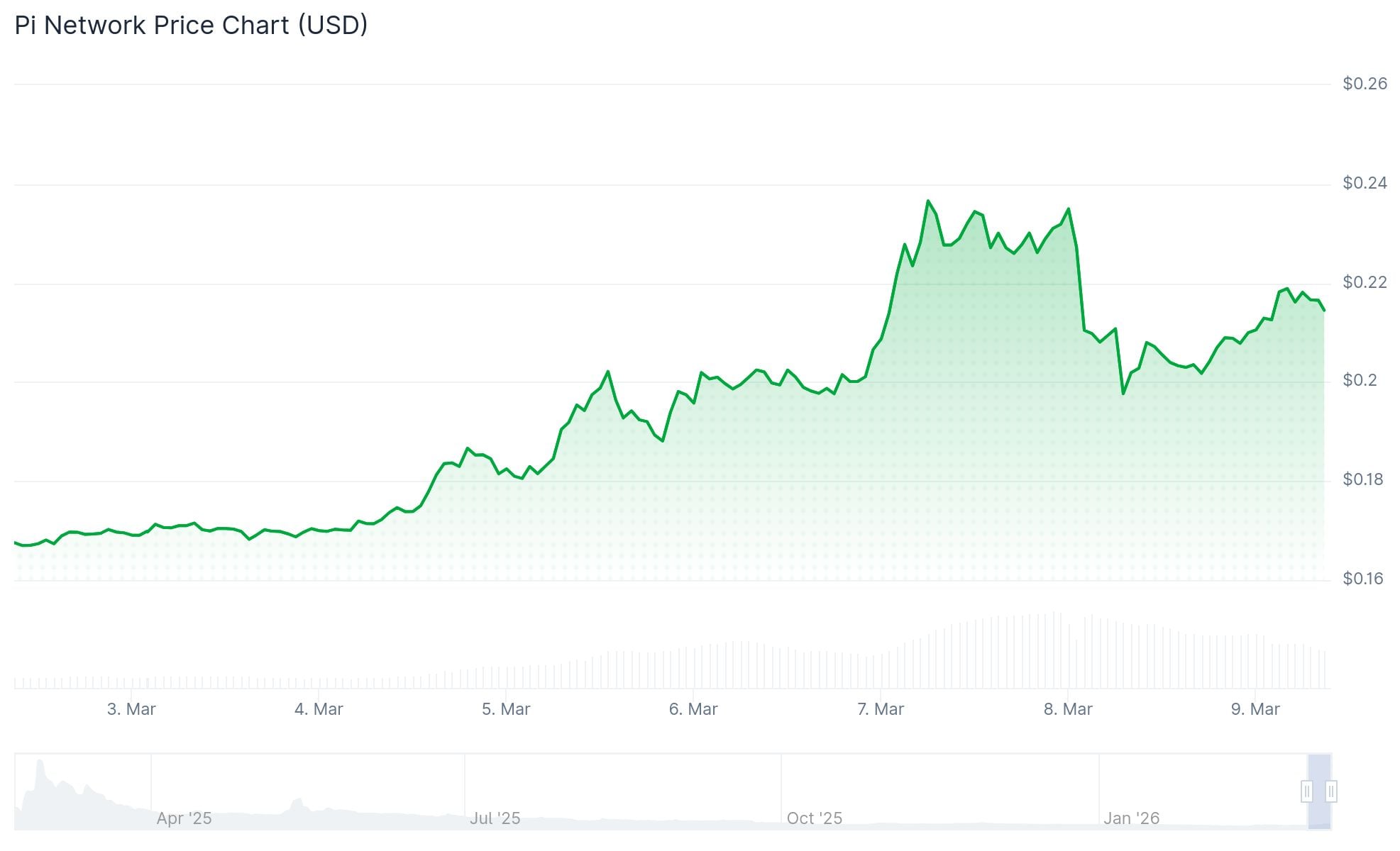
The V20.2 protocol enhancement was activated on March 7. Node operators across Pi’s mainnet must implement this mandatory upgrade before the March 12 cutoff date. The blockchain currently operates with more than 421,000 active nodes. While some brief service disruptions were observed during implementation, the network has since achieved full synchronization.
This update represents the third phase in Pi Network’s migration toward Stellar consensus protocol version 23, which is scheduled to finalize on March 12, just two days ahead of the annual Pi Day celebration on March 14.
Decentralized AI Computing Experiment
The Pi Network development team released a case study earlier this week examining innovative applications for its node infrastructure. Researchers evaluated whether the Pi Node network could support decentralized artificial intelligence training and computational workloads by utilizing unused processing capacity.
The experimental phase involved collaboration with seven volunteer node operators and OpenMind, a robotics company supported by Pi Network Ventures. Testing confirmed that computational tasks were properly distributed to participating nodes and accurate results were successfully delivered to external clients.
With 421,000 nodes representing over one million CPU cores, the network possesses substantial untapped computational power. The development team indicated this capacity could be made available to external organizations requiring large-scale processing resources, with participating node operators earning cryptocurrency compensation for completed work.
Pi Network’s tens of millions of KYC-authenticated users could also contribute human feedback for artificial intelligence training applications, according to the team.
Technical Analysis and Price Targets
From a technical perspective, PI Coin successfully breached a descending trendline near $0.23 that had restricted upward movements throughout February. The Supertrend indicator transitioned to bullish territory for the first time in several weeks, currently positioned at $0.1843.
All four exponential moving averages remain positioned beneath the current trading price. The 100-day EMA at $0.1969 represents the initial resistance barrier, followed by the 200-day EMA at $0.2876.
The $0.28 zone has emerged as the most critical level for market participants. During Q4 2025, PI rallied from approximately $0.19 but encountered significant resistance at $0.28, leading to a sharp reversal. Successfully breaking through this level would decrease the probability of history repeating itself.
Trading activity is intensifying, though CryptoQuant’s spot volume metrics remain in neutral territory, indicating speculation hasn’t reached excessive levels yet.
PI currently holds the 40th position by market capitalization on CoinGecko, with total valuation exceeding $2.2 billion. Nearly 21 million tokens entered circulation on March 7, with additional token release events scheduled for upcoming days.
