



Key Takeaways
- Crude oil skyrocketed more than 36% over seven days, breaching $91 per barrel, following Iran conflict that disrupted critical Strait of Hormuz routes
- Year-to-date, the S&P 500 has declined 1.5%; the Nasdaq Composite has fallen 3.7% from the start of January
- February’s employment report showed a loss of 92,000 positions, significantly missing economist projections of 55,000 gains
- Oracle releases quarterly results on Tuesday; Adobe and Hewlett Packard Enterprise follow later in the week
- Critical inflation metrics arrive Wednesday with CPI and Friday with PCE data, setting the stage for the Fed’s upcoming rate decision
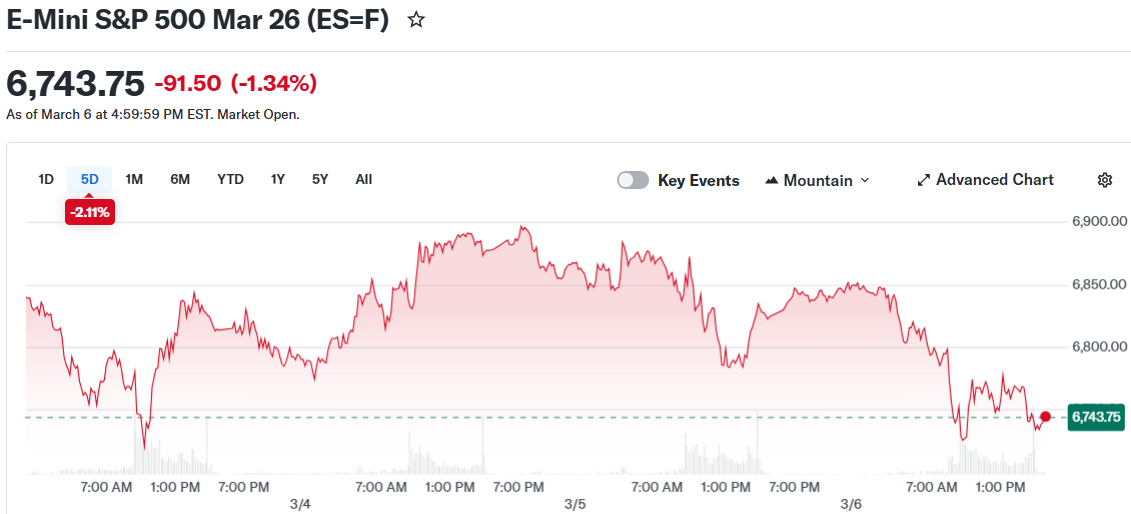
Equity markets concluded Friday’s session sharply lower, wrapping up one of 2026’s most challenging trading weeks. The S&P 500 declined 1.3% in Friday’s session alone, bringing year-to-date performance to negative 1.5%. The Nasdaq Composite slid 1.6% on Friday and currently sits 3.7% below its January 1st starting point. The Dow Jones Industrial Average surrendered approximately 450 points during the day’s trading.
The primary catalyst for widespread market weakness remains the escalating Iranian conflict, which has effectively shut down petroleum shipments through the Strait of Hormuz. During typical conditions, this critical waterway facilitates approximately 20% of global seaborne crude transport.
With passage currently blocked, roughly 16 million barrels remain immobilized without viable alternative routes, according to analytics from Vortexa. Storage facilities have reached capacity. Production is being curtailed. Oil prices have exploded upward by over 36% within just seven days, climbing above $91 per barrel — representing the largest weekly percentage increase dating back to at least 1985.
Macquarie’s global energy strategist Vikas Dwivedi cautioned that “a few weeks of Hormuz closure will create a domino effect of events that could push crude to $150 or higher.” Multiple analysts are now treating this price level as a genuine scenario.
Central Bank and Inflation Concerns
The timing of this energy price surge couldn’t be more problematic for the Federal Reserve. Mary Daly, president of the San Francisco Fed, acknowledged to CNBC on Friday that “the oil price shock, depending on how long it lasts, is a real thing.”
According to Goldman Sachs projections, sustained elevated crude prices over multiple months could push annualized headline inflation back toward the 3% range. The Federal Reserve’s stated objective remains 2%.
The ten-year Treasury yield has climbed back above the 4.14% threshold. Market expectations for rate reductions have moderated as participants evaluate whether rising energy costs might stall disinflationary momentum. Fed policymakers including Neel Kashkari and John Williams have indicated it remains premature to fully assess the situation’s implications.
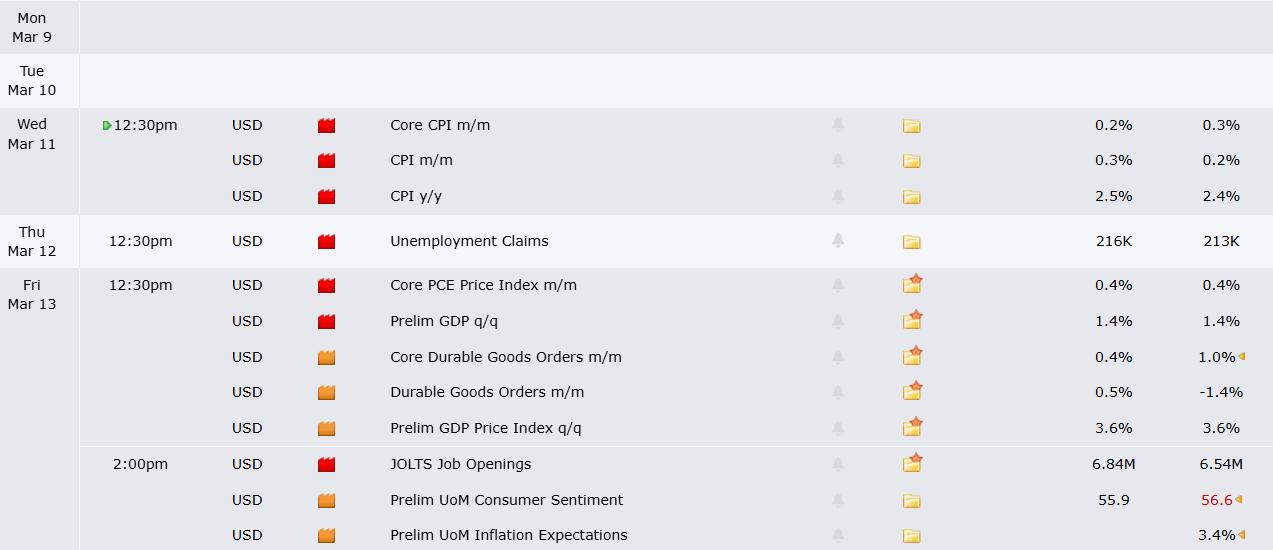
Wednesday’s February Consumer Price Index release and Friday’s January Personal Consumption Expenditures report will provide crucial insight into pricing trends before next week’s Federal Reserve policy meeting.
Employment Data Disappoints
February’s labor market report compounded existing concerns. The US economy shed 92,000 positions, falling well short of the anticipated 55,000 job additions. The unemployment rate increased to 4.4% from January’s 4.3% reading.
Certain economists attributed the weakness to temporary variables, including a Kaiser Permanente labor action that eliminated 37,000 positions from the tally. BNP Paribas economist Andrew Husby characterized the outcome as driven by “special factors.”
Others expressed skepticism. Gina Bolvin from Bolvin Wealth Management identified “a bifurcated market — slower macro growth paired with accelerating technological transformation.” Block, led by Jack Dorsey, eliminated 4,000 positions in February, with its CFO citing artificial intelligence as the direct driver.
[[LINK_START_4]]Oracle[[LINK_END_4]] delivers quarterly results on Tuesday. The company’s shares have tumbled more than 50% from September peak levels. Management recently unveiled plans to secure $50 billion in financing for artificial intelligence data center development. Adobe and Hewlett Packard Enterprise are also scheduled to report this week, along with Dollar General, Li Auto, and Nio.