




TLDR
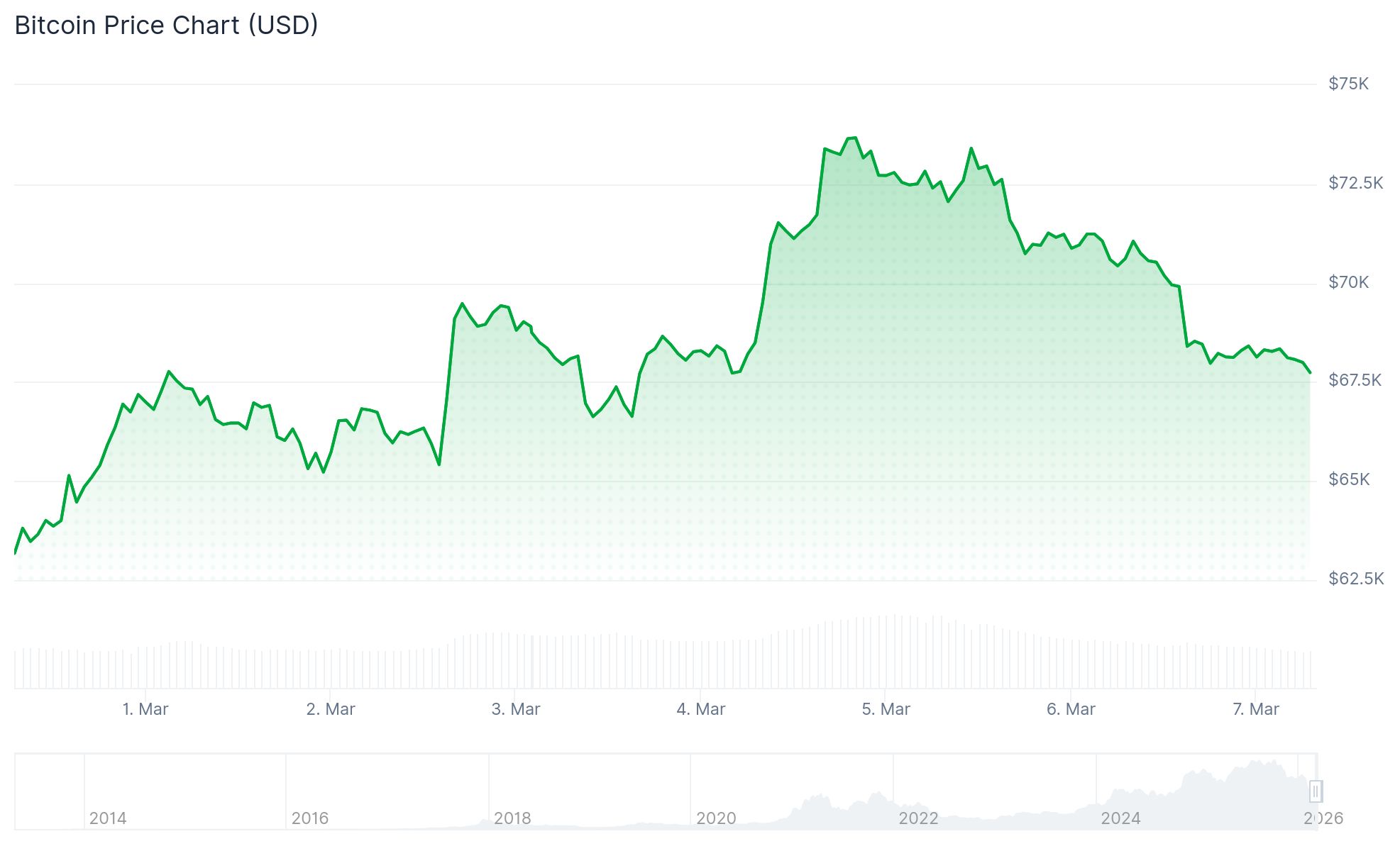
- Bitcoin declined 3.4% to approximately $68,000 on Saturday following a mid-week peak of $74,000
- February saw the U.S. economy shed 92,000 jobs, with unemployment climbing to 4.4%, causing market turbulence
- The greenback recorded its most significant weekly advance in twelve months, weighing on digital assets
- Large holders liquidated approximately 66% of their recent BTC accumulation while smaller investors continued purchasing
- Bitcoin ETFs experienced $348.9 million in withdrawals — the heaviest single-day exodus in three weeks
Bitcoin’s trajectory this week painted a picture of volatility and reversal. After surging to $74,000 on Thursday, the leading cryptocurrency reversed course sharply, settling near $68,000 by Saturday morning — representing a 3.4% decline over a 24-hour period.
The downturn followed disappointing employment data from the Bureau of Labor Statistics, revealing the U.S. economy contracted by 92,000 positions in February. This figure starkly contrasted with economist projections of a 50,000-job increase. Simultaneously, the unemployment rate ticked upward from 4.3% to 4.4%.
Traditional financial markets absorbed the shock as well. The Dow Jones Industrial Average plummeted over 900 points during Friday’s opening session. The tech-heavy Nasdaq Composite retreated 1.7%.
The broader cryptocurrency ecosystem mirrored Bitcoin’s weakness. Ether declined 4.4% to $1,974. Solana shed 4% to reach $84.31. Dogecoin decreased 2.9% to $0.09. XRP slipped 2.2% to $1.37.
Despite Friday’s selloff, the weekly performance for most leading cryptocurrencies remained positive. Bitcoin registered a 3.6% gain across the seven-day period. Ether advanced 2.6%. BNB climbed 2.1%.
Whale Selling and ETF Outflows
Santiment analytics revealed that large holders — defined as wallets containing between 10 and 10,000 BTC — accumulated positions during February 23 through March 3 while Bitcoin traded in the $62,900 to $69,600 range. As Bitcoin breached $70,000 and touched $74,000, these same entities liquidated approximately 66% of their recently acquired holdings.
Conversely, smaller market participants — defined as those holding less than 0.01 BTC — increased their positions. Santiment’s analysis suggests this divergence in behavior often indicates further downside potential.
Spot Bitcoin ETF products registered $348.9 million in net withdrawals on Friday, marking the most substantial single-day outflow since February 12.
Analyst Michael van de Poppe said: “If Bitcoin doesn’t find support in this $67–68K region, then we’re likely going to retest the lows.”
Macro Headwinds
The U.S. dollar experienced its strongest weekly performance in a year. Escalating oil prices — with Brent crude reaching $90 per barrel, representing a 20%-plus weekly surge — combined with persistent Middle Eastern tensions elevated inflation concerns, diminishing expectations for imminent Federal Reserve interest rate reductions.
Glassnode analytics indicated that 43% of Bitcoin’s circulating supply currently sits underwater. This dynamic generates selling pressure during price rallies as holders seek to exit at breakeven levels.
A potentially encouraging signal emerged: net stablecoin inflows surged 415% to $1.7 billion during the week, indicating substantial capital waiting to enter the market.
Economist Timothy Peterson observed that Bitcoin’s present price range has historically represented a floor, citing a 99.5% statistical probability that BTC maintains levels above $60,000.
The Crypto Fear & Greed Index dropped to 12 on Saturday, firmly in “Extreme Fear” territory.
