




Key Takeaways
- Military operations by US and Israel in Iran resulted in the death of Ayatollah Khamenei, driving oil prices up approximately 8% to nearly $80 per barrel
- Trump indicates operations will span 4–5 weeks; economic analysts emphasize conflict duration as critical factor for economic impact
- European economies face highest vulnerability among major economies given dependence on Middle Eastern energy supplies
- Closure of the Strait of Hormuz could drive crude above $100/barrel, potentially pushing US pump prices to approximately $4.50/gallon
- Federal Reserve increasingly likely to maintain current interest rate policy as inflationary pressures mount
Over the weekend, coordinated military operations by the United States and Israel targeted Iran, resulting in the death of Supreme Leader Ayatollah Ali Khamenei. The action sparked retaliatory responses throughout the Middle East region and drove energy prices significantly upward.
Crude oil markets experienced an approximately 8% surge on Monday, pushing prices through the $80 per barrel threshold. Prior to the military escalation, oil had been trading around the $65 per barrel level.
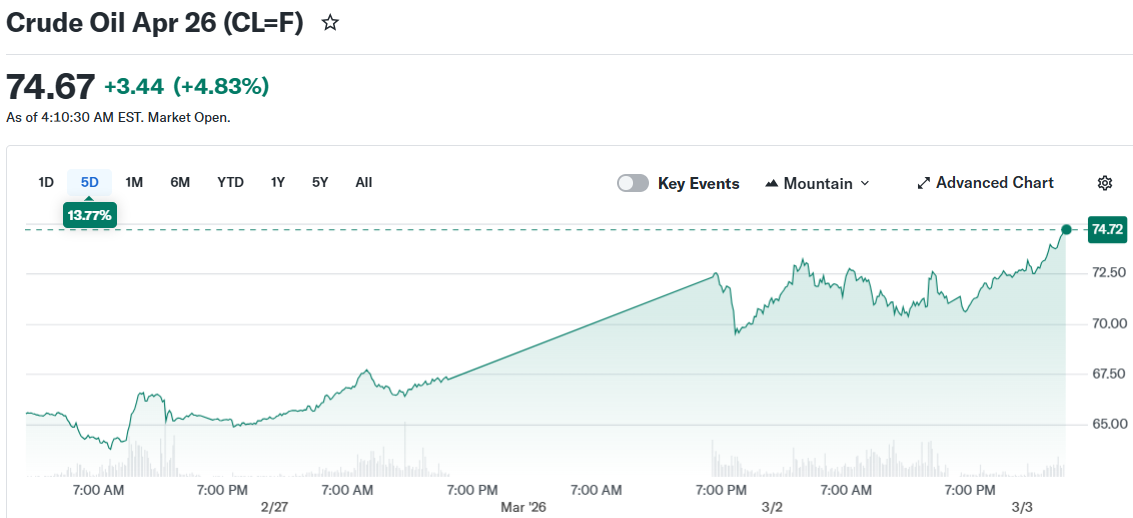
Trump indicated the military campaign is projected to continue for four to five weeks, though he emphasized the US stands ready to extend operations for “whatever it takes.” Defense Secretary Pete Hegseth stated this would not evolve into an extended engagement similar to Iraq.
Economic analysts emphasize that conflict duration represents the most critical variable in determining the scope of global economic impact. A brief military engagement may produce only temporary energy market volatility. An extended conflict could trigger substantial economic disruption.
The Strait of Hormuz, over which Iran maintains significant control, serves as a vital passage for global energy transport. Approximately 20% of worldwide seaborne oil and gas transits through this waterway. Tanker movement has already experienced slowdowns following the outbreak of hostilities.
Economic Impact of Strait Closure
Should oil shipments through the strait fail to resume normal flow, crude prices could stabilize above $100 per barrel, according to projections from energy consultancy Wood Mackenzie. Such an increase would elevate US gasoline prices from the current $3 level to approximately $4.50 per gallon.
This price increase alone would contribute 1.5 percentage points to US headline inflation figures, according to analysis from ING’s James Knightley. Secondary effects would emerge through elevated airfare costs and transportation expenses.
The Federal Reserve had previously suspended its interest rate reduction cycle. Former Treasury Secretary Janet Yellen stated the Iran situation “puts the Fed even more on hold.”
Economists at Natixis detailed two possible scenarios. The first envisions US economic growth decelerating to a range between 0.5% and 1.5% for the current year. The second scenario projects economic contraction lasting at least two quarters should the conflict expand and disrupt international shipping networks.
The United States maintains some insulation due to its current status as a net energy exporter. RSM chief economist Joseph Brusuelas indicated the initial market reaction does not present “any material risk to US growth or inflation outlooks” at this juncture.
European Economies Face Greater Vulnerability
Europe confronts heightened risk exposure. ING economist Carsten Brzeski characterized the eurozone as the “most exposed major economy” to consequences stemming from the Iran conflict given its reliance on regional oil and gas resources.
European economic conditions had been showing signs of improvement, with expanded government expenditure in Germany anticipated to underpin moderate growth. The Iran escalation introduces fresh uncertainty into that recovery trajectory.
Bloomberg Economics indicated that containment of damage remains possible if the conflict proves short-lived. A protracted conflict sustaining elevated energy prices could compel European governments to expand spending to shield consumers.
European natural gas markets experienced sharp price increases on Monday as Gulf region supplies faced threats.
