



TLDR
- XRP declined 1.90% to $1.36 amid heightened geopolitical tensions that prompted risk-off behavior in crypto and stock markets
- Spot XRP exchange-traded funds in the US attracted $6.97 million, marking the strongest single-day inflow in roughly 30 days
- Approximately 38.8% of alternative cryptocurrencies are hovering near record lows, exceeding distress levels seen after the FTX implosion
- Technical chart analysis reveals a bear pennant formation suggesting potential downside movement of 35% toward $0.86
- Hidden Road’s activation on the NSCC directory as of March 2 reinforces Ripple’s expanding institutional framework
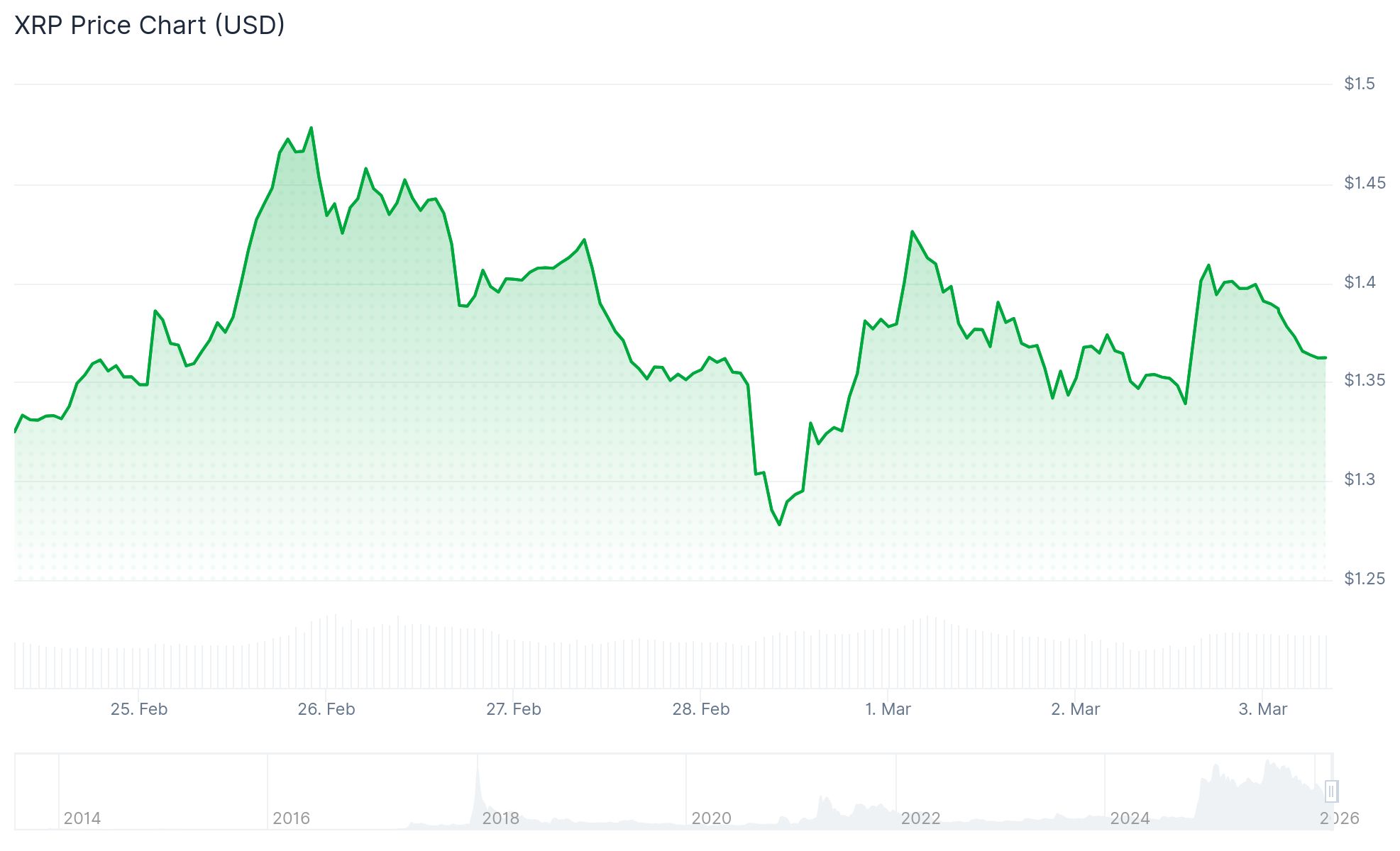
Ripple’s native token XRP experienced a 1.90% decline on March 3, settling near $1.36 as escalating Middle East conflict and surging energy costs sparked widespread selling pressure across risk assets.
Energy markets experienced significant volatility. West Texas Intermediate crude surged 6.3% to reach $71.23 per barrel, while Brent crude climbed 7% to $77.74. Natural gas prices in Europe skyrocketed between 40% and 50% following reports of tanker disruptions in the Strait of Hormuz, suspended liquefied natural gas production in Qatar, and operational constraints at Saudi Arabia’s Ras Tanura facility.
Elevated energy costs typically fuel inflation concerns. This dynamic can drive treasury yields upward and diminish expectations for monetary easing — market conditions that generally create headwinds for speculative assets including XRP.
Federal Reserve officials John C. Williams and Neel Kashkari had speaking engagements scheduled for March 3. Market participants closely monitored their remarks for insight into how energy-related inflation pressures might influence future interest rate policy decisions.
Despite the negative price movement, US-based spot XRP exchange-traded funds registered their most substantial single-day capital influx in approximately 30 days. According to SoSoValue analytics, $6.97 million entered these products, pushing aggregate net assets to approximately $1.02 billion. The data suggests certain investors viewed the pullback as a buying opportunity within regulated investment vehicles.
Altcoin Market Under Pressure
XRP’s weakness reflects broader challenges across the altcoin sector. Research from CryptoQuant indicates that roughly 38.8% of alternative cryptocurrencies are currently trading near their all-time lows. This metric actually surpasses the distress observed immediately following the November 2022 FTX exchange collapse, when the comparable figure registered near 37.8%.
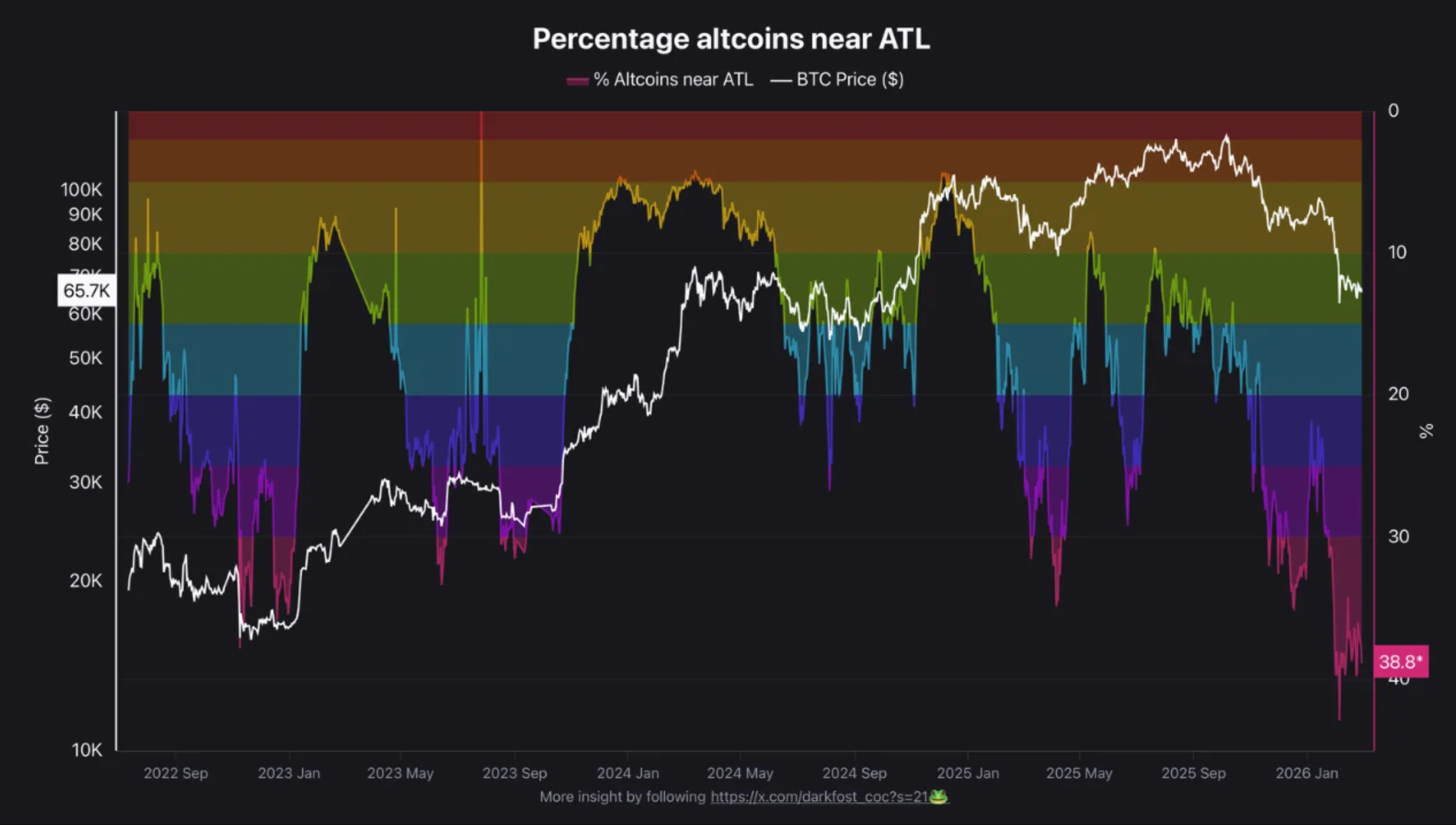
When substantial portions of the altcoin market trade near historical bottoms, capital frequently rotates into Bitcoin or assets perceived as relatively safer. This environment can constrain XRP’s ability to mount sustained rallies, even when buying interest materializes.
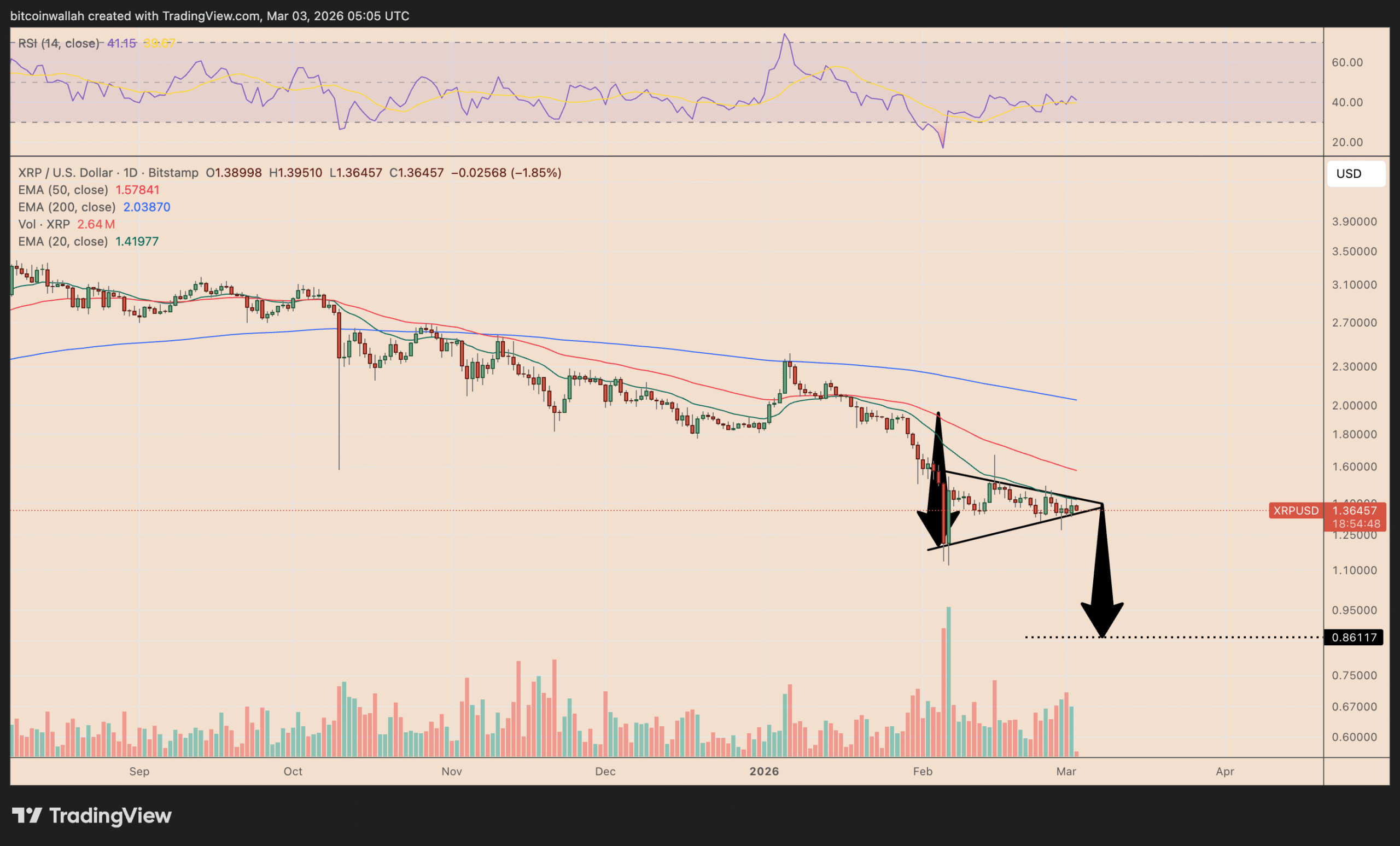
From a technical perspective, XRP has been range-bound following its descent from approximately $2.40 earlier in the year. The token continues trading beneath its 50-day simple moving average positioned near $1.62. The relative strength index hovers around 40, indicating subdued momentum without reaching oversold territory.
Critical support exists between $1.30 and $1.32, with a more robust demand area around $1.20. Overhead resistance appears at $1.45, followed by the 50-day SMA at $1.62. A bear pennant configuration visible on the daily timeframe, if validated through a breakdown below support levels, projects a measured downside objective near $0.86.
Ripple’s Institutional Push
Regarding institutional developments, Hidden Road officially commenced operations on the National Securities Clearing Corporation directory as of March 2, 2026, according to documentation from the Depository Trust & Clearing Corporation. The NSCC facilitates post-trade clearing and settlement services for US equity markets.
Hidden Road’s integration enhances Ripple Prime’s capacity to bridge conventional financial systems with distributed ledger technology.
While this development doesn’t immediately generate XRP buying pressure, market observers frequently interpret institutional infrastructure expansion as constructive for long-term XRPL ecosystem growth.
JPMorgan analysts also indicated that comprehensive US crypto market structure legislation could achieve passage by mid-2026, which the investment bank characterizes as potentially beneficial for digital asset valuations.
