




Key Takeaways
- Jan van Eck, CEO of VanEck, believes Bitcoin is establishing a market floor as the four-year halving cycle nears its conclusion in 2026.
- Bitcoin hovers around $68,000, showing a 2.6% gain over 24 hours and 7.6% increase across the last seven days.
- Spot Bitcoin ETFs in the United States recorded $458 million in daily inflows, marking one of Q1’s most impressive single-day performances.
- Middle Eastern geopolitical conflicts involving the U.S., Israel, and Iran create market turbulence, yet institutional demand remains robust.
- Despite recent gains, BTC remains 22% lower year-to-date and more than 40% beneath its October record peak.
As of March 3, 2026, Bitcoin is changing hands near the $68,000 mark, posting approximately 2.6% gains during the last 24-hour period.
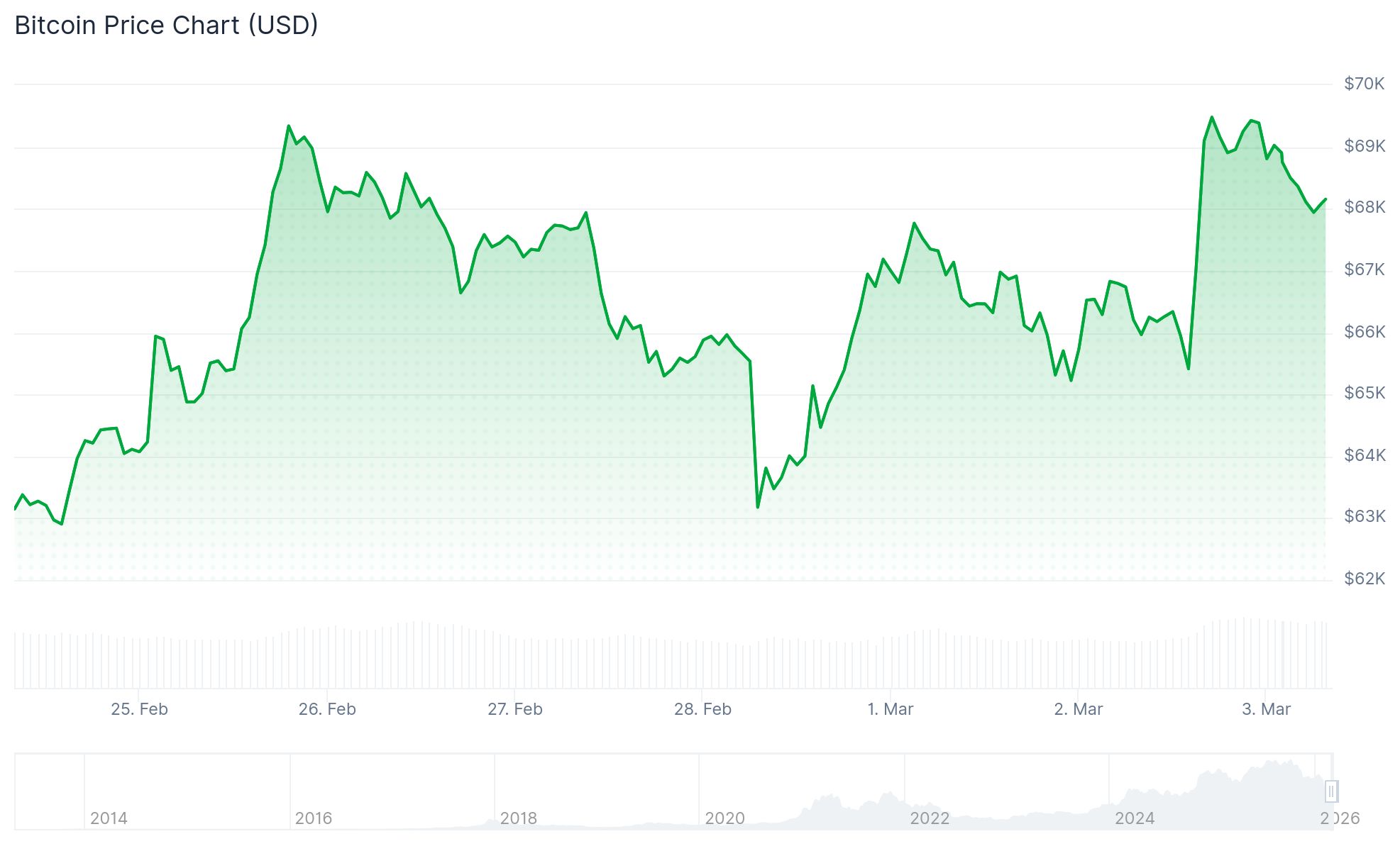
Year-to-date performance shows a 22% decline, while the cryptocurrency trades over 40% below the all-time high established in October 2025.
During a Monday interview with CNBC, VanEck CEO Jan van Eck expressed his conviction that Bitcoin is currently establishing a price floor.
Van Eck attributes the ongoing bear market to the predictable four-year halving cycle rather than any deterioration in Bitcoin’s underlying fundamentals.
“Bitcoin experiences three consecutive years of appreciation, followed by a significant correction in year four. We’re currently in that fourth year,” van Eck explained.
He emphasized that Bitcoin’s fixed supply ceiling of 21 million coins, combined with the quadrennial halving of mining rewards, creates an inherent structural mechanism that influences these price patterns.
Van Eck also noted that BTC’s recent price action might be partially connected to escalating geopolitical events following coordinated U.S. and Israeli military operations against Iran, followed by Iranian retaliatory strikes targeting Israel.
He proposed that cryptocurrency payment infrastructure could function as an alternative financial channel for capital movement beyond conventional banking systems in geopolitically unstable regions, highlighting the UAE and Dubai as relevant case studies.
Institutional Demand Remains Resilient Amid Global Conflict
Tuesday saw U.S. spot Bitcoin ETFs accumulate approximately $458 million in net inflows, based on SoSoValue tracking data — representing one of the quarter’s most substantial daily tallies.
Across three straight trading days last week, ETFs collectively absorbed $1.1 billion in new capital. BlackRock’s IBIT product captured roughly 50% of those aggregate inflows.
QCP Capital, a Singapore-headquartered trading operation, reported that weekend geopolitical developments triggered approximately $300 million in long position liquidations, characterizing the impact as “contained.”
Options pricing temporarily exhibited one-day implied volatility surging to 93% before moderating, which QCP interpreted as traders purchasing event-risk protection rather than anticipating extended crisis conditions.
Resistance Persists Above $70,000 Mark
Bitcoin has primarily oscillated within the $60,000 to $70,000 corridor throughout February. Monday witnessed a peak of $69,213, though the asset couldn’t breach the $70,000 threshold last crossed in late January.
At 01:25 ET Tuesday, the digital asset was valued at $67,884, reflecting a 2.5% intraday increase.
Market observers indicate risk sentiment remains tentative as Middle Eastern military operations persist, with American, Israeli, and Iranian leadership showing minimal willingness toward conflict de-escalation.
Current pricing data from CoinGecko shows Bitcoin trading at $68,153 at the time of publication.
