




TLDR
- ETH has experienced six consecutive monthly declines, representing its longest losing period since the 2018 bear market.
- The cryptocurrency is currently changing hands below $2,000, barely above its 2018 all-time high.
- Multiple headwinds include large holder distribution, derivative market pressures, Layer 2 network competition, and persistent ETF capital outflows.
- Co-founder Vitalik Buterin believes artificial intelligence integration could accelerate Ethereum’s technical evolution and bolster network security.
- Financial institutions including Standard Chartered and VanEck maintain bullish long-term forecasts of $7,500 and $10,000 for ETH.
Ethereum has completed its sixth straight month with negative returns, establishing its lengthiest downturn since the brutal 2018 bear market.
CoinGlass data reveals that the only comparable extended decline occurred during the 2018 cryptocurrency winter, when ETH plummeted beneath $85.
That historic collapse stemmed from the implosion of the Initial Coin Offering boom, as countless blockchain ventures had accumulated capital through ERC-20 token sales on Ethereum’s platform.
Today’s downturn, however, originates from an entirely different combination of market forces.
Market observers identify several contributing elements: large wallet holders liquidating positions, aggressive derivative market activity, broader economic instability, continuous withdrawals from spot Ethereum ETFs, and intense rivalry from Ethereum’s Layer 2 scaling solutions diminishing mainnet transaction fees.
ETH currently hovers marginally above its 2018 peak valuation, a threshold previously celebrated as a significant achievement.
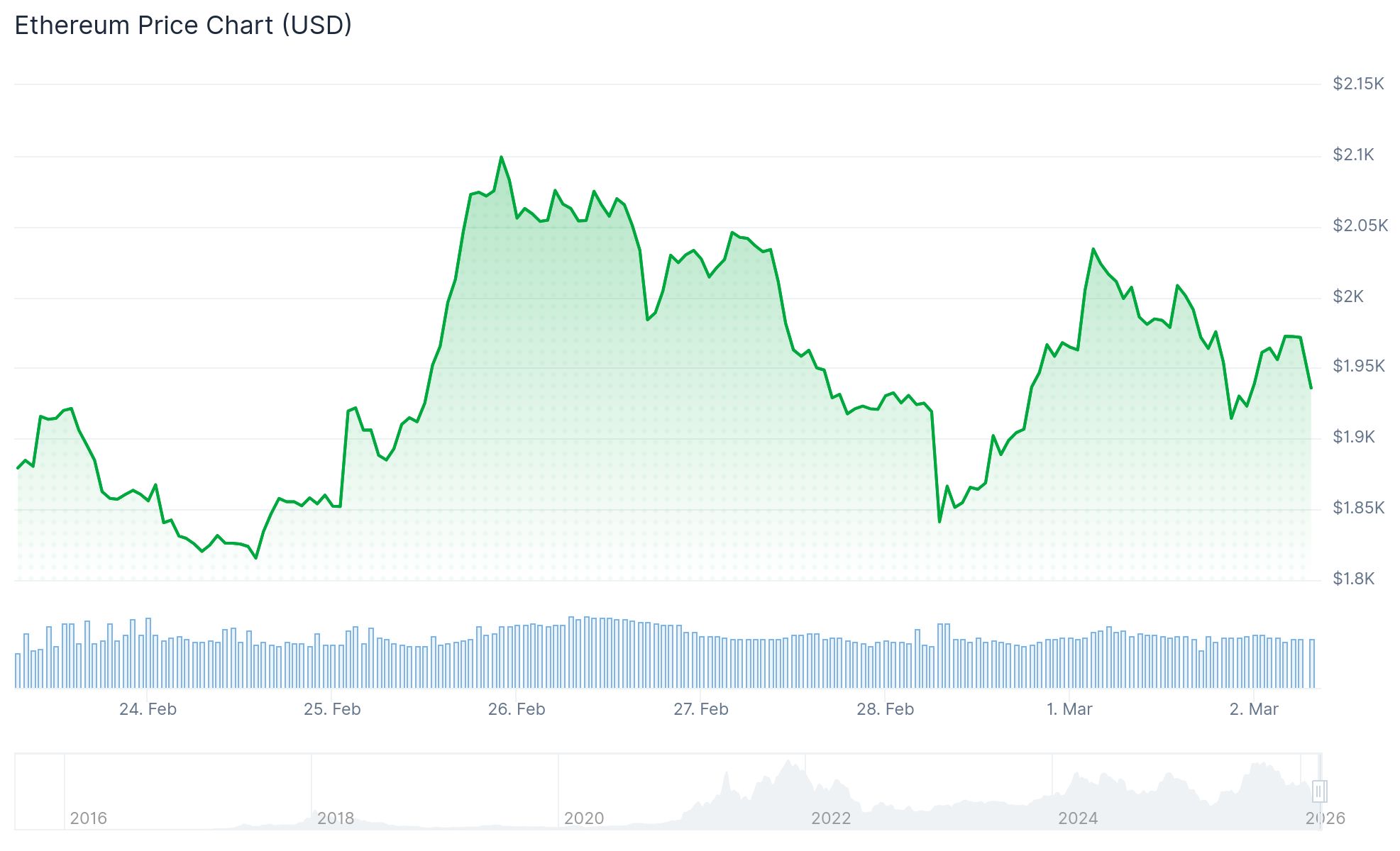
The digital asset recently fell beneath the $2,000 psychological barrier after temporarily touching $2,054. It now trades under the 100-hour Simple Moving Average indicator.
Critical Price Thresholds Under Observation
The nearest resistance barrier stands at $2,000, followed by more substantial obstacles at $2,120 and $2,155.
Should ETH successfully breach the $2,155 level, subsequent upside targets would include $2,220 and $2,250.
Conversely, downside protection exists at $1,920, followed by $1,880. A breakdown below $1,880 could accelerate selling toward $1,840 or $1,800, with $1,740 representing a more significant floor.
Buterin Discusses AI’s Potential Impact on Network Development
Ethereum creator Vitalik Buterin recently stated that artificial intelligence technology could dramatically accelerate the blockchain’s technical advancement timeline.
His remarks followed a demonstration where AI tools were used to create a prototype of Ethereum’s complete 2030 development plan in mere weeks.
Buterin personally experimented with AI-powered coding, successfully constructing a version of his blogging platform in approximately sixty minutes using his personal computer.
He recommended that half the productivity improvements gained through AI should be allocated toward enhancing security measures, including expanded testing protocols and formal code verification processes.
“People should be open to the possibility that the Ethereum roadmap will finish much faster than people expect,” Buterin wrote.
He additionally observed that error-free code, previously thought impractical, might become the industry standard within cryptocurrency development.
Standard Chartered maintains a long-range ETH valuation forecast of $7,500, founded on Ethereum’s central position in stablecoin infrastructure, decentralized finance, and asset tokenization.
VanEck projects an even higher $10,000 target, referencing forthcoming Pectra and Glamsterdam network improvements that could enable throughput of 100,000 transactions every second.
ETH continues defending the $1,900 support zone following its most recent retreat from the $2,054 high.
