




Key Takeaways
- Gold futures declined 0.7% to settle at $5,191.60 while maintaining support above $5,100 on February 26, 2026
- Diplomatic negotiations between Washington and Tehran remain a critical factor influencing near-term price movements
- Weekly performance shows gains exceeding 3.5%, fueled by geopolitical concerns and trade policy ambiguity
- Chart analysis reveals bullish momentum with upside targets identified at $5,500 followed by $6,000
- Elevated U.S. interest rates continue to limit upside potential by strengthening the appeal of yield-generating alternatives
The precious metal experienced a modest retreat during Thursday morning trading on February 26, 2026. Comex gold futures in New York declined 0.7% to reach $5,191.60 per troy ounce.
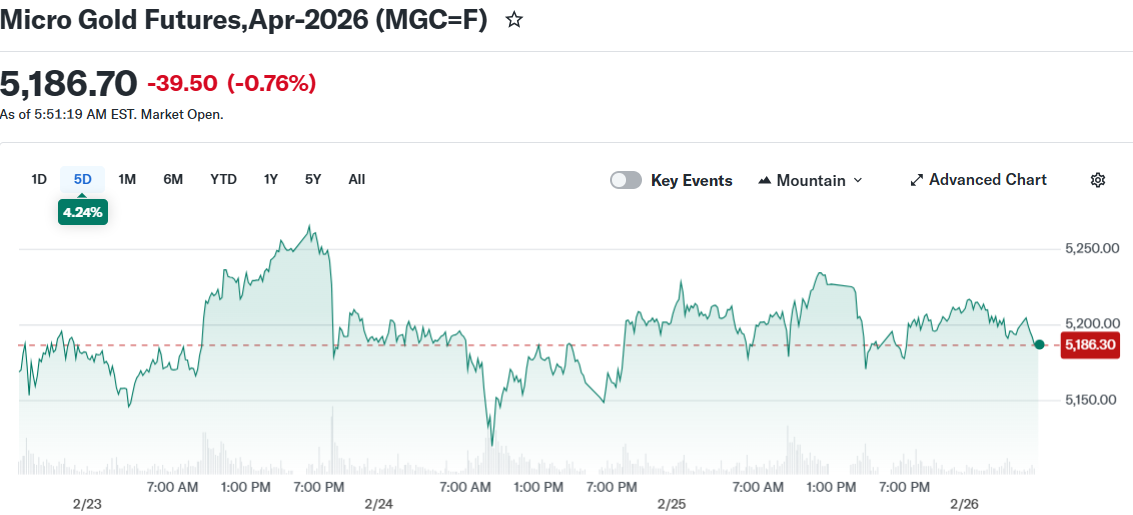
Despite this pullback, the commodity maintained a solid position above the psychologically important $5,100 level. Weekly performance remains impressive with gains surpassing 3.5%.
The intraday decline reflected investor concerns regarding the Federal Reserve’s monetary policy trajectory. Since gold generates no income, elevated interest rates diminish its relative attractiveness when compared to yield-bearing instruments.
Market participants were closely monitoring diplomatic discussions between the United States and Iran set to occur Thursday. The results of these negotiations are widely viewed as a critical catalyst for immediate price direction.
Steve Witkoff, serving as Washington’s primary negotiator with Iran, has issued warnings that Tehran possesses the capability to produce weapons-grade nuclear material in a matter of days. This declaration has sustained market nervousness.
According to intelligence experts and diplomatic sources referenced by the Wall Street Journal, Iran’s nuclear capabilities have remained relatively static following military strikes conducted by U.S. and Israeli forces against three primary nuclear facilities last June.
Tony Sage, serving as CEO of Critical Metals, noted that financial markets are paying careful attention to the diplomatic proceedings. He indicated that failed negotiations could drive capital flows toward protective assets including gold.
Analysts from ING indicated that any military escalation involving Iran would probably strengthen gold’s valuation. They emphasized that the fundamental factors supporting gold’s previous advance continue to exist.
Chart Patterns Suggest Upward Momentum
From a technical analysis perspective, the outlook appears constructive. Joseph Chai, an analyst with RHB Retail Research, identified a new bullish candlestick formation on daily charts indicating diminished downward pressure.
Chai stated that gold buyers have regained control of market direction. He anticipates a potential advance toward the resistance zone at $5,500 per ounce.
Successfully breaching the $5,500 threshold could propel valuations toward the $6,000 per ounce level, according to Chai’s analysis. Both the 20-day and 50-day simple moving averages exhibit upward trajectories, reinforcing this optimistic assessment.
Factors Limiting Upside Potential
The primary constraint on gold prices currently stems from interest rate expectations. Should the Federal Reserve maintain its current policy stance for an extended period, assets without yield like gold face intensified competition from income-producing alternatives.
However, persistent uncertainty surrounding U.S. trade policy has partially counterbalanced this headwind. Defensive portfolio positioning has prevented prices from breaking below the $5,100 support threshold.
Spot gold showed resilience in Asian trading sessions, climbing 0.6% to $5,196.37 per ounce, demonstrating recovery from the early futures weakness.
As of Thursday morning, market attention remained concentrated on the Washington-Tehran negotiations as the next significant driver for the precious metal’s trajectory.
