



Contents
Key Highlights
- Aave makes DeFi history by surpassing $1 trillion in total lending volume
- With $27.2 billion in TVL and $83.3 million in monthly fee revenue, the protocol dominates decentralized lending
- Aave Horizon platform launched in August, targeting institutional clients with real-world asset collateral options
- Community controversy surrounds a $42.5 million funding request for Aave Labs operations
- Despite protocol success, AAVE token hovers around $117, representing a 40%+ yearly decline with $1.8B market cap
The decentralized finance sector has witnessed a historic achievement as Aave becomes the inaugural DeFi protocol to surpass $1 trillion in total lending volume. This landmark accomplishment was announced earlier this week by Stani Kulechov, CEO of Aave Labs, through his official X account.
Originally introduced as ETHLend in November 2017, Kulechov’s project underwent a strategic rebrand to Aave in September 2018. Since then, it has evolved into the dominant player in decentralized lending measured by total value locked.
The platform currently maintains $27.2 billion in total value locked. This positions it significantly ahead of rival platforms such as Morpho, JustLend, SparkLend, and Compound Finance, each of which manages over $1 billion in TVL.
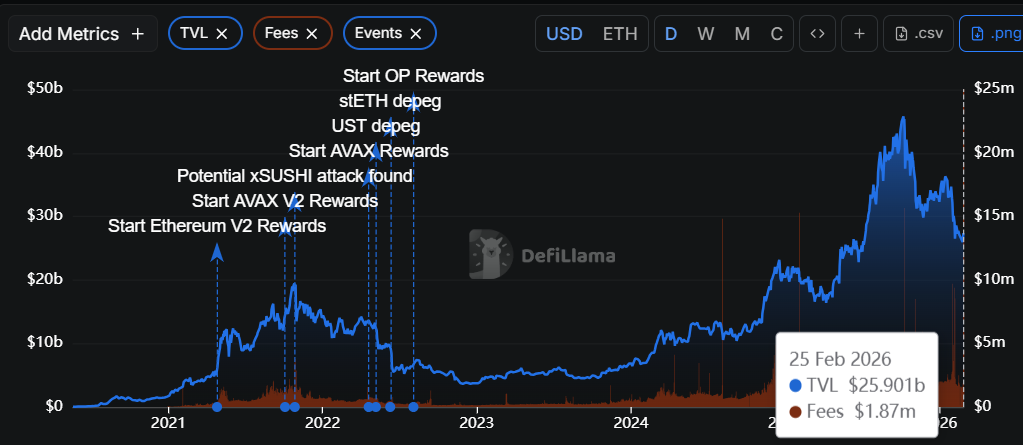
Over the last 30 days, Aave accumulated $83.3 million in protocol fees. This performance represents nearly quadruple the revenue generated by Morpho, its nearest competitor in the space.
Targeting Traditional Finance
Last August, Aave Labs introduced Aave Horizon, an Ethereum-based lending marketplace designed specifically for institutional players from traditional finance. The platform enables these entities to access stablecoin liquidity using real-world assets as backing.
Major financial firms including VanEck, WisdomTree, and Securitize joined as early adopters. This initiative demonstrates Aave’s strategic direction to bridge decentralized finance protocols with conventional financial institutions.
Kulechov has also highlighted tokenized assets as a critical expansion opportunity. He projects that what he terms “abundance assets” — including solar energy infrastructure, battery storage systems, and robotics — could collectively reach $50 trillion in value by 2050.
Governance Controversy Emerges
The trillion-dollar achievement coincides with significant internal debate within Aave’s governance community. A current DAO proposal requests AAVE token holders to authorize up to $42.5 million in stablecoins plus 75,000 AAVE tokens for Aave Labs’ operational funding.
Under the proposed arrangement, Aave Labs would commit to directing all income from Aave-branded services into the DAO treasury.
The initiative has sparked contentious discussion regarding the appropriate balance of financial authority between Aave Labs and the decentralized autonomous organization.
Token Performance Analysis
AAVE currently sits at approximately $117 per token. The digital asset has experienced a decline exceeding 40% across the past year, having previously reached levels above $300 during that timeframe.
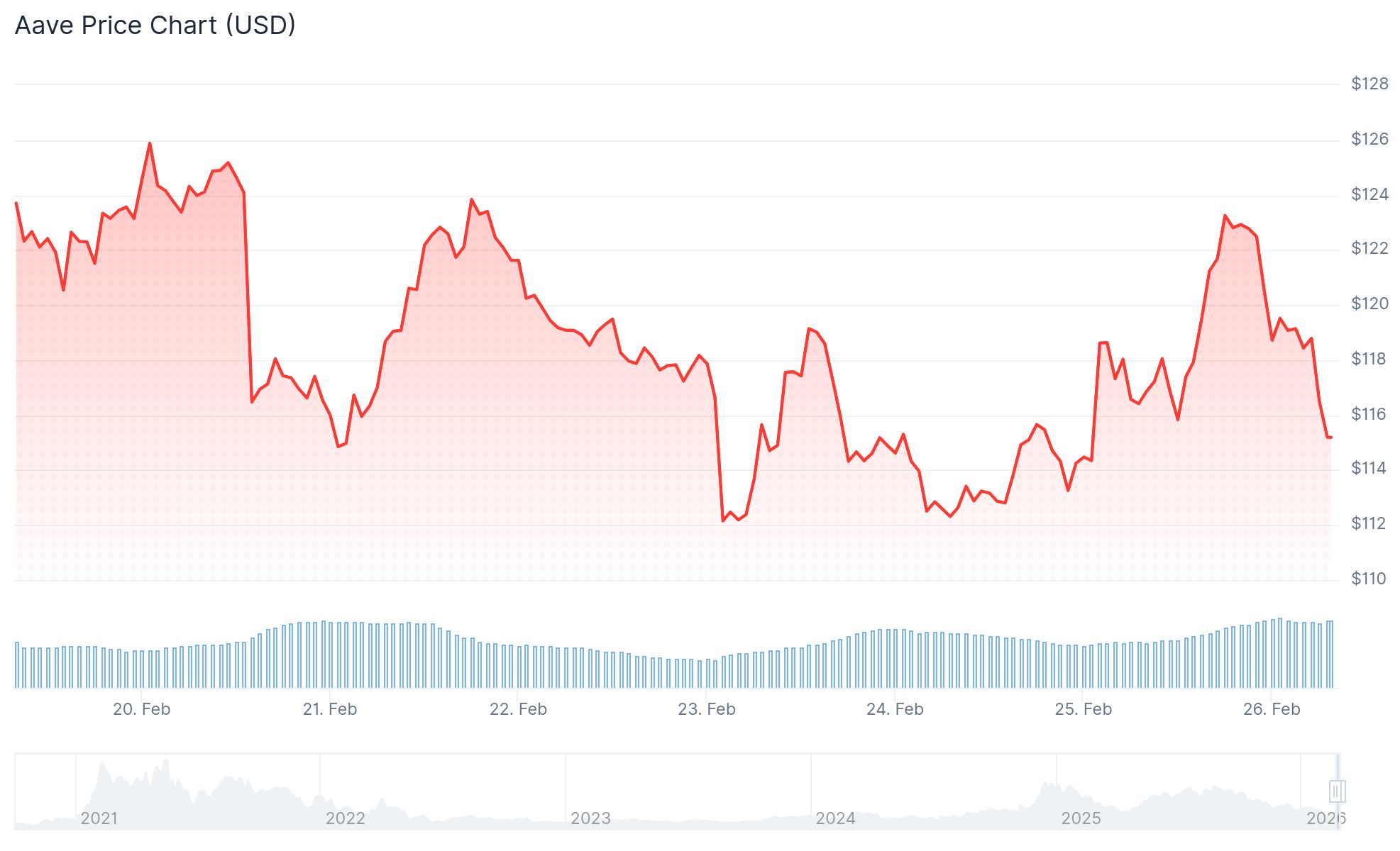
The token’s market capitalization hovers around $1.8 billion. Its Market Cap-to-TVL ratio currently registers below 0.1, a metric that certain market analysts interpret as suggesting potential undervaluation compared to previous market cycles.
Daily trading activity for AAVE surpasses $300 million. The token’s circulating supply totals roughly 15 million units.
Analyst projections for AAVE through 2030 span a wide range, from conservative estimates around $250 to bullish targets reaching $1,500, contingent on factors including TVL expansion, protocol income generation, and overall DeFi market dynamics.
AAVE maintains its current trading level near $117, supported by daily volume exceeding $300 million and a market capitalization approaching $1.8 billion.
