



Key Takeaways
- Spot gold advanced toward $2,950 per ounce following Trump’s announcement of a 15% worldwide tariff after the Supreme Court blocked his emergency tariff authority
- A declining U.S. dollar enhanced gold’s attractiveness for foreign purchasers
- Trade agreements with the European Union, India, and Japan face uncertainty following the judicial decision
- Fourth quarter U.S. GDP expanded by only 1.4%, with inflation remaining above the Federal Reserve’s 2% objective
- Silver jumped 2.3% to reach $86.56 per ounce; additional precious metals showed limited movement
Precious metal markets witnessed gold extending its rally for a fourth consecutive trading day on Monday after President Trump revealed plans for a new 15% worldwide tariff, a response to the Supreme Court’s rejection of his previous emergency tariff authority.
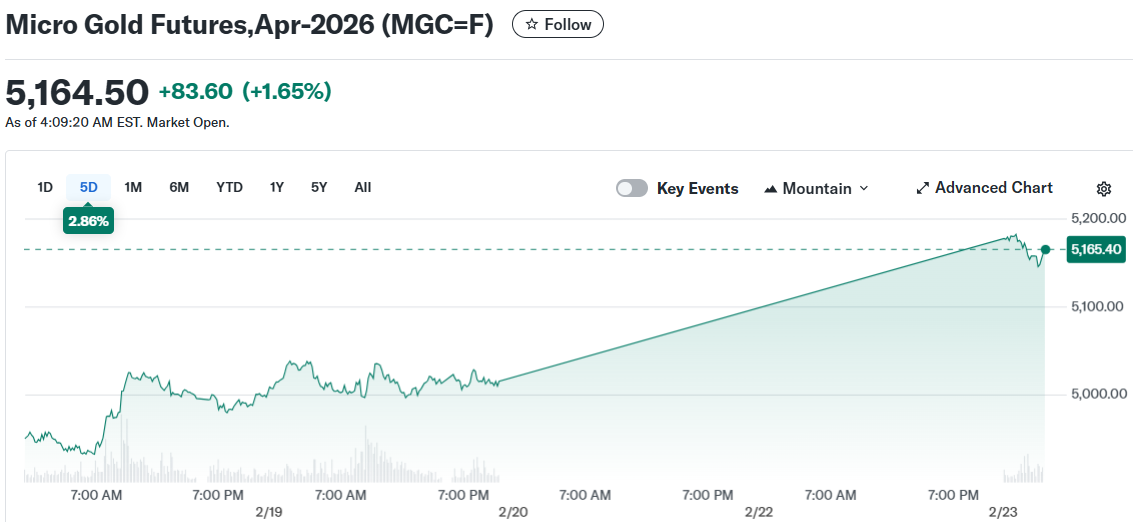
Spot gold advanced 0.8% to settle at $5,148.66 per ounce. U.S. Gold Futures surged 1.8% to $5,170.19.
The President’s initial proposal called for a 10% levy on worldwide imports utilizing Section 122 of U.S. trade legislation. He subsequently increased it to 15%, representing the maximum permissible rate under this statutory provision.
The nation’s highest court ruled against Trump’s attempt to invoke emergency powers for establishing tariff rates. This judicial decision has cast doubt on numerous existing trade arrangements.
The European Union’s top trade official indicated plans to recommend postponing ratification of an agreement with the United States pending greater certainty. Indian government representatives canceled a scheduled visit to America. A Japanese ruling party member characterized the circumstances as “a real mess.”
Safe-Haven Assets Rally Amid Tariff Policy Confusion
Market participants shifted capital toward gold and U.S. Treasury securities as appetite for risk diminished. Questions surrounding the duration of these tariffs and potential legal or legislative opposition have amplified market turbulence.
The greenback also lost ground, reducing gold’s cost for international buyers using alternative currencies. The Bloomberg Dollar Spot Index declined 0.2% on Monday, following a comparable retreat on Friday.
Escalating geopolitical friction between Washington and Tehran provided additional support for precious metals. The United States has significantly expanded its military footprint throughout the Middle East while diplomatic discussions regarding Iran’s nuclear ambitions remain ongoing.
Domestic economic indicators compounded market concerns. Fourth quarter GDP expanded at merely 1.4% on an annualized basis, representing a substantial deceleration. The Federal Reserve’s favored inflation metric, the PCE index, revealed prices climbing 2.9% year-over-year in December, persistently exceeding the 2% target.
Analyst Perspectives on Gold’s Market Positioning
Speculative positioning in gold futures among hedge funds has declined to its weakest level in almost twelve months, based on CFTC records. Market observers suggest this creates potential for renewed accumulation, potentially driving quotations higher.
Silver climbed 2.3% to $86.56 per ounce. Platinum advanced 0.3% to $2,164.60 per ounce. Copper prices remained essentially unchanged.
Gold’s four-session advance follows a pronounced correction earlier this month that had dragged prices down from an all-time peak.
Vasu Menon, a market strategist at Oversea-Chinese Banking Corp, noted sufficient structural elements underpinning gold over the medium timeframe, though he cautioned that near-term price swings appear probable given evolving U.S. trade policy developments and the Iran situation.
Current market data indicates spot gold trading at $5,134.16 as of Monday afternoon Singapore time.
