




Key Takeaways
- Crude oil declined more than 1% Monday following progress in US-Iran nuclear negotiations that reduced regional tension
- President Trump increased worldwide tariffs to 15% from 10% following Supreme Court rejection of his initial trade policy
- Washington and Tehran will conduct their third round of nuclear discussions Thursday in Geneva
- Goldman Sachs upgraded its fourth quarter 2026 Brent projection by $6 to $60 per barrel, pointing to reduced OECD stockpiles
- The investment bank anticipates a worldwide oil oversupply of 2.3 million barrels daily in 2026, with potential downward pressure if Iranian or Russian sanctions are relaxed
Crude oil experienced a decline Monday as energy markets absorbed the impact of two significant developments unfolding simultaneously: expanded American trade barriers and diplomatic advancement regarding Iran’s nuclear programme.
Brent crude settled down 73 cents at $71.03 per barrel. Meanwhile, US West Texas Intermediate decreased 75 cents to reach $65.73.
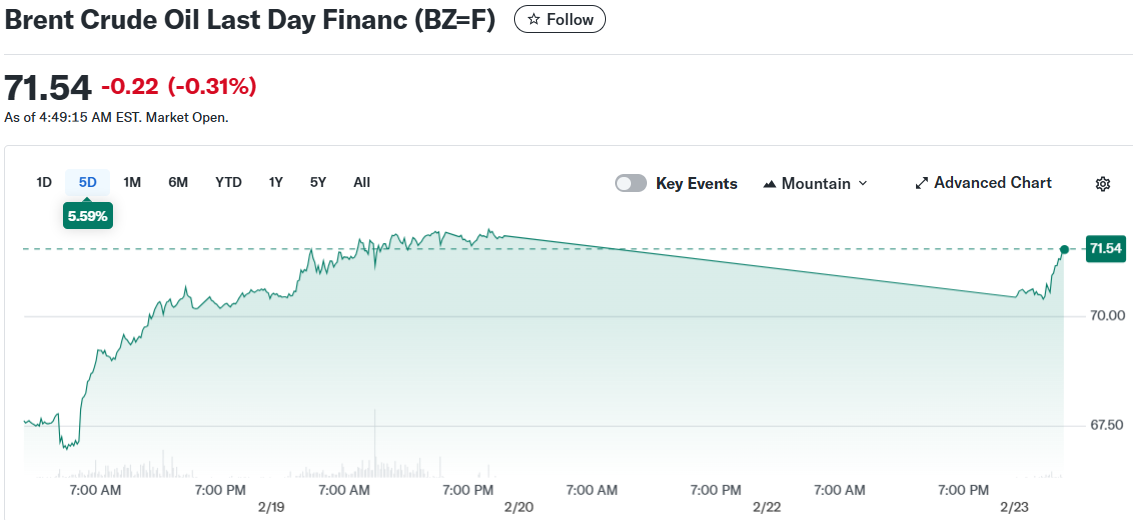
These market movements followed President Trump’s declaration that he would increase tariffs on all American imports to 15% from the previous 10% level. After the US Supreme Court invalidated his earlier tariff framework, the president implemented this adjustment using authority granted under the International Emergency Economic Powers Act.
The expanded trade barriers sparked concerns regarding diminished global economic expansion and reduced petroleum consumption. Market observers noted the announcement triggered widespread risk avoidance throughout financial markets, pressuring crude prices alongside US stock index futures and gold.
Diplomatic Progress With Tehran Weighs on Prices
Tehran and Washington have scheduled Thursday for their third nuclear negotiation session in Geneva. Oman’s Foreign Minister provided confirmation of the upcoming meeting Sunday.
The diplomatic engagement helped diminish concerns about potential military conflict throughout the Middle East region. Both Brent and WTI had climbed over 5% during the previous week driven by those escalation worries.
A high-ranking Iranian representative informed Reuters that Tehran demonstrates willingness to compromise regarding its nuclear activities. Iran seeks sanctions removal and acknowledgment of its uranium enrichment rights as concessions.
This reduction in regional tensions contributed to the price retreat. Market analysts observed that with a possible agreement under consideration, the conflict risk premium embedded in petroleum prices began diminishing.
Goldman Upgrades Petroleum Price Projections
Goldman Sachs elevated its fourth quarter 2026 crude oil price estimates Sunday. The financial institution now projects Brent at $60 and WTI at $56 for that timeframe, representing a $6 increase from previous forecasts.
The investment bank attributed the revision primarily to diminished OECD petroleum reserves. For calendar year 2026 overall, Goldman currently anticipates Brent averaging $64, increased from $56, while WTI should average $60, up from $52.
Goldman maintained its 2026 oversupply projection at 2.3 million barrels daily. This calculation presumes no significant supply interruption and no Russia-Ukraine peace settlement.
The institution reduced supply projections for Kazakhstan, Venezuela, Iran, and Iraq following underperformance against production objectives. Conversely, it enhanced supply expectations for American producers and primary OPEC members.
Goldman anticipates OPEC+ will commence gradual output increases during the second quarter of 2026, since OECD petroleum inventories have not accumulated as initially projected.
The financial institution identified potential downward pressure of $5 for Brent and $8 for WTI should sanctions relief for Iran or Russia accelerate supply expansion.
Goldman projects Brent and WTI averaging $65 and $61 throughout 2027, climbing to $70 and $66 by December 2027.
