




Key Takeaways
- Futures for the S&P 500, Nasdaq, and Dow Jones advanced Friday morning even as US-Iran tensions flared in the Strait of Hormuz region
- Iranian forces deployed missiles, unmanned drones, and small vessels against American warships; US forces retaliated with strikes on Iranian installations
- Trump downplayed the incident as minimal, reaffirming the ceasefire agreement stays active, which helped stabilize investor sentiment
- Energy markets saw measured gains, with Brent climbing 1.1% and WTI advancing 0.7%, indicating contained anxiety over supply disruptions
- Market attention centers on April’s employment figures, with projections showing 65,000 new positions and unemployment steady at 4.3%
Investors brushed aside escalating military action between Washington and Tehran on Friday morning, pushing equity futures into positive territory while preparing for crucial employment statistics.
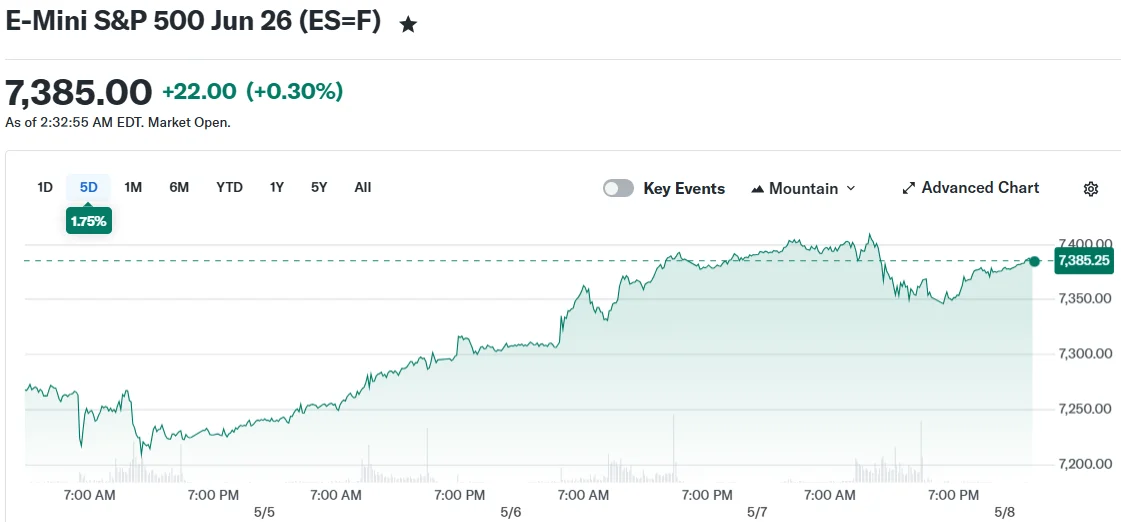
Contracts tied to the S&P 500 gained 0.5%, with Nasdaq 100 futures advancing 0.7%. Dow futures increased 0.3%, representing roughly 137 points. The three benchmark indices had retreated Thursday, with the Dow momentarily surpassing 50,000 before ending below that milestone for the second consecutive session.
Tehran deployed missiles, aerial drones, and watercraft against American naval vessels positioned in the Strait of Hormuz Thursday. US Central Command characterized the offensive as “unprovoked” while emphasizing its desire to avoid further escalation.
American forces countered by targeting Iranian military installations connected to the initial assault. The President confirmed via Truth Social that US destroyers sustained no damage and characterized the response as measured.
Trump further minimized Iran’s offensive as insignificant and confirmed the bilateral ceasefire agreement continues unchanged. This reassurance appeared to ease market concerns about broader conflict.
Wall Street Shows Resilience Amid Geopolitical Flare-Up
Deutsche Bank’s macro strategist Henry Allen acknowledged the obvious intensification while observing that financial markets weren’t factoring in catastrophic outcomes.
Oil prices experienced upward movement but remained relatively constrained. Brent crude increased 1.1% reaching $101.15 per barrel. West Texas Intermediate added 0.7% settling at $95.50 per barrel.
The measured response in petroleum markets indicates traders aren’t anticipating significant interruptions to global energy flows.
The greenback strengthened 0.1% versus a basket of major currencies. The benchmark 10-year Treasury note yield declined one basis point to 4.38%.
Employment Report Takes Center Stage
Friday’s release of April’s nonfarm payrolls data has become the primary focus for financial markets. Economists polled by Bloomberg anticipate 65,000 positions were created during the month.
The jobless rate is projected to remain unchanged at 4.3%. Such figures would indicate labor market stability persisting despite continued international tensions.
Corporate earnings announcements are scheduled Friday from Toyota Motor, Sony, and Brookfield Asset Management.
Bitcoin retreated below the $80,000 threshold following reports of the US-Iran military engagement, based on earlier session data.
Government bond yields dipped during early morning trading amid optimism for de-escalation in the Middle Eastern theater.
The Dow, S&P 500, and Nasdaq remain positioned for weekly gains if premarket momentum carries through the trading day.
