
Key Takeaways
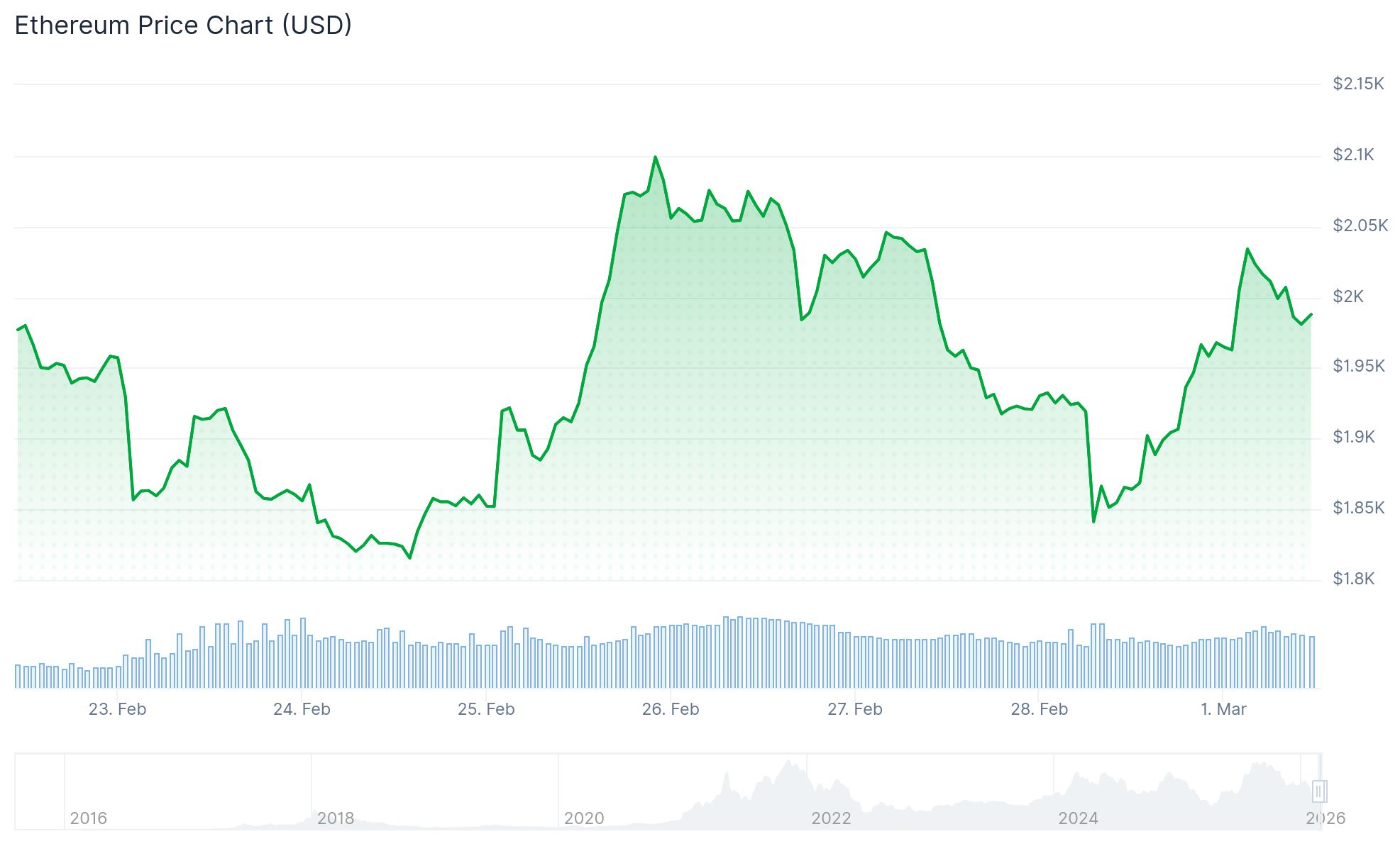
- Ethereum has declined 36% year-to-date in 2026 and sits 60% below its 2025 peak, currently hovering around $2,000
- The network maintains control of 57% of total value locked (TVL), expanding to 65% when layer-2 solutions are factored in
- Leading financial institutions including BlackRock, JP Morgan, and Deutsche Bank are actively developing on Ethereum’s infrastructure
- Vitalik Buterin advocates for base layer scalability enhancements, including ZK-EVM integration
- Following US military action in Iran, ETH surged over 6.5% after briefly touching $1,841
Ethereum has experienced a 36% contraction throughout 2026, currently exchanging hands just below $2,000 after weekend lows reached $1,841. The once-achievable $3,000 threshold now appears considerably distant.
ETH’s performance has lagged behind the wider cryptocurrency market by 9 percentage points during the first two months of 2026. Macroeconomic conditions alone cannot fully account for this underperformance.
Decentralized exchange trading volumes on Ethereum contracted to $56.5 billion throughout February 2026, representing a significant decline from the $128.5 billion peak recorded in August 2025. Meanwhile, Solana captured $95.5 billion in monthly volume during that same period, challenging Ethereum’s narrative around network adoption.
Despite price weakness, Ethereum commands 57% of total value locked throughout the blockchain ecosystem — approximately $52.4 billion. When incorporating layer-2 solutions such as Base, Arbitrum, and Optimism, this market share expands to 65%.
Solana’s TVL registers at $6.4 billion. BNB Chain secures $5.5 billion. No rival blockchain approaches Ethereum’s locked capital.
Major Financial Players Remain Committed to Ethereum
JP Morgan Asset Management, Citi, Deutsche Bank, and BlackRock have all unveiled blockchain initiatives on Ethereum in recent months. Whether tokenizing traditional assets or issuing bank-backed stablecoins, Ethereum remains the preferred infrastructure for institutional decentralized finance.
Ethereum commands a 68% market share within Real World Assets (RWA) tokenization. While BlackRock liquidated $41.8 million worth of Ethereum holdings this week, ETH-focused exchange-traded funds attracted $80.5 million in net inflows during the identical timeframe.
Buterin Champions Base Layer Improvements
Vitalik Buterin has articulated his vision to decrease Ethereum’s dependence on rollup solutions by enhancing the foundational protocol itself. Upcoming modifications encompass parallel block verification mechanisms and the implementation of a zero-knowledge Ethereum Virtual Machine (ZK-EVM).
Quantum-resistant cryptographic signatures also feature prominently in the development timeline. Buterin recognizes these signatures require greater computational resources and validation complexity, though he maintains that protocol-level aggregation optimizations will mitigate associated costs.
These protocol modifications will deploy incrementally, initially affecting a subset of network participants before transitioning to universal requirements.
Regarding price action, ETH rallied more than 6.5% within a 24-hour window following US military operations against Iranian targets, which temporarily destabilized global markets. Bitcoin retreated to $63,000 before stabilizing near $67,000. ETH touched $1,841 before recovering toward the $2,000 level.
Analysts caution that additional volatility may emerge when US equity markets and Bitcoin ETF trading resumes Monday, particularly given the evolving geopolitical tensions across the Middle East.
ETH ETF products accumulated $80.5 million in fresh capital this week.