



Key Takeaways
- Gold recorded an 8% weekly decline, marking its steepest drop since early 2020
- Late February military action by U.S. and Israel against Iran sparked inflation concerns, pressuring precious metals
- Central banks worldwide, including the Federal Reserve and ECB, maintained current rates with hawkish guidance
- Silver experienced a sharper selloff, declining nearly 10% due to heightened dollar sensitivity
- Gold breached critical support between $4,800 and $5,200 maintained since conflict escalation
Precious metals staged a modest rebound Friday, though gold remains positioned for its third successive weekly decline. Spot pricing advanced approximately 1.4% to reach $4,715 per ounce, while futures contracts gained roughly 2.4%.
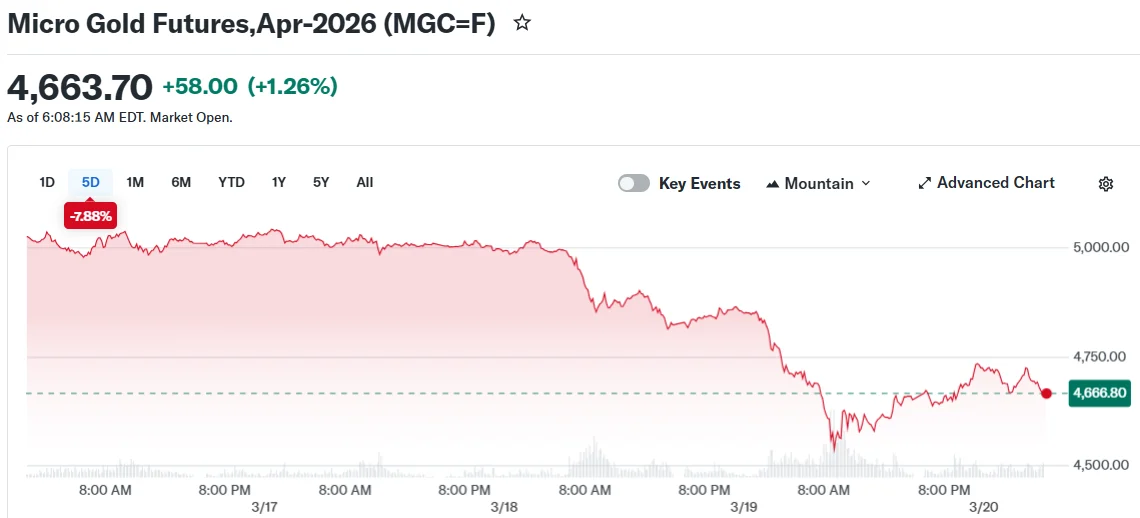
Friday’s uptick provided limited relief from an 8% weekly plunge—gold’s most severe weekly deterioration since the opening months of 2020.
The yellow metal had maintained stability within a $5,000 to $5,200 corridor following the commencement of U.S.-Israeli military operations against Iran in late February. This week’s selloff demolished that support zone.
Geopolitical tensions have amplified concerns regarding energy costs and inflationary pressures. Crude oil surged toward four-year peaks this week following attacks on critical Middle Eastern energy facilities.
Global monetary authorities reacted decisively to these inflationary signals. Australia’s Reserve Bank implemented a rate increase. Meanwhile, the Federal Reserve, European Central Bank, Swiss National Bank, and Bank of Japan maintained their current policy rates.
These institutions delivered uniformly hawkish messaging, indicating monetary easing remains distant. This guidance proved particularly damaging for gold, which typically benefits from accommodative monetary policy.
The Federal Reserve’s Wednesday decision maintained the status quo while projecting potential additional inflation. Although gold traditionally serves as an inflation hedge, elevated interest rates enhance the relative appeal of yield-generating investments.
U.S. dollar strength applied additional downward pressure on gold. Currency appreciation increases gold’s cost for international buyers, potentially dampening demand.
The greenback retreated Friday, providing marginal relief for precious metals. Multiple central banks signaled tightening intentions, strengthening their respective currencies relative to the dollar.
Silver Faces Steeper Losses
Silver experienced a more pronounced selloff, declining nearly 10% across the week—exceeding gold’s depreciation. Spot pricing climbed 0.5% Friday to $73.14 per ounce, though this represented only partial recovery from weekly losses.
OCBC analysts highlighted silver’s greater vulnerability to dollar fluctuations and risk appetite shifts compared to gold. The institution indicated potential downward revisions to silver forecasts may be “modestly lower.”
Silver confronts additional headwinds from potential global economic deceleration, which could diminish industrial consumption. The metal serves critical functions in photovoltaic panels and electronic applications.
Platinum recorded a 2.9% weekly decline but recovered 2.1% Friday, reaching approximately $2,016 per ounce.
Expert Analysis
Nicholas Frappell, who leads institutional markets globally at ABC Refinery, informed Reuters that gold successfully defended crucial technical support thresholds on weekly charts.
He projected potential recovery toward the $4,800 threshold where breakdown occurred. Frappell additionally observed that market positioning favored short sellers rather than buyers following gold’s underwhelming performance throughout the conflict period.
Spot gold has surrendered over 10% since the February 28 U.S.-Israel military strike against Iran.
