



Key Takeaways
- A two-week U.S.-Iran ceasefire agreement sparked a widespread rally across global markets
- The Dollar Index plunged to its weakest level since March 11, declining approximately 1%
- Major currencies including the euro, yen, pound, and commodity-linked dollars strengthened versus the greenback
- Bitcoin advanced 3.2% to $71,514 while Ethereum surged 5.7% to $2,235
- Oil prices retreated on expectations of the Strait of Hormuz reopening, reducing inflation concerns
The greenback experienced a sharp selloff on Wednesday following President Donald Trump’s announcement of a temporary ceasefire agreement with Iran. The development triggered gains across global currencies and digital assets as market participants rotated away from defensive positions.
Trump had earlier issued threats targeting Iran’s civilian infrastructure on a massive scale. His warning that “a whole civilization will die tonight” unless his conditions were satisfied drew widespread international criticism.
The truce was revealed with less than two hours remaining before Trump’s ultimatum deadline for Iran to allow passage through the Strait of Hormuz. Markets immediately responded with a pronounced shift toward risk assets.
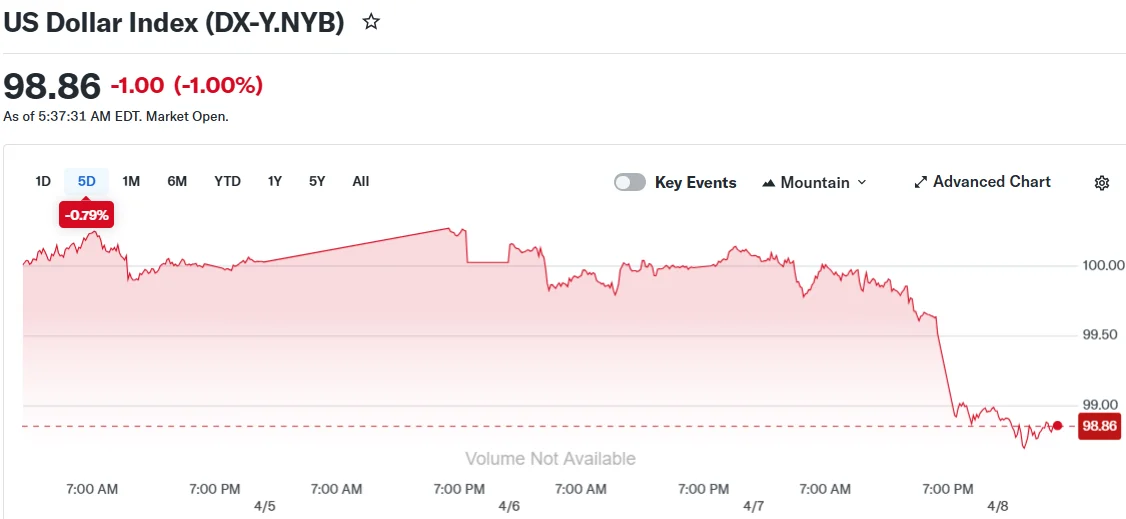
The Dollar Index, which measures the U.S. currency’s performance against a basket of six major rivals, declined roughly 1% to 98.943. This marks its most depressed reading since March 11 and positions it for its steepest single-session loss since April 21, 2025.
Investors typically flock to the dollar during periods of geopolitical instability. As those concerns subsided, the currency’s appeal as a protective asset diminished accordingly.
The euro appreciated 0.7% to $1.1677. Sterling advanced 0.8% to settle at $1.3403. Japan’s yen firmed 0.7% versus the dollar, changing hands at 158.50.
Australia’s dollar rallied 1.2% to $0.7063. New Zealand’s currency jumped 1.1% to $0.5795. These commodity-linked currencies are particularly responsive to shifts in market sentiment, typically appreciating when optimism returns.
Digital Assets Participate in Broad-Based Rally
Bitcoin rose 3.2% to reach $71,514.03. Ethereum posted a 5.7% gain, climbing to $2,235.35. These movements aligned with the broader migration into risk-oriented investments.
Cryptocurrency markets have demonstrated growing correlation with traditional risk appetite indicators, and Wednesday’s trading session exemplified this relationship.
Energy Markets and Inflation Implications
Anticipation surrounding the potential reopening of the Strait of Hormuz also pressured oil prices lower. This strategic waterway serves as a vital conduit for international petroleum shipments.
Declining crude prices alleviate concerns regarding inflationary pressures. When inflation anxiety recedes, the rationale for monetary authorities to tighten policy weakens. Reduced interest rate expectations typically undermine the dollar, as foreign investors find alternative sovereign bonds more appealing for yield-seeking purposes.
Ray Attrill, who leads foreign exchange strategy at National Australia Bank in Sydney, suggested the ceasefire could sustain the risk-positive momentum if shipping lanes reopen. However, he cautioned that currency markets remain susceptible to sudden reversals throughout the 14-day truce period.
“Markets still need to proceed with a degree of scepticism,” Attrill said.
The Dollar Index has now registered declines across three consecutive trading sessions. While the ceasefire has provided near-term market relief, strategists emphasize that developments during the coming fortnight will prove decisive.
