




Key Takeaways
- SOL has breached critical support zones, currently hovering around $77 following a decline to $75.80
- Futures open interest decreased approximately 2% to $5.09 billion as funding rates shifted into negative territory
- A mere 20% of Solana wallet addresses show profitability — marking the weakest level since the end of 2023
- Approximately 67% of SOL’s complete supply remains locked in staking protocols, constraining available tokens
- Corporate treasuries possess more than $1.3 billion in SOL holdings, further limiting circulating supply
Solana (SOL) currently changes hands near $77 following a dip to $75.80, marking an extended six-week downtrend that has driven the cryptocurrency substantially below its early 2026 peaks around $95.
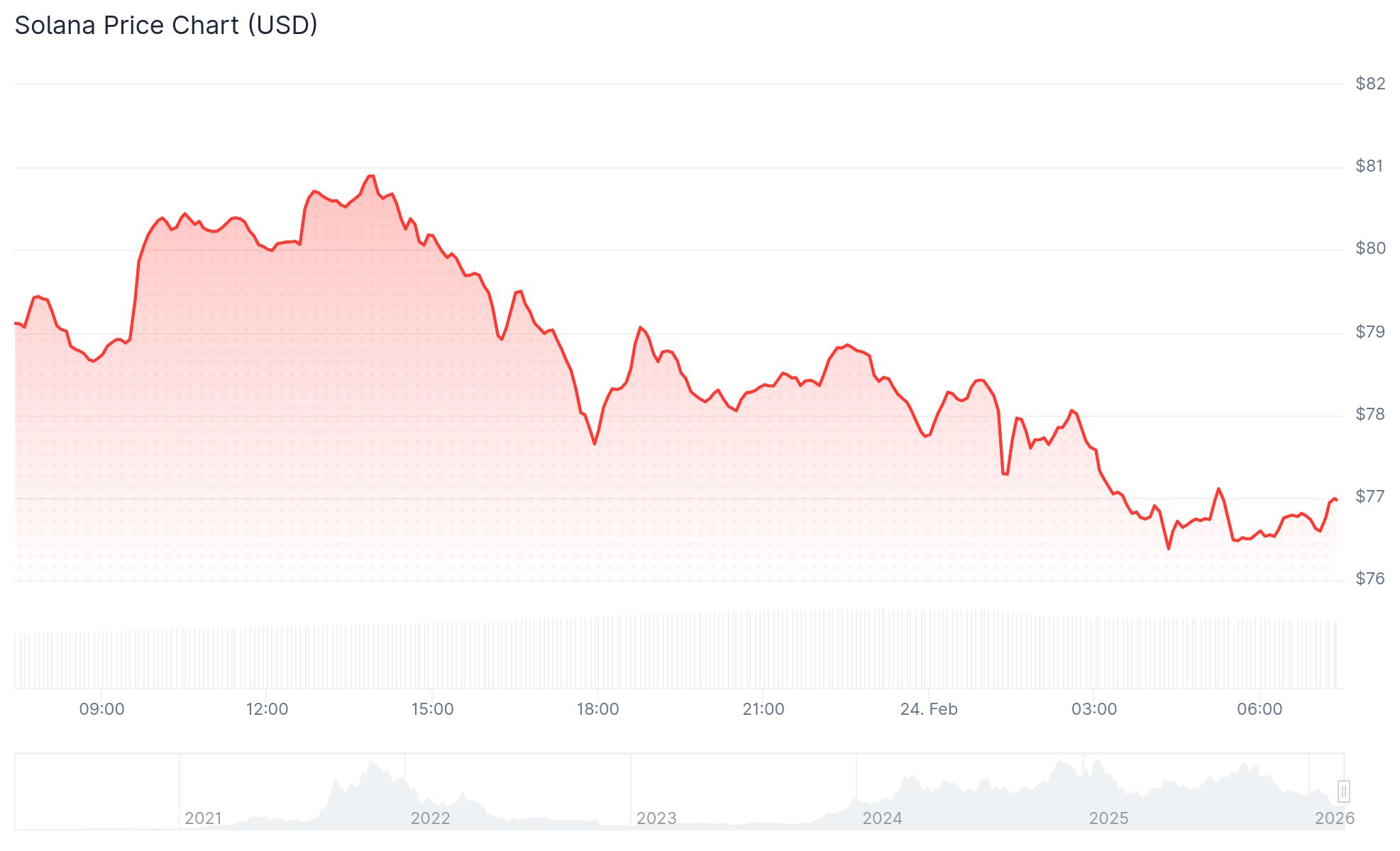
The downturn has maintained a consistent trajectory. SOL has violated important technical thresholds, while market metrics indicate increasing wariness among market participants.
Futures open interest for Solana contracted by approximately 2% to roughly $5.09 billion, despite trading volumes experiencing substantial increases. This particular pattern generally indicates liquidation events rather than fresh capital entering the market.
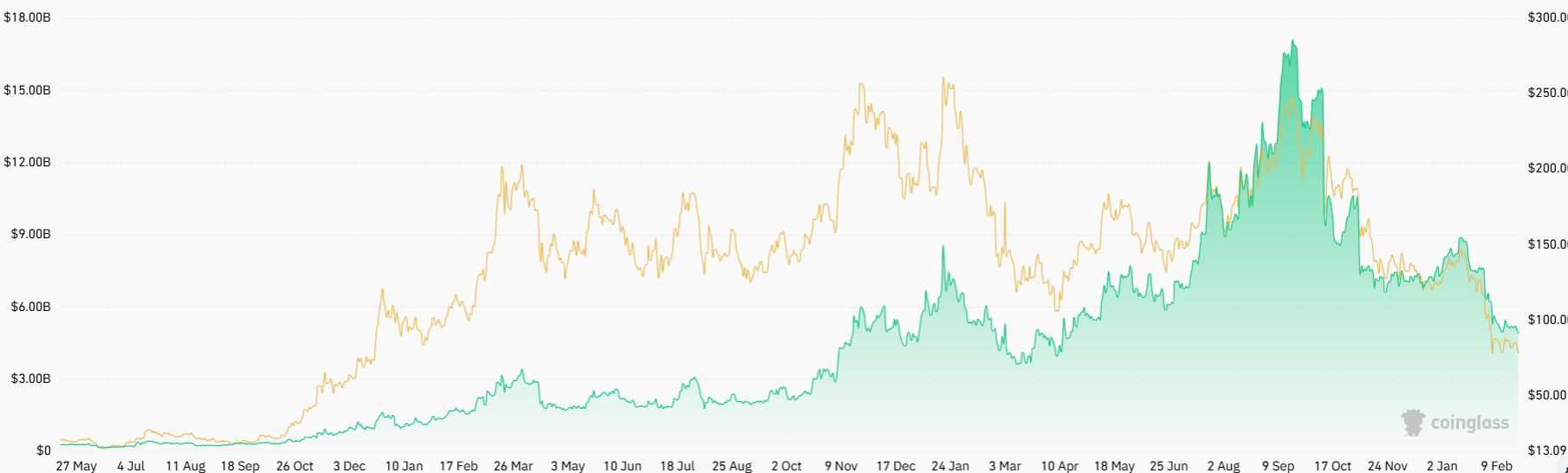
Funding rates have crossed into negative terrain. The ratio of long positions to short positions has fallen beneath 1. These indicators collectively suggest that more market participants are wagering on continued price deterioration rather than an imminent rebound.
Whale accounts have been establishing short positions, whereas retail investors across Binance and OKX maintain leveraged long exposure. This positioning disparity amplifies the potential for increased turbulence should present support zones fail.
Blockchain Metrics Reveal Concerning Trends
Blockchain analytics from Glassnode indicate that merely 20% of Solana addresses currently hold unrealized gains. This represents the weakest measurement recorded since the closing months of 2023.
Previous instances of comparable metrics have coincided with capitulation events during earlier bear markets, although market observers emphasize this doesn’t necessarily confirm a price floor has been established.
Accumulation activity from long-term holders, which demonstrated strength earlier this year, has decelerated since SOL declined beneath the $100 threshold. This development suggests diminishing confidence among participants who previously absorbed selling pressure during prior retracements.
Momentum metrics continue trending downward. RSI measurements approach oversold conditions, reflecting persistent distribution rather than any preliminary reversal signals.
Constrained Supply May Play a Role Eventually
Despite the prevailing price weakness, Solana’s token supply dynamics have contracted. Data from February 23 reveals that 67% of SOL’s aggregate supply remains staked, representing a substantial cohort of committed holders resisting liquidation.
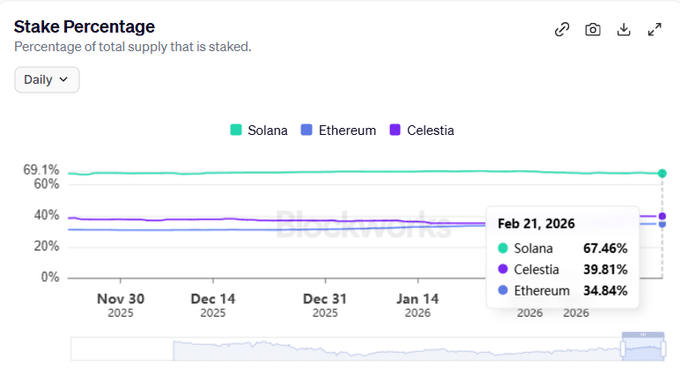
Corporate treasury operations have also amassed over $1.3 billion in SOL holdings, extracting additional tokens from readily available circulation.
When such significant supply quantities remain locked, tradable tokens become increasingly scarce. Historical precedents demonstrate that restricted supply combined with renewed purchasing activity has triggered rapid price appreciation.
This mechanism hasn’t materialized currently. Market analysts emphasize that broader ecosystem stability and clearer macroeconomic conditions are prerequisites before supply constraints can catalyze substantial price momentum.
Presently, market observers are monitoring support zones between $75 and $67. A violation of this range could expose levels at $62 or potentially $60.
Regarding upside potential, SOL confronts resistance between $82 and $83, where a bearish trend line has developed. Currently, SOL trades at approximately $77, marginally above its recent floor of $75.80.
