



Key Takeaways
- SOL surged 22% from its March bottom, reaching a four-week peak at $97 before retracing to the $90 support zone.
- Federal regulators jointly designated SOL as a digital commodity on March 17, ending prolonged regulatory ambiguity.
- Single-day ETF inflows reached $17.81 million on March 17, pushing total cumulative inflows close to $989 million.
- The SuperTrend momentum indicator shifted to bullish territory, with technical analysts targeting $100 and $115 next.
- Minor outflows of $295K on March 18 broke an 11-consecutive-day inflow streak, while open interest declined 6.77%.
Solana has emerged as one of March 2026’s most dynamic digital assets. Following weeks of consolidation within the $77-$92 range, SOL burst through resistance to reach $97 on March 13—its highest level in a month—before retreating. The token currently hovers around the $89-$90 level, resting on a crucial support zone that has held firm since mid-February.
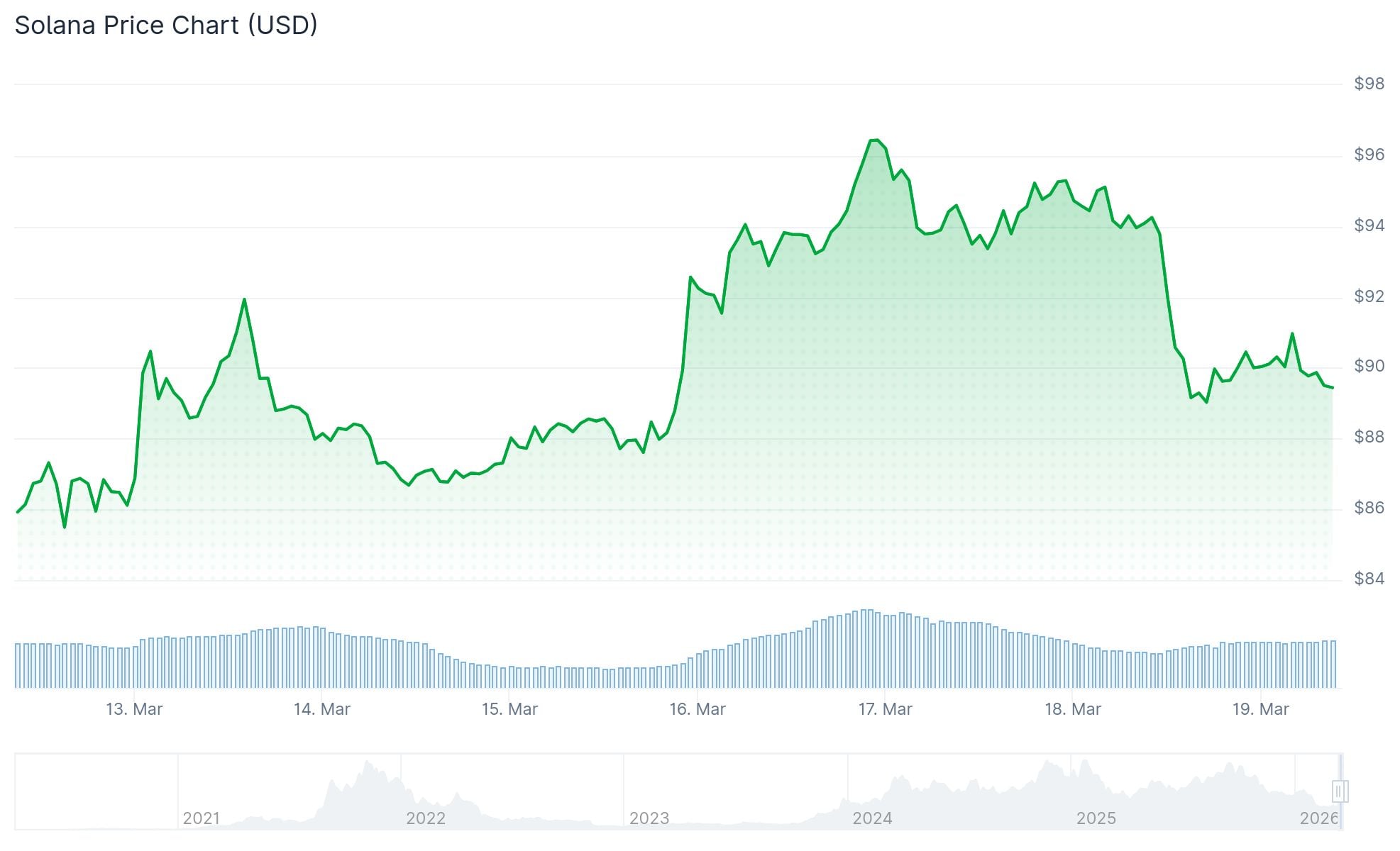
The SuperTrend momentum tracker recently switched from bearish to bullish on the daily timeframe for the first time since January. Technical analyst Ali Martinez highlighted a significant demand zone spanning $85.55 to $82.60, where approximately 76 million SOL tokens were accumulated across 38 trading days. Martinez emphasized that “the ceiling is thinner than the current floor,” suggesting Solana faces minimal resistance en route to “$100, followed by $115.”
On the daily chart, SOL is currently positioned between its 20-day exponential moving average at $88.78 and the Bollinger Band centerline at $95.11. A daily close beneath the $88.78 level would represent the first technical indication that March’s upward momentum may be fading.
Federal Agencies Grant SOL Regulatory Certainty
The most significant development for Solana this week transcended price movements. On March 17, the U.S. Securities and Exchange Commission and Commodity Futures Trading Commission released coordinated guidance identifying 16 cryptocurrencies as digital commodities. Solana joined Bitcoin and Ethereum on this definitive list.
The comprehensive 68-page framework establishes five distinct classifications for crypto assets under federal securities regulations. Digital commodities are now formally defined as assets whose value stems from operational blockchain functionality and market supply-demand mechanics, rather than from managerial efforts of a centralized team.
SEC Chairman Paul Atkins characterized the announcement as “a turning point.” Previously, SOL appeared in SEC enforcement proceedings against platforms including Binance, leaving the asset mired in regulatory limbo for extended periods.
This determination also provides clarity for staking mechanisms, wrapped token variants, and exchange-traded fund applications covering digital commodity assets. Financial institutions can now provide staking infrastructure and custodial services for SOL without navigating securities registration requirements.
Investment Product Flows Pause Following Extended Rally
SOL spot exchange-traded funds maintained an impressive five-week positive flow streak entering this week. March 17 witnessed inflows totaling $17.81 million—the strongest single-day performance since early March.
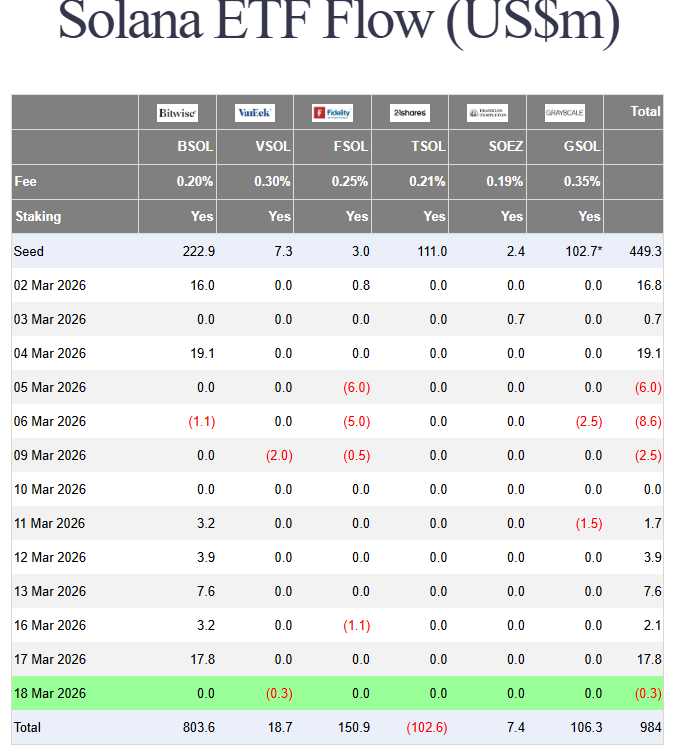
That momentum broke on March 18. VanEck’s VSOL product registered $295,730 in outflows, the sole fund reporting activity that session. Despite this pause, aggregate net inflows across all Solana ETFs remain at $989 million, approaching the symbolic $1 billion threshold.
Open interest contracted 6.77% to $5.28 billion on March 18, even as options trading volume exploded 95.70% to reach $16 million. This dramatic increase in options activity indicates traders are implementing protective strategies rather than establishing fresh directional bets.
Leveraged long positions absorbed $13.92 million in liquidations during the past 24 hours, substantially exceeding the $2.27 million in short liquidations. SOL is presently changing hands at $89.93, with the critical $88 support level remaining defended.
